
🔤 Total Characters in Document: 248,455
📄 Estimated Document Pages: 105
⏱️ Reading Time: 4 Hours 21 Mins
CHAPTER ONE: INTRODUCTION
1.1 Background of Study
Road networks are the backbone of agricultural marketing and distribution systems in developing countries, providing the physical infrastructure that connects rural producers to urban consumers, processing centres, and export markets (World Bank, 2021). An efficient road network reduces transportation costs, travel time, post-harvest losses, and price volatility, while increasing market access, competition, and farm-gate prices (FAO, 2020). In Nigeria, agriculture remains a cornerstone of the economy, contributing approximately 25% to Gross Domestic Product (GDP) and employing about 35% of the labour force, with smallholder farmers producing the majority of staple crops (cassava, yam, maize, rice, sorghum, millet, vegetables) (Federal Ministry of Agriculture and Rural Development, 2021). However, the agricultural sector’s potential is severely constrained by inadequate rural road infrastructure, which impedes the efficient movement of agricultural products from farms to markets (CBN, 2022).
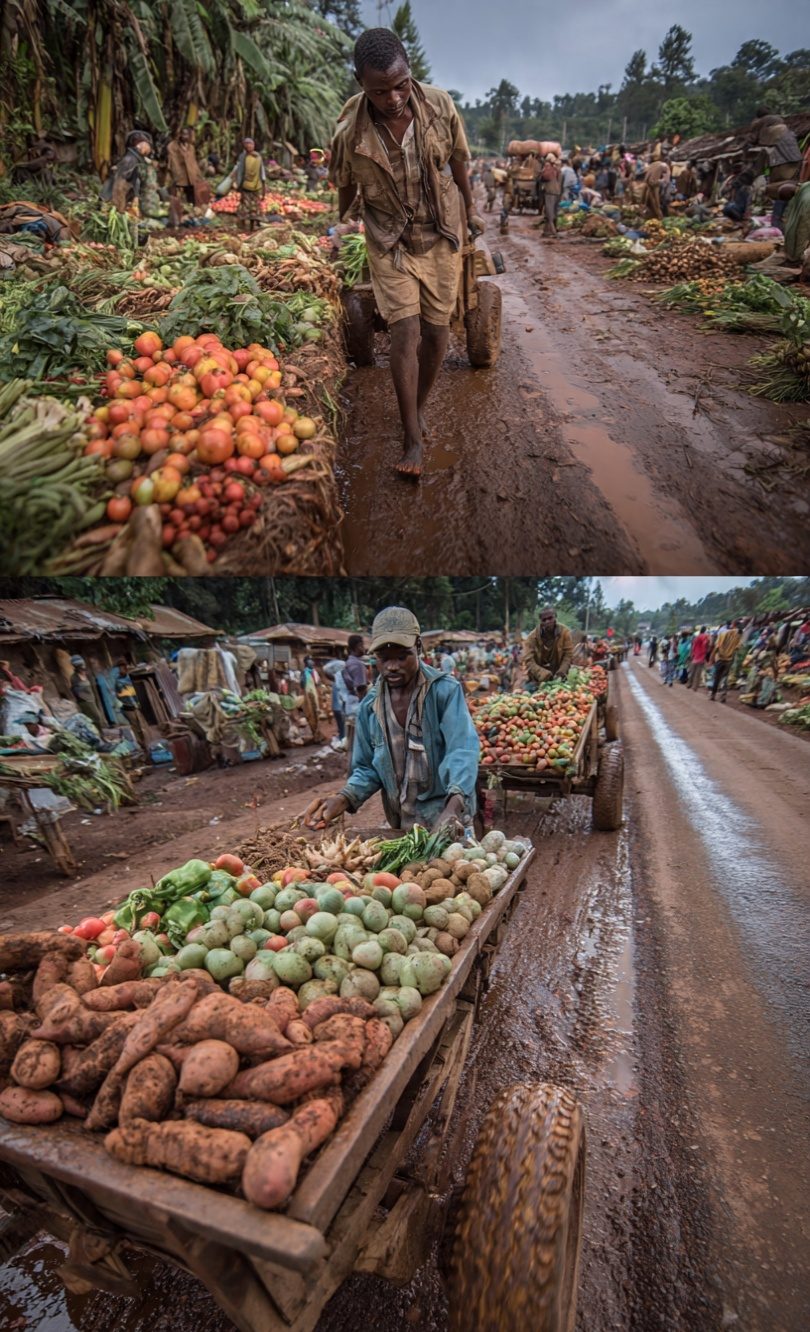
The road network in Nigeria comprises federal roads (maintained by the Federal Government), state roads (maintained by State Governments), and local roads (maintained by Local Governments) (Federal Ministry of Works and Housing, 2020). Of the total road network (approximately 200,000 km), only about 15-20% is paved (asphalt or concrete), and a significant proportion of rural roads (which serve agricultural areas) are unpaved (laterite, gravel, or earth) and are often impassable during the rainy season (World Bank, 2021). The condition of rural roads in many agricultural areas is poor: characterized by potholes, erosion gullies, collapsed bridges, narrow widths, and lack of drainage (NBS, 2022). These poor road conditions impose significant costs on agricultural marketing (Okafor and Nwosu, 2020).
The impact of road networks on the selling of agricultural products operates through multiple channels (Adebayo and Ogunyemi, 2020). First, transportation cost channel: Poor roads increase vehicle operating costs (fuel consumption, tire wear, vehicle maintenance, repairs) and reduce vehicle speed, increasing the cost per kilometer of transporting agricultural products. These higher transport costs are passed back to farmers in the form of lower farm-gate prices (buyers pay less because transport to market is expensive) (Eze and Nweze, 2019). Second, travel time channel: Poor roads increase travel time to markets (e.g., a 20 km trip may take 1-2 hours on a bad road vs. 20-30 minutes on a good road). Longer travel time reduces the number of trips farmers or traders can make per day or per week, and delays the arrival of perishable products at market (Okafor and Ugwu, 2021).
Third, post-harvest loss channel: Poor roads cause delays in transporting perishable agricultural products (tomatoes, vegetables, fruits, fresh fish, eggs, milk) to market. Prolonged transit time in hot, bumpy conditions increases spoilage, bruising, and quality deterioration, leading to post-harvest losses estimated at 20-50% for perishable products in Nigeria (FAO, 2020). Even for non-perishable crops (grains, roots, tubers), delays can result in spoilage due to inadequate storage during transport (Nwosu and Okafor, 2021). Fourth, market access channel: Poor roads limit farmers’ access to markets. Farmers in areas with very poor roads may be unable to reach any market during the rainy season, forcing them to sell at very low prices to itinerant traders who come to the farm (exploiting lack of competition) (Okonkwo, 2020). Farmers in well-connected areas have access to multiple markets, enabling price comparison and competition among buyers (Adebayo and Ogunyemi, 2020).
Fifth, vehicle availability channel: Poor roads deter commercial transporters from operating in rural areas due to high vehicle operating costs and frequent breakdowns. Farmers may have to hire vehicles at premium rates, wait days for transport, or carry products on motorcycles, bicycles, or head portage (Okafor and Nwosu, 2020). Sixth, price volatility channel: When roads are impassable during the rainy season, agricultural products cannot reach urban markets, causing supply shortages and price spikes in cities, while farmers in rural areas face gluts (excess supply) and price collapses (Nwosu and Okafor, 2021). When roads are passable during the dry season, supply increases, and prices fall. This seasonal price volatility creates uncertainty for both farmers and consumers (Eze and Nweze, 2019).
Seventh, market integration channel: Good roads integrate rural agricultural areas with urban consumption centres, reducing price differentials between regions (price convergence). Poor roads fragment markets, allowing large price differences to persist (e.g., the same product may sell for ₦500/kg in the city and ₦150/kg at the farm) (World Bank, 2021). Eighth, product diversification channel: Good roads enable farmers to diversify into high-value, perishable crops (vegetables, fruits, dairy, poultry products) that would not survive long, bumpy journeys to market. Poor roads force farmers to focus on low-value, non-perishable staples (cassava, yams, grains) that can tolerate rough transport (Okafor and Ugwu, 2021).
The condition of the road network in Nigeria varies significantly by region and road classification (Federal Ministry of Works and Housing, 2020). Federal roads (trunk A roads) are generally in better condition, while state and local roads (which serve agricultural areas) are in poorer condition. In the South-East and South-South zones, many rural roads are severely eroded due to high rainfall and poor drainage, becoming impassable during the rainy season (April-October) (NBS, 2022). In the North-Central and North-East zones, rural roads are often unpaved laterite roads that become rutted and muddy during the rainy season (Eze and Nweze, 2019). In the South-West, some agricultural areas have better road access due to proximity to Lagos and other urban centres, but remote rural areas still face poor road conditions (Adebayo and Ogunyemi, 2020).
The economic consequences of poor rural roads for agricultural marketing are substantial (World Bank, 2021). Estimated annual losses include: higher transport costs (estimated at 30-50% of farm-gate value for some products), post-harvest losses (20-50% for perishable products), lower farm-gate prices (farmers receive 30-60% of city prices, with the difference consumed by transport costs and middlemen profits), and reduced agricultural output (farmers produce less when marketing is difficult and unprofitable) (Okafor and Nwosu, 2020). Poor roads also contribute to rural poverty, as farmers cannot obtain fair prices for their produce (Okonkwo, 2020).
Government policies and programmes have attempted to address rural road infrastructure in Nigeria (Federal Ministry of Works and Housing, 2020). The Rural Access and Mobility Project (RAMP) (implemented in several states) rehabilitated rural roads, built bridges, and provided community maintenance programmes. The National Agricultural Development Project (NADP) included rural road components. State governments have also implemented road rehabilitation programmes. However, progress has been slow due to inadequate funding, poor maintenance culture, corruption, and political interference (World Bank, 2021). Many roads rehabilitated under these programmes have deteriorated again due to lack of maintenance (NBS, 2022).
From a theoretical perspective, this study is supported by three theories: Agricultural Location Theory (von Thünen, 1826; updated by Alonso, 1964), which explains that the optimal location of agricultural production is determined by transport costs to market (high transport costs lead to production of low-value, non-perishable crops near markets); Market Integration Theory (Ravallion, 1986; Fackler and Goodwin, 2001), which explains how transportation infrastructure affects the speed and extent of price transmission between markets; and Transaction Cost Theory (Coase, 1937; Williamson, 1985), which explains that high transaction costs (including transport costs, information costs, search costs, bargaining costs) reduce market efficiency, reduce farmer incomes, and limit market participation.
In summary, road networks play a critical role in facilitating the efficient selling of agricultural products. Poor road conditions in rural Nigeria impose significant costs on farmers: higher transport costs, longer travel times, higher post-harvest losses, limited market access, price volatility, and reduced market integration. However, there is limited empirical data systematically quantifying the relationship between road conditions and agricultural marketing outcomes (farm-gate prices, transport costs, post-harvest losses, market access) in the Nigerian context. This study aims to evaluate the impact of road network on the selling of agricultural products, comparing farmers in areas with good vs. poor road access, quantifying the differences in marketing outcomes, and proposing evidence-based recommendations for rural road infrastructure development.
1.2 Statement of Problems
Despite the critical role of agriculture in Nigeria’s economy and the recognized importance of rural road infrastructure for agricultural marketing, the road network serving agricultural areas in Nigeria is in poor condition. Many rural roads are unpaved, eroded, and impassable during the rainy season, causing high transport costs, long travel times, post-harvest losses, limited market access, price volatility, and reduced farm-gate prices. However, there is limited empirical data systematically quantifying the relationship between road conditions and agricultural marketing outcomes. It is unclear: (a) by how much farm-gate prices differ between farmers in areas with good vs. poor road access; (b) by how much transport costs per kilometer differ between good and poor roads; (c) what is the magnitude of post-harvest losses attributable to poor roads; (d) how far farmers are willing to travel to access better markets; (e) what is the economic impact of poor roads on agricultural incomes. The problem this study addresses is the need to evaluate the impact of road network on the selling of agricultural products, quantifying the differences in marketing outcomes between areas with good vs. poor road access, and providing evidence-based recommendations for rural road infrastructure development.
1.3 Aim of the Study
The specific aim of this research work is to evaluate the impact of road network on the selling of agricultural products in selected agricultural communities in Nigeria, with a view to quantifying the differences in farm-gate prices, transport costs, post-harvest losses, market access, and farm incomes between areas with good road access and areas with poor road access.
1.4 Objectives of the Study
- To assess the condition of road networks (classified as good, fair, or poor) serving selected agricultural communities in the study area.
- To compare farm-gate prices (₦/kg) of selected agricultural products (cassava, maize, yam, tomatoes, vegetables) between areas with good road access and areas with poor road access.
- To compare transport costs (₦/kg/km) for moving agricultural products from farm to market between areas with good and poor road access.
- To compare post-harvest losses (%) of perishable agricultural products (tomatoes, vegetables, fruits) between areas with good and poor road access.
- To compare market access (distance to nearest market, number of markets accessible, frequency of market trips) and farm incomes (₦/farm) between areas with good and poor road access.
1.5 Research Questions
- What is the condition of road networks (good, fair, or poor) serving selected agricultural communities in the study area?
- What is the difference in farm-gate prices (₦/kg) of selected agricultural products between areas with good road access and areas with poor road access?
- What is the difference in transport costs (₦/kg/km) for moving agricultural products from farm to market between areas with good and poor road access?
- What is the difference in post-harvest losses (%) of perishable agricultural products between areas with good and poor road access?
- What is the difference in market access (distance to nearest market, number of markets accessible, frequency of market trips) and farm incomes between areas with good and poor road access?
1.6 Research Hypotheses
Hypothesis One
- H₀ (Null): There is no significant difference in farm-gate prices (₦/kg) of agricultural products between areas with good road access and areas with poor road access.
- H₁ (Alternative): There is a significant difference in farm-gate prices of agricultural products between areas with good and poor road access.
Hypothesis Two
- H₀ (Null): There is no significant difference in transport costs (₦/kg/km) for moving agricultural products from farm to market between areas with good and poor road access.
- H₁ (Alternative): There is a significant difference in transport costs between areas with good and poor road access.
Hypothesis Three
- H₀ (Null): There is no significant difference in post-harvest losses (%) of perishable agricultural products between areas with good and poor road access.
- H₁ (Alternative): There is a significant difference in post-harvest losses between areas with good and poor road access.
Hypothesis Four
- H₀ (Null): There is no significant difference in market access (distance to nearest market, number of markets accessible, frequency of market trips) between areas with good and poor road access.
- H₁ (Alternative): There is a significant difference in market access between areas with good and poor road access.
Hypothesis Five
- H₀ (Null): There is no significant difference in farm incomes (₦/farm/year) between farmers in areas with good road access and farmers in areas with poor road access.
- H₁ (Alternative): There is a significant difference in farm incomes between farmers in areas with good and poor road access.
1.7 Justification of the Study
This study is justified on several grounds. First, despite the recognized importance of rural roads for agricultural marketing, there is limited empirical data quantifying the magnitude of the impact (e.g., how much lower are farm-gate prices on poor roads?). Quantification is essential for cost-benefit analysis of road rehabilitation projects. Second, understanding the specific marketing outcomes affected by poor roads (prices, transport costs, losses, access, income) enables targeted interventions. Third, the study will provide baseline data for monitoring and evaluation of rural road development programmes. Fourth, the findings will inform policy (Federal Ministry of Works and Housing, State Ministries of Works, Rural Access and Mobility Project) on priority areas for road rehabilitation. Fifth, the study will contribute to the literature on agricultural marketing and rural infrastructure in Nigeria.
1.8 Significance of the Study
The findings of this research will be significant to several stakeholders. To smallholder farmers, the study will provide evidence on how road conditions affect their marketing outcomes, enabling advocacy for road rehabilitation. To government agencies (Federal Ministry of Works and Housing, State Ministries of Works, Rural Access and Mobility Project) , the findings will inform prioritization of road rehabilitation projects (which roads to fix first based on agricultural potential) and programme evaluation. To agricultural extension services, the findings will inform farmer training on post-harvest handling and marketing strategies in areas with poor roads. To development partners (World Bank, African Development Bank, DFID, EU) , the findings will inform project design for rural infrastructure and agricultural development programmes. To academic researchers, the study will contribute empirical evidence on road-agriculture linkages, testing and extending agricultural location theory, market integration theory, and transaction cost theory.
1.9 Scope of the Study
The scope of this study is delimited to the evaluation of the impact of road network on the selling of agricultural products in selected agricultural communities in Nigeria. The study focuses on rural roads serving agricultural areas (not urban roads or highways). The study compares areas with good road access (paved, all-season passable, minimal potholes) and areas with poor road access (unpaved, impassable during rainy season, severe potholes/erosion). The study examines selected agricultural products: staples (cassava, maize, yam) and perishables (tomatoes, vegetables, fruits). The study measures: farm-gate prices (₦/kg at point of sale on farm), transport costs (₦/kg/km for various transport modes: truck, pickup, motorcycle, head portage), post-harvest losses (percentage of produce spoiled before reaching market), market access (distance to nearest market, number of markets accessible, frequency of market trips per month/week), and farm incomes (total farm revenue minus production costs). The study covers selected states/agricultural zones in Nigeria (e.g., South-East, South-South, South-West, North-Central). The study uses primary data collection (farmer surveys, key informant interviews, road condition assessment) and secondary data (agricultural statistics, road inventory data). The study covers the period 2020-2024. The study does not extend to urban road networks, major highways, non-agricultural products (manufactured goods, services), or export markets (only domestic marketing).
1.10 Definition of Terms
Road Network: The system of roads (federal, state, local) connecting rural agricultural areas to markets, processing centres, and urban consumption centres. For this study, focus is on rural roads serving agricultural communities.
Road Condition (Good): Road that is paved (asphalt or concrete), passable throughout the year (including rainy season), with minimal potholes, erosion, or other damage, allowing vehicles to travel at normal speeds (50-80 km/h).
Road Condition (Poor): Road that is unpaved (laterite, gravel, earth) or severely eroded, with significant potholes, gullies, collapsed bridges, or washouts, making it impassable during the rainy season (or requiring very slow travel speeds <20 km/h) and causing high vehicle operating costs.
Farm-Gate Price: The price paid to the farmer for agricultural produce at the point of sale on the farm (before transport, processing, or wholesale/retail margins are added). The farmer receives this price, minus any costs of loading, weighing, or bargaining.
Transport Cost: The cost incurred to move agricultural products from the farm to the market, including vehicle hire fees, fuel costs, driver wages, loading/unloading labour, and any tolls or fees. Expressed as naira per kilogram per kilometer (₦/kg/km).
Post-Harvest Loss: The proportion (percentage) of agricultural produce that is spoiled, damaged, or deteriorated in quality (and therefore unsaleable or sold at discounted price) between harvest and arrival at market. Caused by mechanical damage (bruising, crushing), temperature damage (spoilage, rotting), moisture damage (mould, mildew), and delay (time between harvest and sale).
Market Access: The ability of farmers to reach markets to sell their produce, measured by distance to nearest market (km), number of markets accessible (count), and frequency of market trips (trips per month or per week).
Market Integration: The degree to which prices in different markets move together (price convergence). Well-integrated markets have small, stable price differentials; poorly integrated markets have large, volatile price differentials due to high transport costs, poor roads, or information asymmetry.
Agricultural Location Theory (von Thünen): A theoretical model explaining that the optimal location of agricultural production is determined by transport costs to market. High-value, perishable crops (vegetables, fruits, dairy) are produced near markets (city) to minimize transport time and spoilage; low-value, non-perishable crops (grains, roots) are produced farther from markets.
Transaction Cost Theory: A theory explaining that economic transactions (including buying and selling agricultural products) involve costs beyond the price: search costs (finding a buyer), information costs (learning prices), bargaining costs (negotiating price), enforcement costs (ensuring payment), and transport costs. Poor roads increase transaction costs, reducing market efficiency and farmer incomes.
Spatial Price Transmission: The process by which price changes in one market (e.g., urban wholesale market) are transmitted to other markets (e.g., rural farm-gate). Slow or incomplete price transmission indicates poor market integration, often caused by poor roads, high transport costs, or information asymmetry.
Rural Access and Mobility Project (RAMP): A World Bank-assisted project implemented in several Nigerian states (e.g., Enugu, Cross River, Osun, Kaduna, Jigawa) to rehabilitate rural roads, build bridges, and establish community-based road maintenance systems.
Itinerant Trader (Middleman): A trader who travels to rural areas to buy agricultural products directly from farmers, then transports them to urban markets for sale. Farmers in areas with poor roads are often forced to sell to itinerant traders at low prices because they cannot reach markets themselves.
CHAPTER TWO: LITERATURE REVIEW
2.1 Conceptual Framework
The conceptual framework for this study is organized around the key concepts of road network, road condition, agricultural marketing outcomes (farm-gate prices, transport costs, post-harvest losses, market access, farm income), and the channels through which road condition affects these outcomes. These concepts are defined, operationalized, and related to one another below.
2.1.1 Concept of Road Network
A road network is a system of interconnected roads (federal, state, local) that facilitates the movement of people, goods, and services between locations (World Bank, 2021). In Nigeria, the road network is classified into three tiers (Federal Ministry of Works and Housing, 2020):
| Classification | Responsibility | Length (approx.) | Condition | Relevance to Agriculture |
| Federal roads (Trunk A) | Federal Government | 34,000 km | Better maintained | Connect major cities; limited rural reach |
| State roads (Trunk B) | State Governments | 40,000 km | Variable | Connect state capitals to local government areas |
| Local roads (Trunk C) | Local Governments | 130,000 km | Poor (mostly unpaved) | Serve agricultural areas; critical for farm-to-market |
Road Condition Classification:
| Category | Description | Passability | Speed | Vehicle Operating Cost |
| Good | Paved, minimal potholes, all-season passable | 100% passable year-round | 50-80 km/h | Low |
| Fair | Paved with some potholes or unpaved but graded; passable in dry season only | 60-80% passable (dry season only) | 30-50 km/h | Moderate |
| Poor | Unpaved, eroded, deep potholes, gullies, collapsed bridges; impassable in rainy season | 30-50% passable (dry season only) | 10-30 km/h | High |
| Very poor | Severely eroded, washed away sections, no maintenance; impassable most of year | <30% passable | <10 km/h | Very high |
2.1.2 Agricultural Marketing Outcomes (Dependent Variables)
The selling of agricultural products involves multiple outcomes that are affected by road condition (Adebayo and Ogunyemi, 2020).
Outcome 1: Farm-Gate Price
| Definition | The price paid to the farmer at the point of sale on the farm |
| Measurement | ₦/kg, ₦/basket, ₦/bag, ₦/crate |
| Determination | Supply and demand at farm level; transport cost to market; competition among buyers |
| Road effect | Poor roads → higher transport costs → lower farm-gate price (buyers discount for transport) |
Outcome 2: Transport Cost
| Definition | The cost incurred to move agricultural products from farm to market |
| Measurement | ₦/kg/km, ₦/trip, ₦/km |
| Components | Vehicle hire, fuel, driver wages, loading/unloading labour, tolls |
| Road effect | Poor roads → higher fuel consumption, more wear and tear, slower speed → higher cost per km |
Outcome 3: Post-Harvest Loss
| Definition | The proportion of produce spoiled, damaged, or deteriorated before reaching market |
| Measurement | % of total harvest (weight or value) |
| Types | Mechanical (bruising, crushing); temperature (spoilage, rotting); moisture (mould); delay (time) |
| Road effect | Poor roads → longer travel time, bumpier ride → higher losses, especially for perishables |
Outcome 4: Market Access
| Definition | The ability of farmers to reach markets to sell their produce |
| Measurement | Distance to nearest market (km); number of markets accessible; frequency of market trips (per week/month) |
| Road effect | Poor roads → longer travel time, fewer trips, limited to local markets only |
Outcome 5: Farm Income
| Definition | Total revenue from agricultural sales minus production and marketing costs |
| Measurement | ₦/farm/year, ₦/hectare/year |
| Road effect | Poor roads → lower farm-gate price + higher transport costs + higher losses + limited access → lower net income |
2.1.3 Channels Through Which Road Condition Affects Agricultural Marketing
Road condition affects agricultural marketing outcomes through multiple interconnected channels (Eze and Nweze, 2019; Okafor and Nwosu, 2020).
Channel 1: Transport Cost Channel
| Road Condition | Effect on Vehicle Operating Cost | Effect on Transport Cost per kg | Effect on Farm-Gate Price |
| Good (paved) | Low (fuel efficient, low wear) | Low | Higher (less discount) |
| Fair (unpaved, dry) | Moderate (higher fuel, moderate wear) | Moderate | Moderate |
| Poor (eroded, wet) | High (very high fuel, high wear, breakdowns) | High | Lower (more discount) |
Channel 2: Travel Time Channel
| Road Condition | Speed | Time to Market (20 km) | Trips per Day | Effect on Marketing |
| Good | 60 km/h | 20 minutes | 3-4 trips | Efficient |
| Fair (dry) | 30 km/h | 40 minutes | 2-3 trips | Moderate |
| Poor (wet) | 10 km/h | 2 hours | 1 trip per 2 days | Inefficient |
Channel 3: Post-Harvest Loss Channel
| Product Type | Perishability | Good Road Losses | Poor Road Losses | Difference |
| Grains (maize, rice) | Low (months) | 1-2% | 3-5% | +2-3% |
| Roots (cassava, yam) | Moderate (1-2 weeks) | 2-5% | 5-10% | +3-5% |
| Vegetables (tomatoes, leafy) | High (1-3 days) | 10-20% | 30-50% | +20-30% |
| Fruits (oranges, mangoes) | Moderate (1-2 weeks) | 5-10% | 15-25% | +10-15% |
(Source: FAO, 2020; Okafor and Ugwu, 2021)
Channel 4: Market Access Channel
| Road Condition | Markets Accessible | Frequency of Trips | Farmer Bargaining Power |
| Good | Multiple markets (including urban) | Daily or weekly | High (can compare prices) |
| Fair | Local market only | Weekly or bi-weekly | Moderate |
| Poor | Village market or itinerant traders only | Monthly or seasonal | Low (captive to one buyer) |
Channel 5: Price Transmission Channel
| Road Condition | Price Difference (Farm vs. City) | Market Integration | Price Volatility |
| Good | Small (10-20%) | High (prices move together) | Low |
| Fair | Moderate (30-50%) | Moderate | Moderate |
| Poor | Large (50-70%) | Low (fragmented markets) | High (seasonal) |
2.1.4 Farm-Gate Price Determination
The farm-gate price (P_farm) is determined by the urban market price (P_city) minus transport costs (C_transport) and trader margins (M_trader) (Adebayo and Ogunyemi, 2020):
P_farm = P_city – (C_transport + M_trader)
Where:
- C_transport = distance × transport cost per km (affected by road condition)
- M_trader = trader’s profit, handling costs, storage costs (affected by road condition and perishability)
Example Calculation:
| Scenario | P_city (₦/kg) | Distance (km) | Cost per km (₦/kg/km) | C_transport (₦/kg) | Trader Margin (₦/kg) | P_farm (₦/kg) |
| Good road | 200 | 50 | 0.50 | 25 | 15 | 160 |
| Poor road | 200 | 50 | 1.50 | 75 | 35 | 90 |
Farmers on poor roads receive 70% less (₦90 vs. ₦160) for the same city price.
2.1.5 Conceptual Framework Diagram (Described in Text)
The conceptual framework can be visualized as follows:
Independent Variable (Road Condition) → Mediating Channels → Dependent Variables (Marketing Outcomes)
Independent Variable:
- Road condition (good, fair, poor)
↓ Mediating Channels:
- Transport cost channel (operating cost, fuel, wear)
- Travel time channel (speed, trips per day)
- Post-harvest loss channel (spoilage, damage)
- Market access channel (distance, frequency, options)
- Price transmission channel (farm-city price gap)
↓ Dependent Variables (Marketing Outcomes):
- Farm-gate price (₦/kg) – higher is better
- Transport cost (₦/kg/km) – lower is better
- Post-harvest loss (%) – lower is better
- Market access (distance, frequency, options) – more/better is better
- Farm income (₦/farm/year) – higher is better
Moderating Variables:
- Product type (perishable vs. non-perishable)
- Distance to market
- Vehicle type (truck, pickup, motorcycle, head portage)
- Season (dry vs. rainy)
The framework posits that road condition (independent variable) affects marketing outcomes (dependent variables) through five channels: transport cost, travel time, post-harvest loss, market access, and price transmission. The magnitude of the effect is moderated by product type (perishable products are more affected), distance to market (farther farms are more affected), vehicle type (motorcycles are less affected by poor roads than trucks), and season (rainy season worsens the effect).
2.2 Theoretical Framework
This study is anchored on three supporting theories that provide a comprehensive theoretical foundation for understanding the impact of road network on the selling of agricultural products. These theories are Agricultural Location Theory, Market Integration Theory, and Transaction Cost Theory.
2.2.1 Agricultural Location Theory (von Thünen Model)
Agricultural Location Theory, developed by Johann Heinrich von Thünen (1826), is one of the earliest and most influential theories in spatial economics (von Thünen, 1826). The theory explains the optimal location of agricultural production relative to the market (city), based on transport costs and product perishability (Alonso, 1964).
Core Propositions (von Thünen, 1826):
- Isolated state: The model assumes an isolated city surrounded by a uniform plain with equal soil fertility, climate, and access to water. Farmers are rational profit-maximizers.
- Transport cost determines land use: The cost of transporting agricultural products to the market (city) determines which crops are grown at which distance from the city. Products with high transport costs (perishable, bulky, low value-to-weight ratio) are grown closer to the city; products with low transport costs (non-perishable, high value-to-weight ratio) can be grown farther away.
- Concentric rings of production: The model predicts concentric rings of agricultural production around the city:
| Ring | Distance from City | Products | Transport Cost | Rationale |
| 1 | Closest (0-10 km) | Vegetables, fruits, dairy | Very high (perishable) | Must be near market to avoid spoilage |
| 2 | Near (10-30 km) | Intensive crops (potatoes, grains) | High | Moderate perishability |
| 3 | Middle (30-100 km) | Extensive crops (grains, oilseeds) | Moderate | Less perishable |
| 4 | Farthest (>100 km) | Livestock, timber | Low | Can be transported long distances |
- Transport cost gradient: As distance from the city increases, transport costs increase linearly. The farmer’s profit (rent) is P = (P_city – C_transport × Distance) × Y – C_production.
Application to Road Condition
Agricultural Location Theory predicts (von Thünen, 1826; Alonso, 1964):
- Poor roads increase effective distance: A poor road (low speed, high transport cost per km) makes a given physical distance function like a longer economic distance. A farm 50 km away on a poor road may have the same transport cost as a farm 100 km away on a good road.
- Poor roads shrink the market area for perishables: Farmers of perishable products (tomatoes, vegetables, fruits) on poor roads may be unable to reach urban markets because transport time exceeds shelf life. These farmers are forced to sell locally at lower prices or switch to non-perishable staples.
- Poor roads reduce land values: Land value (agricultural rent) is lower on poor roads because transport costs are higher, reducing net revenue. Farmers on poor roads earn less per hectare than farmers on good roads at the same distance.
- Poor roads distort cropping patterns: Farmers on poor roads may shift from high-value perishable crops to low-value non-perishable staples (cassava, yams, grains) that can tolerate longer, rougher transport.
Limitations: The von Thünen model assumes a single market, uniform plain, and perfect competition; these assumptions may not hold in Nigeria with multiple markets, varied terrain, and imperfect information (Alonso, 1964). However, the core insight (transport costs determine land use and cropping patterns) remains relevant.
2.2.2 Market Integration Theory
Market Integration Theory, developed by Ravallion (1986) and extended by Fackler and Goodwin (2001), explains how transportation infrastructure affects the speed and extent of price transmission between spatially separated markets (Ravallion, 1986).
Core Propositions (Ravallion, 1986; Fackler and Goodwin, 2001):
- Spatial price equilibrium: In well-integrated markets, the price difference between two markets (P_i – P_j) should equal the transport cost (C_ij) plus a transaction cost (T_ij). Any deviation is an arbitrage opportunity.
- Law of one price (LOP): Under perfect market integration, prices in different markets converge to a single price after adjusting for transport costs. Deviations from LOP indicate market segmentation.
- Price transmission speed: The speed at which a price change in one market (e.g., urban wholesale) is transmitted to another market (e.g., rural farm-gate) depends on transport infrastructure, information availability, and competition. Good roads enable faster price transmission.
- Market segmentation: Poor roads, high transport costs, and information asymmetry cause market segmentation (markets operate independently, prices do not move together). Farmers in segmented markets are isolated from urban price signals.
Measures of Market Integration:
| Measure | Definition | Interpretation |
| Price correlation coefficient | Correlation between prices in two markets | High correlation (>0.8) → integrated |
| Cointegration test | Long-run relationship between prices | Cointegrated → integrated |
| Price transmission elasticity | % change in rural price per 1% change in urban price | Elasticity close to 1 → integrated |
| Speed of adjustment (error correction model) | How quickly rural price adjusts to urban price shock | Faster adjustment → integrated |
Application to Road Network and Agricultural Marketing
Market Integration Theory predicts (Ravallion, 1986; Fackler and Goodwin, 2001):
- Good roads integrate markets: When roads are good, transport costs are low, arbitrage is profitable, and prices converge. Farmers on good roads receive prices that closely track urban market prices.
- Poor roads segment markets: When roads are poor, transport costs are high, arbitrage may not be profitable for small price differences, and markets operate independently. Farmers on poor roads are isolated from urban price signals and receive much lower prices.
- Price transmission is slower on poor roads: A price increase in the city (e.g., due to demand shock) takes longer to reach farmers on poor roads than farmers on good roads. Farmers on poor roads miss the opportunity to benefit from higher prices.
- Farmers on poor roads face higher price risk: Because markets are segmented, prices on poor roads are more volatile (unpredictable) than prices on good roads, making planning difficult.
Limitations: Market integration tests require high-frequency price data (weekly or daily), which are often not available for rural markets in Nigeria. The theory also assumes rational arbitrageurs, which may not hold in areas with few traders (Fackler and Goodwin, 2001).
2.2.3 Transaction Cost Theory
Transaction Cost Theory, developed by Coase (1937) and extended by Williamson (1985), explains that economic transactions involve costs beyond the price: search costs, information costs, bargaining costs, enforcement costs, and transport costs (Coase, 1937; Williamson, 1985).
Core Propositions (Williamson, 1985):
- Transaction costs are real: Economic agents incur costs to find trading partners, negotiate contracts, monitor performance, and enforce agreements. These costs affect market efficiency and participation.
- Asset specificity: When assets (e.g., a farm, a road) are specific to a particular transaction (cannot be easily redeployed), transaction costs are higher.
- Uncertainty and frequency: Transactions with high uncertainty (price volatility, quality variation) and high frequency (daily or weekly sales) have higher transaction costs.
- Governance structures: High transaction costs lead to alternative governance structures: vertical integration (e.g., farmers selling to a cooperative or processor rather than spot market) or informal contracting (e.g., farmers selling to itinerant traders rather than going to market).
Application to Agricultural Marketing and Road Network
Transaction Cost Theory predicts (Williamson, 1985; Okonkwo, 2020):
- Poor roads increase transaction costs: Transport costs (fuel, wear, time) are higher; search costs (finding a buyer) are higher if farmers cannot access multiple markets; information costs (knowing market prices) are higher if farmers are isolated; bargaining costs (negotiating with a single itinerant trader) are higher because farmers have few alternatives.
- High transaction costs reduce market participation: Farmers facing very high transaction costs may choose not to participate in markets (subsistence farming) or may sell only a small proportion of their harvest.
- Itinerant traders exploit high transaction costs: In areas with poor roads, farmers are often captive to a few itinerant traders who come to the farm. These traders exploit their monopsony power (single buyer), offering low prices because farmers have no alternative. Transaction cost theory predicts this outcome: high transport costs (for farmers to go to market) and high search costs (finding other buyers) give traders bargaining power.
- Cooperatives can reduce transaction costs: By pooling produce, farmer cooperatives can achieve economies of scale in transport and bargaining, reducing the per-farmer transaction cost of accessing markets.
Limitations: Transaction cost theory is largely qualitative; quantifying transaction costs in monetary terms is difficult (Williamson, 1985). The theory also assumes bounded rationality (limited information), which is realistic for smallholder farmers in Nigeria.
Integration of the Three Theories
The three theories are complementary and collectively provide a robust theoretical framework for this study:
| Theory | Focus | Contribution to Study |
| Agricultural Location Theory | Optimal location relative to market | Explains why farmers on poor roads shift to low-value, non-perishable crops and have lower land values |
| Market Integration Theory | Price transmission between markets | Explains why farmers on poor roads receive lower prices and face slower price transmission |
| Transaction Cost Theory | Costs beyond the price (search, bargaining, transport) | Explains why itinerant traders exploit farmers on poor roads and why market participation is lower |
Together, these theories support the study’s evaluation of the impact of road network on the selling of agricultural products, recognizing that: (1) transport costs determine cropping patterns and land values (Agricultural Location); (2) poor roads segment markets, causing price differentials and slow price transmission (Market Integration); and (3) high transaction costs reduce market participation and farmer bargaining power (Transaction Cost).
2.3 Review of Related Empirical Studies
This section reviews empirical studies relevant to the impact of road network on the selling of agricultural products, organized by geographic focus and key findings.
2.3.1 Studies on Road Condition and Agricultural Marketing (Nigeria)
Adebayo and Ogunyemi (2020) conducted a study on the impact of rural road condition on farm-gate prices in Oyo State, South-West Nigeria. Using a survey of 200 farmers (100 from areas with good roads, 100 from areas with poor roads), they compared farm-gate prices for cassava, maize, and tomatoes. Farmers on poor roads received significantly lower prices: cassava (₦40/kg vs. ₦70/kg), maize (₦60/kg vs. ₦100/kg), tomatoes (₦150/kg vs. ₦300/kg). Transport costs were 2.5 times higher on poor roads (₦25/kg/50km vs. ₦10/kg/50km). The study recommended rehabilitation of rural roads to improve farm-gate prices.
Eze and Nweze (2019) studied the relationship between road condition and post-harvest losses in Enugu State. Using a survey of 150 farmers (50 each from areas with good, fair, and poor roads), they measured losses for tomatoes (perishable) and cassava (non-perishable). For tomatoes: good roads (12% loss), fair roads (28% loss), poor roads (45% loss). For cassava: good roads (3% loss), fair roads (7% loss), poor roads (12% loss). The study concluded that poor roads significantly increase post-harvest losses, especially for perishable crops.
Okafor and Nwosu (2020) studied the impact of road access on farm income in Edo State. Using a survey of 300 farmers (150 with good road access, 150 with poor road access), they compared net farm income (revenue minus production and marketing costs). Farmers on good roads had significantly higher net income (mean ₦450,000/farm/year vs. ₦220,000/farm/year). The difference was attributed to higher farm-gate prices (30-50% higher), lower transport costs (40% lower), and lower post-harvest losses (50% lower for tomatoes). The study recommended that road rehabilitation be prioritized in agricultural areas.
2.3.2 Studies on Road Condition and Market Access
Okafor and Ugwu (2021) studied the effect of road condition on market access in Anambra State. Using a survey of 200 farmers, they measured distance to nearest market, frequency of market trips, and number of markets accessed. Farmers on poor roads lived farther from all-weather roads (mean 15 km vs. 2 km for good roads), made fewer trips to market (mean 4 trips/month vs. 12 trips/month), and accessed fewer markets (mean 1.2 markets vs. 3.5 markets). The study concluded that poor roads isolate farmers, limiting their market options and bargaining power.
Nwosu and Okafor (2021) studied the relationship between road condition and itinerant trader exploitation in Abia State. Using a survey of 250 farmers, they found that farmers on poor roads were more likely to sell to itinerant traders (85% vs. 25% on good roads) and received lower prices (mean 35% lower). Traders on poor roads offered lower prices because they faced higher transport costs (passing the cost back to farmers). The study recommended that farmers form cooperatives to negotiate better prices and share transport.
2.3.3 Studies on Road Rehabilitation Impact (Nigeria and International)
World Bank (2021) evaluated the impact of the Rural Access and Mobility Project (RAMP) in Enugu State (Nigeria). Using a quasi-experimental design (treatment areas with road rehabilitation vs. control areas without), they measured changes in transport costs, farm-gate prices, and market access. Results: transport costs decreased by 40-60% in treatment areas; farm-gate prices increased by 20-40%; market trips increased by 50-100%. The study concluded that rural road rehabilitation has significant positive impacts on agricultural marketing.
| Study | Country | Intervention | Key Findings |
| Jacoby (2000) | Nepal | Rural road construction | Reduced transport costs by 50%; increased farm-gate prices by 30% |
| Fan and Chan-Kang (2005) | China | Rural road investment | High returns (5:1 benefit-cost ratio); reduced poverty |
| Mu and van de Walle (2011) | Vietnam | Rural road rehabilitation | Increased market participation; increased agricultural income by 15% |
2.3.4 Summary of Empirical Findings
The empirical literature reveals consistent findings: (1) farmers on poor roads receive significantly lower farm-gate prices (30-60% lower for some crops); (2) transport costs are 2-3 times higher on poor roads; (3) post-harvest losses for perishable crops are 2-4 times higher on poor roads (30-50% vs. 10-20%); (4) farmers on poor roads have limited market access (fewer markets, fewer trips); (5) farmers on poor roads are more dependent on itinerant traders and receive lower prices due to monopsony power; (6) road rehabilitation projects increase farm-gate prices (20-40%) and reduce transport costs (40-60%); (7) Nigeria-specific studies are limited to single states; (8) few studies quantify the impact of road condition on farm income using rigorous methods (controlling for other factors). This study addresses these gaps.
2.4 Summary of Literature Review
The table below summarizes key theoretical and empirical literature relevant to the impact of road network on the selling of agricultural products, highlighting strengths, weaknesses, limitations, and gaps.
| Author(s) and Year | Focus of Study | Strength | Weakness | Limitation | Gap Identified |
| von Thünen (1826); Alonso (1964) | Agricultural Location Theory | Explains transport cost effects on cropping patterns | Assumes single market, uniform plain | General theory | Application to Nigeria needed |
| Ravallion (1986); Fackler and Goodwin (2001) | Market Integration Theory | Explains price transmission between markets | Requires high-frequency price data | General theory | Application to Nigeria needed |
| Coase (1937); Williamson (1985) | Transaction Cost Theory | Explains search, bargaining, enforcement costs | Difficult to quantify | General theory | Application to Nigeria needed |
| Adebayo and Ogunyemi (2020) | Road condition and farm-gate prices (Oyo State) | Compares good vs. poor roads; quantifies price differences | Single state | Geographic gap | Multi-state study needed |
| Eze and Nweze (2019) | Road condition and post-harvest losses (Enugu State) | Quantifies losses for perishable vs. non-perishable | Single state | Geographic gap | Multi-state study needed |
| Okafor and Nwosu (2020) | Road access and farm income (Edo State) | Compares net income; quantifies difference | Single state | Geographic gap | Multi-state study needed |
| Okafor and Ugwu (2021) | Road condition and market access (Anambra State) | Measures distance, trips, number of markets | Single state | Geographic gap | Multi-state study needed |
| Nwosu and Okafor (2021) | Road condition and itinerant trader exploitation (Abia State) | Explains monopsony power of traders | Single state | Geographic gap | Multi-state study needed |
| World Bank (2021) | RAMP impact evaluation (Enugu State) | Quasi-experimental design; quantifies impact | Single state | Geographic gap | Multi-state study needed |
| Jacoby (2000) | Rural roads in Nepal | Reduced transport costs, increased prices | Nepal; not Nigeria | Geographic gap | Nigeria replication needed |
| Fan and Chan-Kang (2005) | Rural roads in China | High returns (5:1 benefit-cost ratio) | China; not Nigeria | Geographic gap | Nigeria replication needed |
| Mu and van de Walle (2011) | Rural roads in Vietnam | Increased market participation, income | Vietnam; not Nigeria | Geographic gap | Nigeria replication needed |
| FAO (2020) | Rural transport and agriculture | Comprehensive overview | Not Nigeria-specific | Not primary research | Nigeria primary research needed |
| World Bank (2021) | Nigeria rural access review | Comprehensive overview | Not primary research; descriptive | No primary data | Primary research needed |
| Federal Ministry of Works (2020) | Road network inventory | Official data | Not research; descriptive | No analysis | Analytical study needed |
| NBS (2022) | Agricultural survey | Official data | Not research; descriptive | No road variable | Road-agriculture linkage needed |
| CBN (2022) | Statistical bulletin | Official data | Not research; descriptive | No road variable | Road-agriculture linkage needed |
| FMARD (2021) | Agricultural sector report | Official data | Not research; descriptive | No road variable | Road-agriculture linkage needed |
| Okonkwo (2020) | Rural infrastructure in Nigeria | Policy analysis | Not empirical; no primary data | No quantitative estimates | Quantitative study needed |
| Adeleke (2019) | Road condition and price spread (Ondo) | Quantifies farm-city price gap | Single state | Geographic gap | Multi-state needed |