
🔤 Total Characters in Document: 225,450
📄 Estimated Document Pages: 99
⏱️ Reading Time: 4 Hours 7 Mins
Abstract
This study examined the effects of socio-economic characteristics on forestland conversion in Isi-Uzo Local Government Area of Enugu State, Nigeria. The research described the agricultural activities of male and female farmers, identified problems encountered during agricultural activities that may be socio-economically dependent, and linked these characteristics to their marginal effects on the forest environment. Data were collected from three development councils of the Local Government Area using a sample of 160 respondents. The study employed descriptive statistics, multiple regression, and t-test statistics for data analysis. Findings revealed that agricultural activities in the study area were irrespective of gender, but some socio-economic characteristics of male respondents were statistically significant in relation to forestland conversion, while none of the female socio-economic characteristics were statistically significant. The mean conversion for both genders was insignificant when tested for equality. The study also found that ownership of forestland does not influence its management in the study area. The study concluded that agricultural activities leading to forestland alteration could be more male-dependent. The study recommended policies addressing socio-economic characteristics of both genders, pronatalist issues of unnecessary family size increment, efficient institutional constructs for land tenure laws, and creation of job diversification and sustainable investments for forest and environmental preservation .
Chapter One: Introduction
1.1 Background of the Study
Forests represent one of the most critical natural resources globally, providing essential ecosystem services, supporting rural livelihoods, and serving as carbon sinks that mitigate climate change. The global forest estate has experienced significant decline over recent decades, with approximately 420 million hectares of forest lost worldwide since 1990 due to land conversion for agriculture, infrastructuredevelopment, urbanization, and other human activities . This alarming rate of forest loss has placed deforestation at the forefront of global environmental concerns, particularly in developing countries where forests play a vital role in supporting rural livelihoods and providing environmental services .
Nigeria, as a nation endowed with significant forest resources, has experienced one of the most rapid deforestation rates globally. The Nigerian Conservation Foundation has issued stark warnings that the country has lost nearly 90 percent of its forest cover in the past three decades, leaving less than 10 percent of its original forest landscape intact . This figure represents one of the most rapid deforestation rates anywhere in the world and has placed Nigeria among countries with the highest net losses of forest area globally, ranking fifth in absolute value for the period 1990-2000 and fourth during 2000-2010 .
The forest sector in Nigeria contributes approximately 2.5 percent to the nation’s Gross Domestic Product and employs over five million people through timber and non-timber forest products . Non-timber forest products serve as major sources of food, income, and medicines for households, particularly in rural areas, with approximately 70 percent of households in Nigeria and 90 percent of the rural population relying on fuelwood for energy . Forests also serve as important safety nets during times of shock and provide critical ecosystem services that support agricultural productivity and water security .
The drivers of deforestation in Nigeria are well documented yet persistently unaddressed. Illegal logging for timber and charcoal feeds urban demand and export markets, rapid population growth intensifies pressure for fuelwood, urban sprawl consumes peri-urban forests, and industrial agriculture and plantation expansion convert woodlands into cropland . Agricultural expansion has been identified as the primary driver of deforestation, accounting for over 90 percent of global deforestation and approximately 92 percent of forest loss in Sub-Saharan Africa between 2001 and 2015 .
In Nigeria, agriculture-driven deforestation has been particularly pronounced in the rainforest regions where smallholder farmers employ slash-and-burn practices to clear forest areas for cultivation. Smallholder farmers account for approximately 33 percent of forest losses in Nigeria . The expansion of agricultural land has been driven by population growth, poverty, and the need for food security, creating a complex relationship between socio-economic factors and environmental outcomes . The negative association between employment in agriculture and deforestation suggests nuanced relationships influenced by factors like land-use conflicts and climate change .
Enugu State, located in the southeastern region of Nigeria, has experienced significant forest cover changes over recent decades. GIS analysis reveals that Enugu State suffered from serious deforestation due to various economic activities including agricultural production and infrastructural developments . The forest area in Enugu State decreased from 1,685,448.99 hectares in 2000 to 990,753.03 hectares in 2010 and further to 682,993.66 hectares in 2020, representing a substantial loss of forest cover within two decades . The deforestation rate in Enugu State for the period of study was found to be 4.2 percent, which is considerably high .
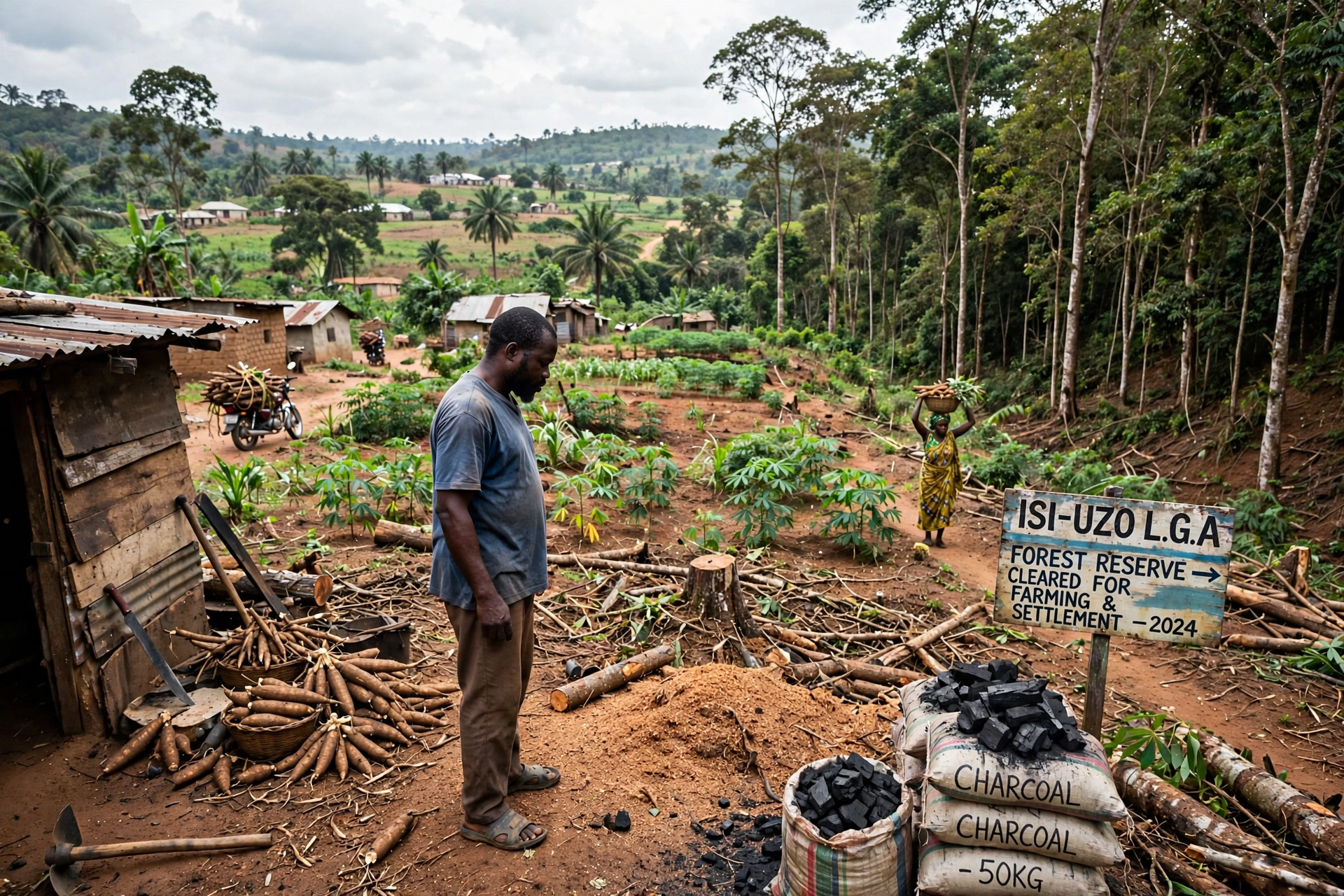
Isi-Uzo Local Government Area, one of the seventeen LGAs in Enugu State, exemplifies the challenges of forestland conversion in southeastern Nigeria. Isi-Uzo covers an area of 877 square kilometers and has a population estimated at approximately 220,000, with its capital in Ikem . The LGA is a primarily rural region that relies heavily on local agribusiness initiatives for economic growth, hosting over sixty local markets used for commerce . The rural nature of Isi-Uzo and its dependence on agriculture make it particularly susceptible to forestland conversion driven by socio-economic factors.
The relationship between socio-economic characteristics and forestland conversion represents a critical area of inquiry for understanding deforestation dynamics. Socio-economic characteristics such as age, gender, education level, household size, income, farm size, land ownership, and occupation significantly influence land-use decisions and forest resource utilization patterns . Studies have shown that farmers’ socio-economic and institutional factors significantly shape their choice of incentives and land management practices, with education status, duration of residence, farm size, and age being key factors influencing household welfare and environmental outcomes .
Gender dynamics play a significant role in forestland conversion processes. Research indicates that there are notable disparities in agricultural employment, with significantly more males engaged in agricultural activities compared to females . The socio-economic characteristics of male farmers have been found to be statistically significant in relation to forestland conversion, suggesting that agricultural activities leading to alteration of forest environments may be more male-dependent . Understanding these gender differentials is essential for developing targeted policies for sustainable forest management.
Land tenure systems and ownership patterns represent another critical socio-economic factor influencing forestland conversion. The complexity of land tenure in Nigeria, where customary rights often coexist with statutory regulations, creates challenges for sustainable forest management. Studies indicate that ownership of forestland does not necessarily influence its management, suggesting that institutional constructs such as land tenure laws are needed to define and allot forest ownership patterns in a manner that promotes conservation . The lack of secured land tenure often leads farmers to focus on short-term gains rather than long-term sustainability, resulting in overexploitation of natural resources and escalated deforestation .
Population growth has been identified as a significant underlying driver of forestland conversion in Nigeria. The regular increase in population pressure triggers the need for commercialization across boundaries, leading to intensified pressure on forest resources . Pronatalist issues of unnecessary family size increment without corresponding economic benefits have been linked to increased agricultural activities that contribute to forestland conversion . The relationship between population dynamics and forestland conversion underscores the need to address demographic factors in forest conservation strategies.
Economic factors, including poverty, income levels, and livelihood diversification, significantly influence forestland conversion patterns. Many rural households depend on forest resources for their livelihoods, with forest resources contributing to employment generation and household income . However, poverty and lack of alternative income sources can drive unsustainable forest exploitation. Studies have found that income negatively influences awareness of climate variability, suggesting that economic constraints may limit farmers’ capacity to adopt sustainable land management practices . Creation of jobs, diversification of employment, and sustainable investments have been recommended as strategies to reduce pressure on forest resources .
The policy and institutional environment plays a crucial role in mediating the relationship between socio-economic factors and forestland conversion. Despite multiple national policies addressing deforestation, the absence of an updated forest inventory, coordinated federal-state action, community incentives, and adequate funding has left the forestry sector vulnerable . Forest management in Nigeria has been decentralized to individual states, with varying degrees of effectiveness in implementing conservation measures . The conceptualization of Forestry Commissions as revenue-raising agencies rather than management entities has been identified as contributing to forest depletion, with an excessive focus on forests’ revenue-generating capacity leading to unsustainable exploitation .
Understanding local perspectives on forest change drivers is essential for developing effective conservation strategies. Research in neighboring states has identified agricultural expansion, lumbering, charcoal production, and grazing as the most reported direct drivers of forest change, while population growth, poverty, and government policies were perceived as indirect drivers . These perceptions vary across communities, with some prioritizing agricultural expansion, others emphasizing population growth, and others identifying lumbering as the primary driver . This variation underscores the need for context-specific interventions that match local perceptions and priorities.
Climate change adds another dimension to the forestland conversion challenge, creating feedback loops that exacerbate environmental degradation. Deforestation contributes to climate change through greenhouse gas emissions, while climate change in turn affects forest ecosystems and agricultural productivity. Temperature has been found to decrease with increase in vegetation cover, with a negative relationship observed between vegetation cover and carbon dioxide concentration . Unchecked agriculture-induced deforestation exacerbates climate variability, leading to temperature variations, loss of stored carbon as carbon dioxide, and increased greenhouse gas emissions contributing to global warming . This creates a vicious cycle where environmental degradation reinforces socio-economic conditions that drive further forest conversion.
The significance of forest resources for rural livelihoods cannot be overstated. Forests provide employment generation through collection of non-timber forest products, with employment generated per person per year varying between 5.28 to 55.10 man-days . The employment generated from non-timber forest products is important in contributing to household income, but deforestation without afforestation, ignorance of conservation techniques due to low education levels, inadequate local people involvement in conservation decisions, instability in government policies, and deforestation and overgrazing are major constraints in the study area . These constraints highlight the complex interplay between socio-economic characteristics and forest resource management.
Given the critical role of forests in supporting rural livelihoods, providing environmental services, and contributing to national development, understanding the effects of socio-economic characteristics on forestland conversion in Isi-Uzo LGA is imperative. The local government area’s rural nature, reliance on agriculture, and significant forest resources make it an important case study for examining the socio-economic drivers of deforestation in southeastern Nigeria. The findings from this study have implications for policy formulation, sustainable land management practices, and the development of targeted interventions to address forestland conversion while supporting rural livelihoods.
Previous studies on forestland conversion have largely focused on proximate drivers such as agricultural expansion, logging, and infrastructure development, with less attention to the underlying socio-economic factors that shape these activities . There is a need to examine how household characteristics, demographic factors, economic conditions, and institutional arrangements influence farmers’ decisions to convert forestland for agricultural and other uses. This study seeks to fill this gap by providing empirical evidence on the effects of socio-economic characteristics on forestland conversion in Isi-Uzo LGA, Enugu State.
The study is grounded in the understanding that sustainable forest management requires addressing both proximate causes and underlying driving forces of deforestation and forest degradation . The Geist and Lambin conceptual framework of ‘proximate causes and underlying driving forces’ provides a useful lens for analyzing the complex relationships between socio-economic characteristics and forestland conversion . By examining how socio-economic factors at the household and community levels influence forestland conversion decisions, this study contributes to a more comprehensive understanding of deforestation dynamics in southeastern Nigeria.
Ultimately, the findings of this study are expected to inform policy interventions that address the socio-economic drivers of forestland conversion while promoting sustainable livelihoods and forest conservation. The study recognizes that effective forest conservation requires balancing the needs of rural communities with the imperative of protecting forest resources for present and future generations. By identifying the socio-economic characteristics that significantly influence forestland conversion, the study provides a basis for developing targeted interventions that address the root causes of deforestation in Isi-Uzo LGA and similar contexts.
1.2 Statement of the Problems
Forestland conversion, particularly deforestation driven by agricultural expansion, constitutes one of the most pressing environmental challenges facing Nigeria, with Isi-Uzo Local Government Area of Enugu State experiencing significant forest cover loss over recent decades. Despite the recognized importance of forests for environmental sustainability, rural livelihoods, and climate change mitigation, forestland conversion continues at an alarming rate in the study area. The problem is compounded by the complex interplay of socio-economic characteristics that influence farmers’ decisions regarding forestland use and management.
One of the primary problems is the lack of empirical understanding of how specific socio-economic characteristics affect forestland conversion decisions in Isi-Uzo LGA. While deforestation has been extensively studied at national and regional levels, there is limited research that specifically examines the socio-economic determinants of forestland conversion at the local government level in Enugu State . The rural nature of Isi-Uzo LGA and its heavy reliance on agriculture suggest that socio-economic factors play a critical role in shaping land-use decisions, yet the nature and extent of this influence remain inadequately understood.
Gender disparities in agricultural activities and forest resource utilization present another significant problem. Research indicates that agricultural activities leading to forestland conversion may be more male-dependent, with some socio-economic characteristics of male farmers being statistically significant in relation to forestland conversion . However, the specific mechanisms through which gender influences forestland conversion decisions in Isi-Uzo LGA are not well understood. The fact that none of the female socio-economic characteristics were found to be statistically significant in relation to forestland conversion in previous studies raises questions about the factors that differentiate male and female farmers’ impacts on forest environments .
The relationship between land tenure systems and forestland management constitutes a critical problem area. Studies suggest that ownership of forestland does not necessarily influence its management, indicating that the institutional and legal frameworks governing land ownership may be inadequate for promoting sustainable forest management . In Isi-Uzo LGA, where customary land tenure systems coexist with statutory regulations, the complexity of land ownership arrangements may contribute to unsustainable forestland conversion practices. The lack of clear property rights and secure land tenure has been identified as a factor that can lead farmers to focus on short-term gains rather than long-term sustainability .
Household characteristics, including family size and dependency ratios, represent another dimension of the problem. Research has linked pronatalist issues of unnecessary family size increment without corresponding economic benefits to increased agricultural activities that contribute to forestland conversion . In rural areas where agricultural labor is primarily provided by family members, larger household sizes may necessitate more extensive agricultural activities, leading to increased pressure on forest resources. However, the specific relationship between household demographic characteristics and forestland conversion in Isi-Uzo LGA requires empirical investigation.
Poverty and limited economic opportunities contribute to the problem of forestland conversion by creating dependence on forest resources for livelihoods while limiting farmers’ capacity to adopt sustainable land management practices. Studies have found that income negatively influences awareness of climate variability and environmental sustainability, suggesting that economic constraints may limit farmers’ engagement with conservation practices . The lack of alternative income sources and employment opportunities in Isi-Uzo LGA may force rural households to rely on forestland conversion for agricultural expansion and income generation, creating a cycle of poverty and environmental degradation.
The problem of limited awareness and education regarding sustainable forest management practices compounds the challenge of forestland conversion. Majority of respondents in rural areas have been found to have formal education, yet awareness of sustainable practices remains limited . The study identified the need for public enlightenment and awareness campaigns on appropriate and sustainable forest extraction methods as essential for sustaining forest resources . The low level of education and ignorance of conservation techniques among some farmers in rural Nigeria represents a significant barrier to sustainable forest management.
Policy and institutional failures represent another critical dimension of the problem. Despite multiple national policies addressing deforestation, the absence of an updated forest inventory, coordinated federal-state action, community incentives, and adequate funding has left the forestry sector vulnerable . The conceptualization of Forestry Commissions as revenue-raising agencies rather than management entities has contributed to forest depletion . In Enugu State, the effectiveness of forest management policies and institutions in addressing forestland conversion remains uncertain.
The problem of inadequate involvement of local communities in forest management decisions has been identified as a constraint to sustainable forest resource utilization. Research indicates that inadequate local people involvement in conservation decisions contributes to deforestation . In Isi-Uzo LGA, where local communities depend on forest resources for their livelihoods, the exclusion of community members from forest management decisions may undermine conservation efforts and lead to continued forestland conversion.
Infrastructure development and urbanization also contribute to the problem of forestland conversion in Isi-Uzo LGA. Studies have reported that urban expansion is one of the major causes of forest loss and that about 10.26% of forest cover in Enugu State transitioned to built-up areas and bare ground . The development of transportation networks, market infrastructure, and settlements in rural areas creates pressure on forest resources that may be exacerbated by socio-economic factors.
Agricultural practices and technologies employed by farmers in Isi-Uzo LGA present specific problems for forestland conservation. The prevalence of shifting cultivation and slash-and-burn practices among smallholder farmers in Nigeria has been identified as a major driver of deforestation . In the study area, the use of crude implements and traditional agricultural methods may contribute to inefficient land use and increased forestland conversion. The expansion of agricultural land has been identified as a significant driver of deforestation in Nigeria, creating a problem that requires urgent attention .
Climate variability and change add another layer of complexity to the problem of forestland conversion. Deforestation contributes to climate change through greenhouse gas emissions, while climate change in turn affects agricultural productivity and forest ecosystems . The resulting feedback loops may create conditions that further drive forestland conversion as farmers respond to changing environmental conditions. The relationship between socio-economic characteristics and climate adaptation strategies in the context of forestland conversion requires investigation.
The problem of unsustainable forest resource extraction, including logging and fuelwood collection, compounds the challenge of forestland conversion in Isi-Uzo LGA. Studies have identified illegal logging for timber and charcoal, as well as fuelwood extraction, among the drivers of deforestation in Nigeria . The socio-economic factors that drive these extraction activities, including household energy needs and income generation, are not well understood in the context of the study area.
Weak enforcement of forestry regulations and corruption in forestry governance represent significant problems that facilitate forestland conversion. The absence of effective monitoring and enforcement mechanisms allows violators to operate with impunity, contributing to continued forest loss . In Isi-Uzo LGA, the capacity of forestry institutions to enforce regulations and prevent illegal forestland conversion is uncertain.
The lack of empirical data on the effects of socio-economic characteristics on forestland conversion in Isi-Uzo LGA represents a fundamental problem that this study seeks to address. Despite the recognition of deforestation as a critical environmental issue in Enugu State, there is limited research that specifically examines the socio-economic determinants of forestland conversion at the local level . This knowledge gap hampers the development of effective policy interventions tailored to the specific conditions and challenges of Isi-Uzo LGA.
The cumulative effect of these problems is continued forestland conversion with adverse consequences for environmental sustainability, climate change mitigation, and rural livelihoods. The loss of forest cover in Enugu State has implications for water security, agricultural productivity, biodiversity conservation, and rural livelihoods . Addressing the problem of forestland conversion requires a comprehensive understanding of the socio-economic factors that drive it, enabling the development of targeted interventions that address the root causes.
1.3 Aim of the Study
The aim of this study is to empirically analyze the effects of socio-economic characteristics on forestland conversion in Isi-Uzo Local Government Area of Enugu State, Nigeria.
1.4 Objectives of the Study
The specific objectives of this study are to:
- Identify and describe the socio-economic characteristics of farmers engaged in agricultural activities in Isi-Uzo Local Government Area.
- Examine the relationship between gender and agricultural activities leading to forestland conversion in the study area.
- Analyze the effects of specific socio-economic characteristics (including age, education, household size, income, and land ownership) on forestland conversion decisions.
- Assess the influence of land tenure and ownership patterns on forestland management practices.
- Determine the statistical significance of socio-economic characteristics in relation to forestland conversion and identify the most influential factors.
The following research questions guide this study:
- What are the socio-economic characteristics of farmers engaged in agricultural activities in Isi-Uzo Local Government Area?
- What is the relationship between gender and agricultural activities leading to forestland conversion in the study area?
- What are the effects of specific socio-economic characteristics (age, education, household size, income, and land ownership) on forestland conversion decisions?
- How do land tenure and ownership patterns influence forestland management practices in Isi-Uzo LGA?
- Which socio-economic characteristics are statistically significant in relation to forestland conversion, and what is their relative influence?
The following research hypotheses, each with both null and alternative forms, are formulated for this study:
- H₀₁: There is no statistically significant relationship between gender and agricultural activities leading to forestland conversion in Isi-Uzo LGA.
- Hₐ₁: There is a statistically significant relationship between gender and agricultural activities leading to forestland conversion in Isi-Uzo LGA.
Hypothesis 2
- H₀₂: Age does not have a statistically significant effect on forestland conversion decisions in Isi-Uzo LGA.
- Hₐ₂: Age has a statistically significant effect on forestland conversion decisions in Isi-Uzo LGA.
Hypothesis 3
- H₀₃: Education level does not have a statistically significant effect on forestland conversion decisions in Isi-Uzo LGA.
- Hₐ₃: Education level has a statistically significant effect on forestland conversion decisions in Isi-Uzo LGA.
Hypothesis 4
- H₀₄: Household size does not have a statistically significant effect on forestland conversion in Isi-Uzo LGA.
- Hₐ₄: Household size has a statistically significant effect on forestland conversion in Isi-Uzo LGA.
Hypothesis 5

- H₀₅: There is no statistically significant relationship between land ownership and forestland management practices in Isi-Uzo LGA.
- Hₐ₅: There is a statistically significant relationship between land ownership and forestland management practices in Isi-Uzo LGA.
1.7 Significance of the Study
This study holds significant importance for multiple stakeholders and contributes to knowledge in several ways. The findings will be valuable for policymakers at the federal, state, and local government levels who are responsible for formulating and implementing policies related to forestry, agriculture, and land use management. By identifying the specific socio-economic characteristics that significantly influence forestland conversion, the study provides evidence-based insights for developing targeted policy interventions that address the root causes of deforestation.
The study will be beneficial for forestry agencies and institutions, including the Enugu State Ministry of Environment and Forestry, the National Forestry Commission, and related agencies. The findings will enhance understanding of the socio-economic drivers of forestland conversion, enabling these agencies to design more effective forest management strategies, extension programs, and conservation initiatives. The study’s insights into the relationship between land tenure and forest management will be particularly valuable for institutional reforms in the forestry sector.
For rural communities in Isi-Uzo LGA and similar contexts, the study provides a basis for understanding the socio-economic factors that influence their land-use decisions and forest resource utilization. This understanding can empower communities to engage more effectively with forestry agencies and policymakers, advocate for their interests, and adopt sustainable land management practices. The study’s findings on gender dynamics in forestland conversion will be useful for promoting gender-sensitive approaches to forest management.
Academic researchers and scholars in environmental studies, forestry, agricultural economics, rural sociology, and related disciplines will find the study valuable as a contribution to the literature on deforestation and forestland conversion in Nigeria. The empirical evidence provided by the study can serve as a foundation for further research, comparative studies, and the development of theoretical frameworks for understanding the socio-economic drivers of environmental change.
The study has practical significance for agricultural extension services and rural development agencies working in Isi-Uzo LGA and surrounding areas. By identifying the socio-economic characteristics that influence forestland conversion, the study provides insights that can be used to design more effective extension programs, training modules, and awareness campaigns that promote sustainable agricultural practices and forest conservation.
For non-governmental organizations and civil society organizations working on environmental conservation and rural development, the study provides evidence-based insights for program design, advocacy, and community engagement. The findings can inform the development of interventions that address both socio-economic development and forest conservation goals.
The study contributes to the broader goal of sustainable development by providing insights into the relationship between socio-economic factors and environmental sustainability. The findings are relevant to achieving the Sustainable Development Goals, particularly Goal 15 (Life on Land), Goal 1 (No Poverty), and Goal 13 (Climate Action). By identifying the socio-economic drivers of forestland conversion, the study supports the development of integrated approaches that balance environmental conservation with socio-economic development.
The study has significance for climate change mitigation efforts by contributing to understanding the drivers of deforestation, a major source of greenhouse gas emissions. The findings can inform the design of interventions under international frameworks such as REDD+ (Reducing Emissions from Deforestation and Forest Degradation) and contribute to Nigeria’s climate change mitigation commitments.
For local government authorities in Isi-Uzo LGA, the study provides evidence and recommendations that can inform local planning and development strategies. By understanding the socio-economic factors that influence forestland conversion in their jurisdiction, local authorities can develop more effective land-use plans, enforce regulations, and promote sustainable development.
Finally, the study has significance for forest-dependent communities whose livelihoods depend on forest resources. By enhancing understanding of the factors that drive forestland conversion, the study contributes to efforts to maintain forest ecosystems and the ecosystem services they provide, thereby supporting the long-term well-being of rural communities.
1.8 Scope of the Study
The study is geographically delimited to Isi-Uzo Local Government Area of Enugu State, Nigeria. Isi-Uzo LGA is a rural area with significant agricultural activities and forest resources, making it suitable for examining the relationship between socio-economic characteristics and forestland conversion. The study covers the three development councils of the Local Government Area to ensure comprehensive representation of the study population.
The study focuses on the effects of socio-economic characteristics on forestland conversion. The socio-economic variables examined include age, gender, education level, household size, income, farm size, land ownership, tenure status, and occupation. These variables were selected based on their theoretical and empirical relevance to forestland conversion and agricultural land-use decisions.
The study concentrates on agricultural activities as the primary driver of forestland conversion, consistent with the literature that identifies agricultural expansion as the main proximate cause of deforestation in Nigeria and other developing countries. The study examines agricultural practices, land-use decisions, and forest resource utilization by farming households in the study area.
The temporal scope of the study focuses on contemporary forestland conversion patterns and the current socio-economic characteristics of the study population. While reference is made to historical trends in forest cover change, the primary focus is on current relationships between socio-economic factors and forestland conversion.
The study employs a quantitative research approach using survey methodology to collect data from farming households. The study sample includes both male and female farmers to enable gender analysis and comparison. The sample size of 160 respondents is drawn from the three development councils of Isi-Uzo LGA.
The study’s analysis focuses on descriptive statistics to characterize the study population, multiple regression analysis to examine the relationships between socio-economic variables and forestland conversion, and t-test statistics to compare means and test for significant differences between groups, particularly by gender.
The scope of the study is limited to the socio-economic characteristics of farmers and does not extend to detailed ecological analysis of forest ecosystems, biodiversity assessment, or biophysical measurement of forest cover change. The study relies on farmers’ perceptions and reported practices regarding forestland conversion rather than direct measurement of forest cover change.
The study is delimited to Isi-Uzo LGA and the findings may not be generalizable to other local government areas in Enugu State or other parts of Nigeria without appropriate caution. However, the study’s findings may have relevance for similar rural communities with comparable socio-economic and ecological characteristics.
1.9 Limitation of the Study
The study was subject to several limitations that should be considered when interpreting the findings. First, the study relied on self-reported data from farmers regarding their agricultural activities, land-use decisions, and socio-economic characteristics. Self-reported data may be subject to recall bias, social desirability bias, and inaccuracies in estimation. Farmers may have underreported or overreported certain activities or characteristics based on their perceptions of what is socially acceptable or beneficial.
Second, the study’s sample size of 160 respondents, while adequate for statistical analysis, may limit the generalizability of findings to the broader population of Isi-Uzo LGA. The use of a larger sample size could have enhanced the statistical power of the analysis and provided more precise estimates of relationships between variables. However, resource constraints and the practical challenges of data collection in rural areas necessitated the use of a manageable sample size.
Third, the study was conducted within a limited geographical area (Isi-Uzo LGA) and may not capture the full diversity of socio-economic conditions and forestland conversion patterns across Enugu State or southeastern Nigeria. The findings may be influenced by the specific characteristics of the study area, including its ecological conditions, tenure systems, and economic structure. Caution should be exercised in generalizing findings to other contexts.
Fourth, the study focused on agricultural activities as the primary driver of forestland conversion and did not comprehensively examine other drivers such as logging, infrastructure development, or urbanization. While agricultural expansion is recognized as the primary driver of deforestation in Nigeria, other factors may contribute to forestland conversion in Isi-Uzo LGA and should be considered in future research.
Fifth, the study’s cross-sectional design provides a snapshot of relationships at a single point in time and does not capture temporal dynamics in socio-economic characteristics and forestland conversion patterns. Longitudinal studies would be valuable for understanding how changes in socio-economic conditions affect forestland conversion over time and for establishing causal relationships.
Sixth, the study encountered practical challenges in data collection, including access to remote communities, language barriers, and the time required to administer questionnaires. The rainy season and poor road networks in some areas of Isi-Uzo LGA created difficulties in reaching respondents, which may have affected the representativeness of the sample.
Seventh, the study’s reliance on multiple regression analysis to examine the effects of socio-economic characteristics on forestland conversion assumes linear relationships between variables and may not capture complex, non-linear relationships or interactions between variables. Alternative analytical approaches, such as logistic regression or structural equation modeling, might provide additional insights into the relationships under investigation.
Eighth, the study did not include ecological measurements of forest cover change, relying instead on farmers’ reports of forestland conversion. Direct measurement of forest cover using remote sensing or ground-based methods would provide more objective data on the extent and rate of forestland conversion in the study area.
Despite these limitations, the study provides valuable empirical evidence on the effects of socio-economic characteristics on forestland conversion in Isi-Uzo LGA. The findings contribute to the understanding of deforestation dynamics in southeastern Nigeria and provide a basis for policy recommendations and future research. The limitations identified do not undermine the overall validity of the findings but should be considered when interpreting and applying the results.
1.10 Definition of Terms
Forestland: Land covered with trees and forest vegetation, including natural forests, forest reserves, and woodlands. In the context of this study, forestland refers to areas in Isi-Uzo LGA that are covered by forest vegetation and are subject to conversion for agricultural or other uses.
Forestland Conversion: The process of changing forestland from its natural state to other uses, particularly agricultural use. This includes deforestation, clearing of forest vegetation, and transformation of forest areas into cropland, pasture, or other land uses. In this study, forestland conversion refers to the clearing of forest areas for agricultural activities.
Socio-Economic Characteristics: The demographic, economic, and social attributes of individuals and households that influence their behavior and decision-making. These include age, gender, education level, household size, income, farm size, land ownership, occupation, and other relevant variables examined in this study.
Deforestation: The permanent removal of forest cover and conversion of forestland to other uses. Deforestation involves the loss of forest ecosystems and the associated biodiversity and ecosystem services. In this study, deforestation is used interchangeably with forestland conversion to refer to the clearing of forest areas.
Agricultural Activities: The various farming practices undertaken by rural households, including crop cultivation, livestock rearing, and related activities. In the context of this study, agricultural activities refer to farming practices that may lead to forestland conversion, including shifting cultivation, slash-and-burn agriculture, and expansion of farmland.
Land Tenure: The system of rights, rules, and institutions that govern access to and use of land. Land tenure includes ownership rights, use rights, transfer rights, and the legal and customary frameworks that define these rights. In this study, land tenure refers to the arrangements through which farmers in Isi-Uzo LGA access and use land for agricultural purposes.
Forest Management: The process of planning, implementing, and monitoring activities to ensure the sustainable use and conservation of forest resources. Forest management includes practices such as forest protection, reforestation, sustainable harvesting, and community-based forest management.
Rural Livelihoods: The means by which rural households secure their basic needs, including food, income, shelter, and other necessities. Rural livelihoods are often dependent on natural resources, including forests and agricultural land. In this study, rural livelihoods refer to the economic activities and resource use patterns of farming households in Isi-Uzo LGA.
Smallholder Farmers: Farmers who operate on a small scale, typically cultivating less than five hectares of land and relying primarily on family labor. Smallholder farmers are the predominant farming group in rural Nigeria and are the focus of this study.
Slash-and-Burn Agriculture: A farming practice in which forest vegetation is cut and burned to clear land for cultivation. This practice is common among smallholder farmers in tropical regions and is a major driver of deforestation.
Agroforestry: A land-use system that integrates trees and shrubs with crops and livestock on the same land. Agroforestry is considered a sustainable alternative to forest conversion that provides both agricultural production and forest conservation benefits.
Gender: The socially constructed roles, behaviors, activities, and attributes that a given society considers appropriate for men and women. In this study, gender is examined in relation to agricultural activities and forestland conversion patterns.
Household Size: The number of individuals living in a household, including family members and other dependents. Household size is a socio-economic characteristic that may influence agricultural labor availability and pressure on forest resources.
Farm Size: The area of land cultivated by a farmer or farming household, typically measured in hectares. Farm size is a socio-economic characteristic that influences agricultural production and may be related to forestland conversion.
Income: The monetary and non-monetary resources available to a household, including income from agricultural activities, non-farm employment, and other sources. Income is a socio-economic characteristic that influences farmers’ capacity to adopt sustainable land management practices.
Conservation: The protection, preservation, and sustainable management of natural resources, including forests, biodiversity, and ecosystems. In this study, conservation refers to efforts to protect forest resources from conversion and degradation.


