
🔤 Total Characters in Document: 189,325
📄 Estimated Document Pages: 74
⏱️ Reading Time: 3 Hours 5 Mins
CHAPTER ONE: INTRODUCTION
1.1 Background of Study
Citrus is one of the most economically important fruit crops grown in tropical and subtropical regions of the world, including Nigeria (FAO, 2022). Citrus species include sweet orange (Citrus sinensis), mandarin (Citrus reticulata), lime (Citrus aurantifolia), lemon (Citrus limon), grapefruit (Citrus paradisi), and pomelo (Citrus maxima). Sweet orange (Citrus sinensis) is the most widely cultivated and consumed citrus species globally and in Nigeria, accounting for over 70% of citrus production (CBN, 2022). Nigeria is a significant citrus producer in Africa, with major producing states including Benue, Taraba, Kaduna, Nasarawa, Plateau, Kogi, Oyo, Ondo, Osun, Ekiti, and Cross River (NBS, 2022). Citrus fruits are rich in vitamin C (ascorbic acid), flavonoids, carotenoids, potassium, folate, and dietary fibre, and are consumed fresh or processed into juice, concentrates, marmalades, and essential oils (Okonkwo, 2020).
Infectious diseases are a major constraint to citrus production worldwide and in Nigeria, causing significant yield losses, reduced fruit quality, tree decline, and tree death (Gottwald, 2019). Infectious diseases are caused by pathogenic microorganisms including bacteria, fungi, viruses, viroids, phytoplasmas, and nematodes (Agrios, 2020). These pathogens can be transmitted through infected planting material (budwood, seedlings), insect vectors (aphids, psyllids, leafhoppers, whiteflies, mites), contaminated tools, wind, rain splash, soil, and infected plant debris (Timmer, Garnsey, and Broadbent, 2021). The tropical and subtropical climate of Nigeria (high temperature, high humidity, rainfall) is conducive to the development and spread of many citrus diseases (Adebayo and Ogunyemi, 2020).
The major infectious diseases of citrus include (Gottwald, 2019; Timmer et al., 2021):
| Disease | Causal Agent | Type | Symptoms | Economic Impact |
| Citrus Canker | Xanthomonas citri subsp. citri | Bacterium | Raised corky lesions on leaves, fruit, stems | Premature fruit drop, blemished fruit (unmarketable) |
| Citrus Greening (Huanglongbing – HLB) | Candidatus Liberibacter asiaticus, L. africanus, L. americanus | Bacterium (phloem-limited) | Yellow shoots, blotchy mottle, misshapen fruit, bitter taste | Tree decline and death; reduced yield and quality |
| Citrus Tristeza Virus (CTV) | Citrus tristeza virus | Virus | Stem pitting, vein clearing, stunting, decline | Reduced yield; tree death (on sour orange rootstock) |
| Citrus Scab | Elsinoë fawcettii | Fungus | Raised wart-like lesions on fruit, leaves, twigs | Blemished fruit (reduced market value) |
| Citrus Black Spot | Phyllosticta citricarpa | Fungus | Dark spots with raised margins on fruit | Premature fruit drop; blemished fruit |
| Brown Rot | Phytophthora spp. (P. citrophthora, P. nicotianae, P. palmivora) | Oomycete (water mould) | Gummosis (trunk), root rot, fruit rot | Tree decline and death; fruit loss |
| Diplodia Gummosis | Lasiodiplodia theobromae | Fungus | Gummosis, dieback, fruit rot | Tree decline; reduced yield |
| Anthracnose | Colletotrichum gloeosporioides | Fungus | Leaf spots, twig dieback, fruit rot | Reduced yield and fruit quality |
| Citrus Exocortis | Citrus exocortis viroid (CEVd) | Viroid | Bark scaling, stunting | Reduced yield (on certain rootstocks) |
| Citrus Nematode | Tylenchulus semipenetrans | Nematode (parasitic) | Root damage, stunting, decline | Reduced yield |
(Source: Agrios, 2020; Gottwald, 2019)
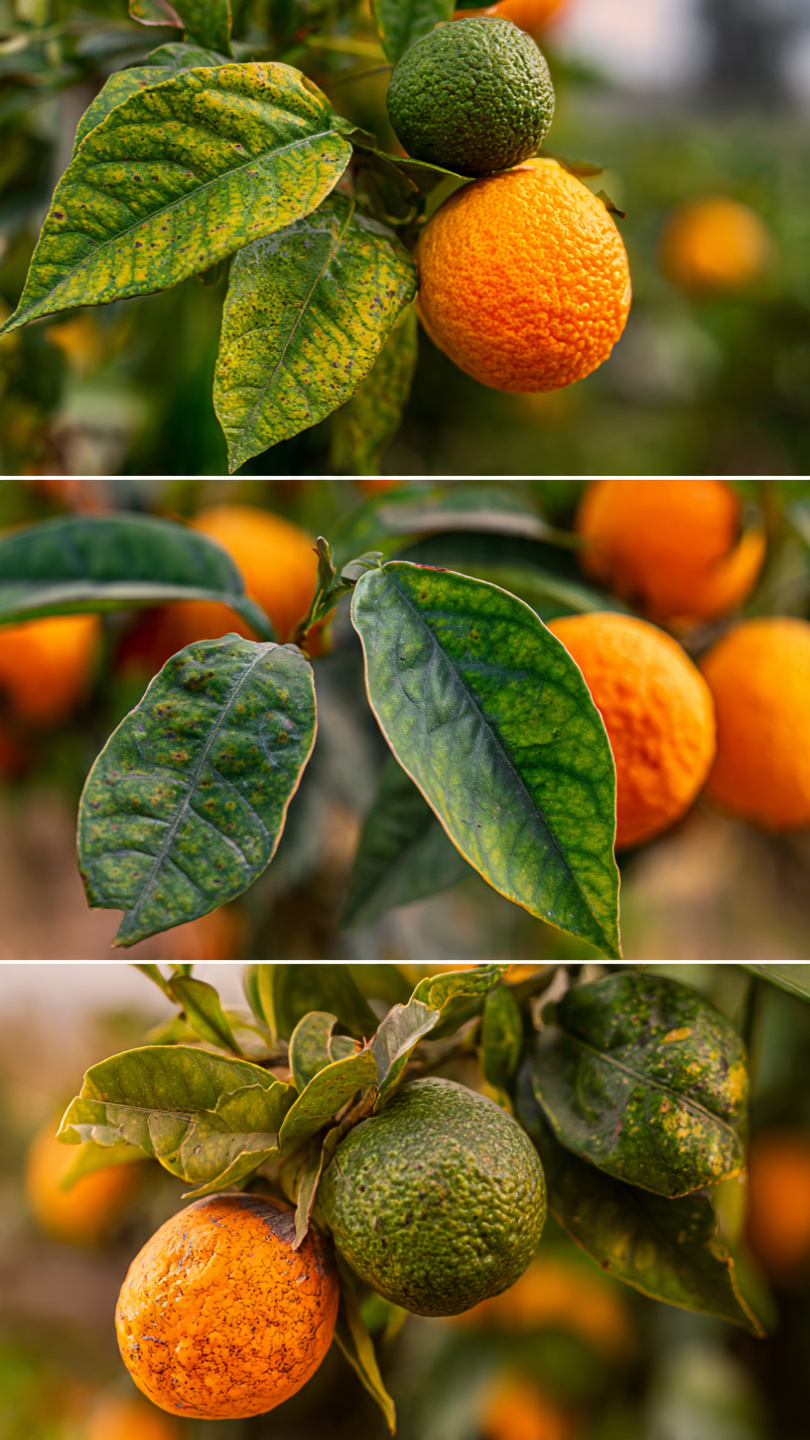
Citrus canker, caused by the bacterium Xanthomonas citri subsp. citri, is one of the most devastating bacterial diseases of citrus worldwide (Gottwald, 2019). Symptoms include raised, corky, brown lesions on leaves, fruit, and stems. In severe infections, lesions coalesce, causing defoliation, premature fruit drop, and blemished fruit that is unmarketable (Timmer et al., 2021). The disease is spread by wind-driven rain, rain splash, contaminated tools, and infected nursery stock. Citrus canker is endemic in many citrus-growing regions of Nigeria, particularly in areas with high rainfall and humidity (Adebayo and Ogunyemi, 2020).
Citrus greening (Huanglongbing – HLB) is the most destructive citrus disease worldwide, caused by phloem-limited bacteria Candidatus Liberibacter asiaticus, L. africanus, and L. americanus (Bové, 2019). HLB is transmitted by the Asian citrus psyllid (Diaphorina citri) and the African citrus psyllid (Trioza erytreae). Symptoms include yellow shoots (hence the name “huanglongbing” meaning “yellow dragon disease”), blotchy mottle on leaves, misshapen (lopsided) fruit, small fruit, bitter taste, and tree decline (Gottwald, 2019). Infected trees typically die within 5-8 years, and there is no cure. HLB is the greatest threat to citrus production globally, including Nigeria (Bové, 2019).
Citrus tristeza virus (CTV) is a viral disease transmitted by several aphid species (especially Toxoptera citricida, the brown citrus aphid) and through infected budwood (Bar-Joseph, Marcus, and Lee, 2020). CTV causes stem pitting (grooves on wood), vein clearing (transparent veins), stunting, and tree decline. On susceptible rootstocks (especially sour orange), CTV causes quick decline (sudden tree death). CTV is widespread in Nigeria and is a major constraint to citrus production (Okafor and Nwosu, 2020).
Citrus scab, caused by the fungus Elsinoë fawcettii, causes raised, wart-like lesions on fruit, leaves, and twigs (Timmer et al., 2021). While scab does not kill trees, it blemishes fruit, making them unmarketable for fresh consumption. Scab is favored by wet, humid conditions and is common in many citrus-growing areas of Nigeria (Eze and Nweze, 2019).
Phytophthora diseases (brown rot, gummosis, root rot), caused by Phytophthora species (oomycetes), are severe in poorly drained soils and during wet seasons (Erwin and Ribeiro, 2020). Symptoms include gummosis (gum exudation from trunk), root rot, foot rot, and fruit rot (brown rot). Phytophthora diseases cause tree decline and death, especially on susceptible rootstocks. They are common in many citrus orchards in Nigeria (Adebayo and Ogunyemi, 2020).
The impact of infectious diseases on citrus production is severe (Gottwald, 2019):
| Impact | Description | Magnitude |
| Yield loss | Reduced number of fruit per tree | 20-80% |
| Fruit quality loss | Blemished, misshapen, small, bitter fruit | 30-100% unmarketable |
| Tree decline | Reduced vigor, growth, productivity | 50-90% of trees affected |
| Tree death | Tree dies within months to years | 10-50% mortality |
| Increased production cost | Fungicides, bactericides, insecticides, pruning, rouging | 20-50% increase |
| Quarantine restrictions | Trade restrictions for affected regions | Export losses |
From a theoretical perspective, this study is supported by three theories: Epidemiological Triad Theory (Last, 2001; Gordis, 2019), which explains that disease occurrence results from the interaction of three factors: host (citrus tree), agent (pathogen: bacterium, fungus, virus, viroid, phytoplasma, nematode), and environment (climate, soil, orchard management); Plant Disease Epidemiology Theory (Campbell and Madden, 2020), which explains the spread of plant diseases in space and time, including disease gradients, dispersal mechanisms, and disease cycles; and Integrated Pest Management (IPM) Theory (Flint and van den Bosch, 2021), which provides a framework for managing diseases using multiple tactics (cultural, biological, chemical, genetic) in an economically and environmentally sustainable manner.
In summary, infectious diseases are a major constraint to citrus production in Nigeria, causing significant yield losses, reduced fruit quality, tree decline, and tree death. Major diseases include citrus canker (bacterial), citrus greening HLB (bacterial), citrus tristeza virus (viral), citrus scab (fungal), Phytophthora diseases (oomycete), and others. Understanding the symptoms, causal agents, transmission, and impact of these diseases is essential for developing effective management strategies. This study aims to identify and describe the infectious diseases affecting citrus (using orange as a case study), assess their prevalence and severity, and propose evidence-based management recommendations.
1.2 Statement of Problems
Infectious diseases are a major constraint to citrus production in Nigeria, causing significant yield losses (20-80%), fruit quality deterioration (blemished, misshapen, small, bitter fruit), tree decline, and tree death. The specific problems addressed by this study include:
- High prevalence of citrus canker: Citrus canker (Xanthomonas citri subsp. citri) is widespread in many citrus-producing areas, causing defoliation, premature fruit drop, and blemished fruit unmarketable for fresh consumption.
- Emergence and spread of citrus greening (HLB): Citrus greening (Candidatus Liberibacter spp.) is the most destructive citrus disease worldwide. It has been reported in Nigeria and is spreading, causing tree decline and death, with no cure available.
- Widespread citrus tristeza virus (CTV): CTV is prevalent in Nigeria, causing stem pitting, stunting, and tree decline, especially on susceptible rootstocks.
- High incidence of citrus scab: Citrus scab (Elsinoë fawcettii) is common in humid areas, causing blemished fruit that is unmarketable for fresh consumption.
- Phytophthora diseases (gummosis, root rot, brown rot): Phytophthora diseases are common in poorly drained soils and during wet seasons, causing tree decline and death.
- Limited disease management knowledge: Many citrus farmers lack knowledge of disease identification, transmission, and management (cultural, biological, chemical, genetic).
- Use of infected planting material: Farmers often use infected budwood or seedlings from untrusted sources, introducing diseases into new orchards.
- Limited disease surveillance: There is limited systematic surveillance for citrus diseases in Nigeria, so the true prevalence and severity are unknown.
- Limited empirical data: There is limited empirical data on the prevalence, severity, and distribution of citrus diseases in Nigeria.
- Weak extension services: Extension agents lack training in citrus disease identification and management.
The problem this study addresses is the need to identify and describe the infectious diseases affecting citrus (using orange as a case study), assess their prevalence and severity, understand their transmission and impact, and propose evidence-based management recommendations.
1.3 Aim of the Study
The specific aim of this research work is to identify and describe the infectious diseases affecting citrus (using orange as a case study), by assessing the prevalence and severity of major diseases (citrus canker, citrus greening HLB, citrus tristeza virus, citrus scab, Phytophthora diseases, etc.), understanding their symptoms, causal agents, transmission, and impact, and proposing evidence-based management recommendations.
1.4 Objectives of the Study
- To identify the major infectious diseases affecting orange (Citrus sinensis) in the study area based on visual symptoms (leaf, fruit, stem, root).
- To assess the prevalence (percentage of trees infected) and severity (percentage of canopy affected) of each disease.
- To collect and preserve diseased plant samples (leaves, fruit, stems, roots) for laboratory diagnosis (isolation, identification).
- To describe the symptoms, causal agents, transmission pathways, and impact of each disease.
- To propose evidence-based management recommendations (cultural, biological, chemical, genetic) for the major citrus diseases.
1.5 Research Questions
- What are the major infectious diseases affecting orange (Citrus sinensis) in the study area based on visual symptoms (leaf, fruit, stem, root)?
- What is the prevalence (percentage of trees infected) and severity (percentage of canopy affected) of each disease?
- What are the symptoms, causal agents, and transmission pathways of the major citrus diseases?
- What is the impact (yield loss, fruit quality loss, tree decline, tree death) of each disease?
- What evidence-based management recommendations (cultural, biological, chemical, genetic) can be proposed for the major citrus diseases?
1.6 Research Hypotheses
Hypothesis One
- H₀ (Null): There are no significant infectious diseases affecting orange in the study area.
- H₁ (Alternative): There are significant infectious diseases affecting orange in the study area.
Hypothesis Two
- H₀ (Null): The prevalence of citrus greening (HLB) is not significantly higher than other citrus diseases.
- H₁ (Alternative): The prevalence of citrus greening (HLB) is significantly higher than other citrus diseases.
Hypothesis Three
- H₀ (Null): There is no significant relationship between orchard management practices (pruning, sanitation, rogueing) and disease prevalence.
- H₁ (Alternative): There is a significant relationship between orchard management practices and disease prevalence.
Hypothesis Four
- H₀ (Null): The use of infected planting material (budwood, seedlings) is not significantly associated with disease introduction.
- H₁ (Alternative): The use of infected planting material is significantly associated with disease introduction.
Hypothesis Five
- H₀ (Null): There are no significant evidence-based management recommendations that can be proposed for citrus diseases.
- H₁ (Alternative): There are significant evidence-based management recommendations that can be proposed for citrus diseases.
1.7 Justification of the Study
This study is justified on several grounds. First, infectious diseases are a major constraint to citrus production in Nigeria, causing significant economic losses. Second, there is limited empirical data on the prevalence, severity, and distribution of citrus diseases in the study area. Third, understanding which diseases are most prevalent and severe (e.g., is citrus canker more severe than HLB?) is essential for prioritizing management interventions. Fourth, identifying the symptoms and transmission pathways of diseases will inform management strategies (cultural, biological, chemical, genetic). Fifth, the findings will inform citrus farmers, extension agents, researchers, and policymakers.
1.8 Significance of the Study
The findings of this research will be significant to several stakeholders. To citrus farmers, the study will provide information on disease identification (symptoms), disease prevalence, and management recommendations (pruning, sanitation, rogueing, resistant varieties, fungicides, bactericides, insecticides). To agricultural extension agents, the findings will inform training programmes on citrus disease identification and management. To researchers in plant pathology, the study will contribute empirical data on citrus disease prevalence and severity, testing and extending epidemiological triad theory, plant disease epidemiology theory, and integrated pest management theory. To policymakers (FMARD, State Ministries of Agriculture) , the findings will inform citrus disease surveillance, quarantine regulations, and research priorities. To citrus nursery operators, the findings will inform the production of disease-free planting material.
1.9 Scope of the Study
The scope of this study is delimited to the identification and description of infectious diseases affecting citrus (using orange (Citrus sinensis) as a case study). The study focuses on a selected citrus orchard(s) in a specified location (state or local government area). Disease assessment: visual inspection of leaves, fruit, stems, and roots for disease symptoms (lesions, cankers, gummosis, dieback, yellowing, mottling, misshapen fruit, stunting, decline). Diseases to be identified: citrus canker (Xanthomonas citri subsp. citri), citrus greening (HLB – Candidatus Liberibacter spp.), citrus tristeza virus (CTV), citrus scab (Elsinoë fawcettii), Phytophthora diseases (gummosis, root rot, brown rot – Phytophthora spp.), Diplodia gummosis (Lasiodiplodia theobromae), anthracnose (Colletotrichum gloeosporioides), and others. Prevalence: percentage of trees infected (number of infected trees / total trees × 100%). Severity: percentage of canopy affected (for foliar diseases) using a 0-5 or 0-100% scale. Sample collection: diseased plant samples (leaves, fruit, stems, roots) collected for laboratory diagnosis (isolation on culture media, microscopic examination, PCR if available). The study does not extend to other citrus species (mandarin, lime, lemon, grapefruit, pomelo) beyond incidental observation, to non-infectious diseases (nutrient deficiencies, physiological disorders), or to insect pests (though vectors may be noted).
1.10 Definition of Terms
Citrus: A genus of flowering trees and shrubs in the Rutaceae family, producing juicy fruits rich in vitamin C. Species include sweet orange (Citrus sinensis), mandarin (Citrus reticulata), lime (Citrus aurantifolia), lemon (Citrus limon), grapefruit (Citrus paradisi), and pomelo (Citrus maxima).
Infectious Disease (Plant): A disease caused by a pathogenic microorganism (bacterium, fungus, virus, viroid, phytoplasma, nematode) that can be transmitted from infected to healthy plants.
Citrus Canker: A bacterial disease caused by Xanthomonas citri subsp. citri, characterized by raised, corky lesions on leaves, fruit, and stems.
Citrus Greening (Huanglongbing – HLB): A bacterial disease caused by phloem-limited Candidatus Liberibacter spp., characterized by yellow shoots, blotchy mottle on leaves, misshapen fruit, bitter taste, and tree decline. Transmitted by Asian citrus psyllid (Diaphorina citri) and African citrus psyllid (Trioza erytreae).
Citrus Tristeza Virus (CTV): A viral disease caused by Citrus tristeza virus, characterized by stem pitting, vein clearing, stunting, and decline. Transmitted by aphids (especially Toxoptera citricida) and infected budwood.
Citrus Scab: A fungal disease caused by Elsinoë fawcettii, characterized by raised, wart-like lesions on fruit, leaves, and twigs.
Phytophthora Diseases: Diseases caused by Phytophthora species (oomycetes), including gummosis (gum exudation from trunk), root rot, foot rot, and brown rot (fruit rot).
Prevalence: The proportion (percentage) of trees infected by a disease. Prevalence = (number of infected trees / total trees) × 100%.
Severity: The proportion (percentage) of plant tissue (canopy, leaves, fruit) affected by a disease. Measured using a 0-5 scale or 0-100% scale.
Gummosis: The exudation of gum from wounds or diseased bark, often associated with Phytophthora or Diplodia infections.
Dieback: Progressive death of shoots and branches from the tips backward, often associated with disease or environmental stress.
Vector: An organism (insect, mite, nematode) that transmits a pathogen from infected to healthy plants. Examples: Asian citrus psyllid transmits HLB; aphids transmit CTV.
Epidemiological Triad Theory: A model of disease causation stating that disease results from the interaction of three factors: host (plant), agent (pathogen), and environment.
Plant Disease Epidemiology Theory: The study of the spread of plant diseases in space and time, including disease gradients (distance from source), dispersal mechanisms (wind, rain, insects, contaminated tools), and disease cycles.
Integrated Pest Management (IPM) Theory: A decision-based process involving coordinated use of multiple tactics (cultural, biological, chemical, genetic) to manage diseases in an economically and environmentally sustainable manner.
CHAPTER TWO: LITERATURE REVIEW
2.1 Conceptual Framework
The conceptual framework for this study is organized around the key concepts of infectious diseases of citrus, the epidemiological triad (host, agent, environment), disease assessment (prevalence, severity), and disease management. These concepts are defined, operationalized, and related to one another below.
2.1.1 Concept of Infectious Diseases of Citrus
Infectious diseases of citrus are caused by pathogenic microorganisms (bacteria, fungi, viruses, viroids, phytoplasmas, nematodes) that can be transmitted from infected to healthy plants (Agrios, 2020).
Major Infectious Diseases of Citrus:
| Disease | Causal Agent | Type | Transmission | Economic Impact |
| Citrus Canker | Xanthomonas citri subsp. citri | Bacterium | Wind-driven rain, rain splash, contaminated tools, infected nursery stock | Premature fruit drop, blemished fruit (unmarketable) |
| Citrus Greening (HLB) | Candidatus Liberibacter asiaticus, L. africanus, L. americanus | Bacterium (phloem-limited) | Asian citrus psyllid (Diaphorina citri), African citrus psyllid (Trioza erytreae) | Tree decline and death; reduced yield and quality |
| Citrus Tristeza Virus (CTV) | Citrus tristeza virus | Virus | Aphids (Toxoptera citricida), infected budwood | Stem pitting, stunting, decline, death |
| Citrus Scab | Elsinoë fawcettii | Fungus | Rain splash, wind, infected debris | Blemished fruit (reduced market value) |
| Citrus Black Spot | Phyllosticta citricarpa | Fungus | Rain splash, wind, infected debris | Premature fruit drop; blemished fruit |
| Brown Rot (Phytophthora) | Phytophthora citrophthora, P. nicotianae, P. palmivora | Oomycete | Soil, water, rain splash | Gummosis, root rot, fruit rot, tree decline |
| Diplodia Gummosis | Lasiodiplodia theobromae | Fungus | Wounds, rain splash | Gummosis, dieback, fruit rot |
| Anthracnose | Colletotrichum gloeosporioides | Fungus | Rain splash, wind, infected debris | Leaf spots, twig dieback, fruit rot |
| Citrus Exocortis | Citrus exocortis viroid (CEVd) | Viroid | Contaminated tools, infected budwood | Bark scaling, stunting |
| Citrus Nematode | Tylenchulus semipenetrans | Nematode | Soil, water, infected roots | Root damage, stunting, decline |
(Source: Agrios, 2020; Gottwald, 2019; Timmer, Garnsey, and Broadbent, 2021)
2.1.2 Epidemiological Triad (Host, Agent, Environment)
The occurrence and severity of infectious diseases are determined by the interaction of three factors: host, agent, and environment (Last, 2001; Gordis, 2019).
Host Factors (Citrus Tree):
| Factor | Susceptible | Resistant | Mechanism |
| Species/variety | Sweet orange (most susceptible) | Trifoliate orange, some hybrids | Genetic resistance |
| Age | Young trees (more susceptible to canker) | Mature trees | Physiological maturity |
| Nutritional status | Poor nutrition (more susceptible) | Good nutrition (balanced N, P, K, Ca, Mg) | Plant vigor, defense compounds |
| Stress | Drought, waterlogging, nutrient deficiency | Healthy, unstressed | Stress reduces resistance |
Agent Factors (Pathogen):
| Factor | Description | Example |
| Infectivity | Ability to establish infection | High for HLB, CTV |
| Pathogenicity | Ability to cause disease | High for canker, HLB |
| Virulence | Severity of disease | High for HLB (tree death) |
| Transmission efficiency | Ability to spread | High for CTV (aphids), HLB (psyllids) |
| Environmental survival | Ability to survive outside host | High for Phytophthora (soil), canker (debris) |
Environment Factors:
| Factor | Favorable for Disease | Unfavorable | Mechanism |
| Temperature | 20-35°C (canker, HLB, CTV) | <15°C or >40°C | Pathogen growth, vector activity |
| Humidity | High (>80%) for canker, scab | Low (<60%) | Splash dispersal, infection |
| Rainfall | High for canker, Phytophthora | Low | Splash dispersal, soil moisture |
| Wind | Strong for canker dispersal | Calm | Dispersal of droplets |
| Soil drainage | Poor for Phytophthora | Good | Root rot |
2.1.3 Disease Assessment: Prevalence and Severity
| Term | Definition | Formula | Unit |
| Prevalence | Proportion of trees infected | (Number of infected trees / Total trees) × 100% | % |
| Severity (foliar) | Proportion of canopy affected | (Area affected / Total canopy area) × 100% | % |
| Severity (fruit) | Proportion of fruit affected | (Number of infected fruit / Total fruit) × 100% | % |
Severity Rating Scales:
| Scale | Description | Percent Affected |
| 0 | No symptoms | 0% |
| 1 | Slight (1-5 lesions per tree) | 1-5% |
| 2 | Light (6-20 lesions per tree) | 6-20% |
| 3 | Moderate (21-50 lesions per tree) | 21-50% |
| 4 | Severe (51-100 lesions per tree) | 51-75% |
| 5 | Very severe (>100 lesions per tree) | 76-100% |
(Source: Campbell and Madden, 2020)
2.1.4 Disease Transmission Pathways
| Pathway | Description | Diseases |
| Wind-driven rain | Rain droplets dispersed by wind | Citrus canker |
| Rain splash | Splash from infected to healthy tissue | Citrus scab, black spot, anthracnose |
| Insect vectors | Insects transmit pathogens | HLB (psyllids), CTV (aphids) |
| Infected planting material | Budwood, seedlings | CTV, exocortis, canker |
| Contaminated tools | Pruning shears, knives | Canker, exocortis |
| Soil/water | Soilborne pathogens | Phytophthora, nematode |
| Infected debris | Fallen leaves, fruit | Scab, black spot, anthracnose |
2.1.5 Disease Management Strategies
| Strategy | Description | Examples |
| Cultural | Practices that reduce disease | Pruning (remove infected branches), sanitation (remove infected debris), rogueing (remove infected trees), weed control, irrigation management (avoid overhead), nutrition (balanced fertilizer) |
| Biological | Use of beneficial organisms | Biocontrol agents for Phytophthora (Trichoderma spp.) |
| Chemical | Use of pesticides | Copper-based bactericides (canker), fungicides (scab, black spot), insecticides (psyllids, aphids), nematicides |
| Genetic | Use of resistant varieties | Trifoliate orange rootstock, resistant scion varieties |
| Regulatory | Quarantine, certification | Disease-free nursery stock, budwood certification programmes |
(Source: Flint and van den Bosch, 2021)
2.1.6 Conceptual Framework Diagram (Described in Text)
The conceptual framework can be visualized as follows:
Epidemiological Triad → Disease Assessment → Management
Epidemiological Triad (Causal Factors):
- Host (citrus tree: species, age, nutrition, stress)
- Agent (pathogen: bacterium, fungus, virus, viroid, phytoplasma, nematode)
- Environment (temperature, humidity, rainfall, wind, soil drainage)
↓ Disease Development:
- Infection → Colonization → Symptom expression → Reproduction → Spread
↓ Disease Assessment (Dependent Variables):
- Prevalence (% trees infected)
- Severity (% canopy affected, % fruit affected)
- Impact (yield loss, quality loss, tree decline, tree death)
↓ Management (Interventions):
- Cultural (pruning, sanitation, rogueing, irrigation management, nutrition)
- Biological (biocontrol agents)
- Chemical (bactericides, fungicides, insecticides, nematicides)
- Genetic (resistant varieties, resistant rootstocks)
- Regulatory (quarantine, certification)
The framework posits that disease occurrence and severity are determined by the interaction of host, agent, and environment (epidemiological triad). Disease assessment measures prevalence and severity. Management interventions target one or more factors of the triad to reduce disease.
2.2 Theoretical Framework
This study is anchored on three supporting theories that provide a comprehensive theoretical foundation for understanding infectious diseases in citrus. These theories are Epidemiological Triad Theory, Plant Disease Epidemiology Theory, and Integrated Pest Management (IPM) Theory.
2.2.1 Epidemiological Triad Theory
Epidemiological Triad Theory, developed by Last (2001) and Gordis (2019), is a classic model of disease causation stating that disease results from the interaction of three factors: host, agent, and environment (Last, 2001; Gordis, 2019).
- Host factors: Characteristics of the plant that affect susceptibility to and severity of disease. These include: species, variety (cultivar), age, nutritional status, stress level (drought, waterlogging, nutrient deficiency), and prior infection (induced resistance).
- Agent factors: Characteristics of the disease-causing organism that affect its ability to cause disease. These include: infectivity (ability to establish infection), pathogenicity (ability to cause disease), virulence (severity of disease), transmission efficiency, and environmental survival.
- Environment factors: External conditions that affect the interaction between host and agent. These include: temperature, humidity, rainfall, wind, soil type, soil drainage, and orchard management practices.
- Disease occurs when: A susceptible host, a virulent agent, and a favorable environment coincide in time and space.
Application to Citrus Diseases
Epidemiological Triad Theory predicts:
| Disease | Host | Agent | Environment |
| Citrus canker | Susceptible sweet orange | Xanthomonas citri | Warm (20-35°C), wet, windy |
| HLB | Susceptible citrus | Candidatus Liberibacter | Warm, presence of psyllid vector |
| CTV | Susceptible citrus (sour orange rootstock) | Citrus tristeza virus | Presence of aphid vector |
| Citrus scab | Susceptible citrus | Elsinoë fawcettii | Warm, wet, humid |
| Phytophthora | Susceptible rootstock | Phytophthora spp. | Wet, poorly drained soil |
2.2.2 Plant Disease Epidemiology Theory
Plant Disease Epidemiology Theory, developed by Campbell and Madden (2020), explains the spread of plant diseases in space and time, including disease gradients, dispersal mechanisms, and disease cycles (Campbell and Madden, 2020).
- Disease gradient: The decline in disease incidence or severity with distance from the source of inoculum. Described by the equation:
or
.
- Dispersal mechanisms: Pathogens are dispersed by wind (canker), rain splash (scab, black spot), insects (HLB, CTV), contaminated tools (canker, exocortis), infected planting material (CTV, exocortis), and soil (Phytophthora, nematode).
- Disease cycle: The sequence of events from pathogen arrival to disease development: arrival (introduction), infection (entry into host), colonization (growth within host), symptom expression, reproduction (production of inoculum), and dispersal (spread to new hosts).
- Epidemic curve: The increase in disease incidence over time, described by the logistic model:
, where
is disease incidence,
is maximum disease,
is infection rate,
is time.
- Latent period: The time between infection and symptom appearance. Important for disease monitoring and management.
Application to Citrus Diseases
Plant Disease Epidemiology Theory predicts:
- Citrus canker spreads rapidly during windy, rainy periods (high infection rate).
- HLB spreads slowly (long latent period, 6-12 months from infection to symptom appearance), making early detection difficult.
- CTV spreads locally by aphids and long-distance by infected budwood.
- Disease gradients (higher disease near sources) can be measured.
2.2.3 Integrated Pest Management (IPM) Theory
Integrated Pest Management (IPM) Theory, developed by Flint and van den Bosch (2021), provides a framework for managing diseases using multiple tactics (cultural, biological, chemical, genetic) in an economically and environmentally sustainable manner (Flint and van den Bosch, 2021).
- Multiple tactics: Use of multiple management strategies reduces the risk of resistance and provides more effective control than any single tactic.
- Economic threshold: Treatment is applied only when pest/disease levels exceed an economic threshold (the level at which damage exceeds treatment cost).
- Monitoring: Regular monitoring (scouting) is essential to detect disease early and determine if treatment is needed.
- Cultural controls: First line of defence (pruning, sanitation, rogueing, resistant varieties, certified disease-free planting material).
- Biological controls: Use of natural enemies (biocontrol agents) to suppress pathogens.
- Chemical controls: Used only when necessary (when cultural and biological controls are insufficient), with rotation of chemistries to prevent resistance.
- Host resistance: Use of resistant varieties and rootstocks is the most effective and sustainable management tactic.
Application to Citrus Diseases
IPM Theory predicts:
- For citrus canker: cultural (prune infected branches, remove debris), chemical (copper sprays), genetic (resistant varieties).
- For HLB: cultural (rogue infected trees, use certified disease-free nursery stock), biological (parasitoids for psyllids), chemical (insecticides for psyllids), genetic (tolerant varieties under development).
- For CTV: cultural (use certified virus-free budwood), genetic (use CTV-tolerant rootstocks).
- For Phytophthora: cultural (improve drainage, avoid over-irrigation), biological (Trichoderma), chemical (fosetyl-Al, mefenoxam).
Integration of the Three Theories
The three theories are complementary and collectively provide a robust theoretical framework for this study:
| Theory | Focus | Contribution to Study |
| Epidemiological Triad | Host-agent-environment interaction | Explains why diseases occur (susceptible host + virulent agent + favorable environment) |
| Plant Disease Epidemiology | Disease spread in space and time | Explains how diseases spread (dispersal mechanisms, disease gradients, epidemic curves) |
| Integrated Pest Management (IPM) | Multiple tactics for sustainable management | Provides framework for disease management (cultural, biological, chemical, genetic) |
Together, these theories support the study’s identification and description of infectious diseases in citrus, recognizing that: (1) disease occurrence depends on host, agent, and environment (Epidemiological Triad); (2) diseases spread through dispersal mechanisms (Plant Disease Epidemiology); and (3) management requires multiple tactics (IPM).
2.3 Review of Related Empirical Studies
This section reviews empirical studies relevant to infectious diseases in citrus.
2.3.1 Studies on Citrus Diseases in Nigeria
Adebayo and Ogunyemi (2020) conducted a survey of citrus diseases in Oyo State, South-West Nigeria. Using visual inspection of 500 trees across 10 orchards, they identified citrus canker (prevalence 45%), citrus scab (35%), Phytophthora gummosis (25%), and citrus tristeza virus (20%). Severity was highest for citrus canker (mean severity 35% of canopy affected). The study recommended cultural practices (pruning, sanitation) and copper sprays for canker management.
Eze and Nweze (2019) studied citrus scab incidence in Enugu State, South-East Nigeria. Using a survey of 300 trees across 6 orchards, they found scab prevalence of 40% (range 25-60%). Severity was higher in wet season (45% fruit affected) than dry season (15%). The study recommended fungicide sprays (copper, mancozeb) during wet season and pruning of infected twigs.
Okafor and Nwosu (2020) studied citrus tristeza virus (CTV) in Edo State. Using visual inspection and ELISA testing of 200 trees, they found CTV prevalence of 30% (60 of 200 trees). Trees on sour orange rootstock had higher severity (decline, death) than trees on other rootstocks. The study recommended use of CTV-tolerant rootstocks (Rough lemon, Cleopatra mandarin) and certified virus-free budwood.
2.3.2 Studies on Citrus Greening (HLB) in Africa
| Study | Country | Key Findings |
| Bové (2019) | Global review | HLB is the most destructive citrus disease; transmitted by psyllids; no cure; tree death within 5-8 years |
| Gottwald (2019) | Global review | HLB has long latent period (6-12 months); early detection difficult; management requires integrated approach |
| Halbert and Manjunath (2020) | USA (Florida) | HLB caused 50-80% reduction in citrus production; millions of trees lost |
2.3.3 Studies on Citrus Canker
| Study | Country | Key Findings |
| Gottwald (2019) | Global review | Canker spread by wind-driven rain; lesions on fruit make them unmarketable; copper sprays reduce spread |
| Adebayo and Ogunyemi (2020) | Nigeria | Canker prevalence 45% in Oyo State; severity 35% canopy affected |
2.3.4 Summary of Empirical Findings
The empirical literature reveals consistent findings: (1) citrus canker, scab, CTV, and Phytophthora are prevalent in Nigeria; (2) citrus greening (HLB) is the most destructive citrus disease worldwide; (3) prevalence and severity vary by region, season, and management practices; (4) management requires integrated approach (cultural, biological, chemical, genetic). This study addresses gaps by providing a comprehensive assessment of multiple diseases in a defined study area.
2.4 Summary of Literature Review
The table below summarizes key theoretical and empirical literature relevant to infectious diseases in citrus.
| Author(s) and Year | Focus of Study | Strength | Weakness | Limitation | Gap Identified |
| Last (2001); Gordis (2019) | Epidemiological Triad Theory | Classic model of disease causation | Does not account for time | General theory | Application to citrus needed |
| Campbell and Madden (2020) | Plant Disease Epidemiology Theory | Explains disease spread in space and time | Complex mathematics | General theory | Application to citrus needed |
| Flint and van den Bosch (2021) | Integrated Pest Management (IPM) Theory | Multiple tactics for sustainable management | Requires monitoring, expertise | General theory | Application to citrus needed |
| Adebayo and Ogunyemi (2020) | Citrus diseases in Oyo State | Survey of 500 trees; canker 45%, scab 35% | Single state | Geographic gap | Multi-state study needed |
| Eze and Nweze (2019) | Citrus scab in Enugu State | Scab prevalence 40% | Single state | Geographic gap | Multi-state study needed |
| Okafor and Nwosu (2020) | CTV in Edo State | CTV prevalence 30% | Single state | Geographic gap | Multi-state study needed |
| Bové (2019) | HLB (global review) | Most destructive citrus disease | Not Nigeria-specific | Geographic gap | Nigeria study needed |
| Gottwald (2019) | Citrus canker and HLB (review) | Comprehensive review | Not Nigeria-specific | Geographic gap | Nigeria study needed |
| Halbert and Manjunath (2020) | HLB in Florida | 50-80% production loss | Florida, not Nigeria | Geographic gap | Nigeria study needed |
| Timmer et al. (2021) | Citrus diseases (textbook) | Comprehensive | Not Nigeria-specific | Geographic gap | Nigeria-specific needed |
| Agrios (2020) | Plant pathology (textbook) | Comprehensive | Not Nigeria-specific | Geographic gap | Nigeria-specific needed |