
🔤 Total Characters in Document: 111,135
📄 Estimated Document Pages: 46
⏱️ Reading Time: 1 Hour 54 Mins
CHAPTER ONE: INTRODUCTION
1.1 Background of Study
Fish production is a vital component of the agricultural sector in Nigeria, contributing significantly to food security, nutrition, employment, income generation, and foreign exchange earnings (FAO, 2022). Fish is an excellent source of high-quality animal protein (15-20% protein content), essential amino acids, omega-3 fatty acids (EPA and DHA), vitamins (A, D, E, B12), and minerals (calcium, phosphorus, iron, iodine, selenium, zinc) (World Bank, 2021). Fish consumption is associated with reduced risk of cardiovascular disease, improved brain development in children, and reduced malnutrition (WHO, 2020). In Nigeria, fish is a preferred animal protein source for many households, accounting for approximately 40% of animal protein intake (NBS, 2022).
The fish production sector in Nigeria comprises two main subsectors: capture fisheries (wild fish from rivers, lakes, reservoirs, and marine waters) and aquaculture (farmed fish in ponds, cages, and tanks) (FMARD, 2021). Nigeria has abundant water resources for fish production, including the Atlantic Ocean (853 km coastline), the Niger and Benue river systems, Lake Chad (though shrinking), Kainji Lake, Jebba Lake, Shiroro Lake, and numerous smaller reservoirs, ponds, and floodplains (CBN, 2022). Despite this potential, Nigeria is a net importer of fish, with an estimated annual fish demand of over 3.6 million metric tons (MMT) and domestic production of only about 1.2 MMT, leaving a deficit of over 2.4 MMT that is met through imports (FAO, 2022).
Fish Production in Nigeria: Capture Fisheries vs. Aquaculture:
| Sub-sector | Production (MMT/year) | Share (%) | Major species | Regions |
| Capture fisheries (wild) | 0.8-0.9 | 65-75% | Tilapia, catfish, croaker, sardines, bonga, shrimps | Coastal, riverine |
| Aquaculture (farmed) | 0.3-0.4 | 25-35% | Catfish (Clarias gariepinus), tilapia (Oreochromis niloticus) | All states (especially South-West) |
(Source: FMARD, 2021; NBS, 2022)
Major Fish Species in Nigerian Waters:
| Species | Scientific Name | Type | Habitat | Importance |
| African catfish | Clarias gariepinus | Freshwater | Rivers, lakes, ponds | Most cultured species |
| Nile tilapia | Oreochromis niloticus | Freshwater | Rivers, lakes, ponds | Second most cultured |
| Croaker | Pseudotolithus spp. | Marine | Atlantic Ocean | Important capture fishery |
| Sardines (Bonga) | Ethmalosa fimbriata | Marine/Brackish | Coastal waters | Important capture fishery |
| Shrimps/prawns | Penaeus spp., Macrobrachium spp. | Marine/Brackish/Freshwater | Coastal waters, rivers | Export commodity |
(Source: FAO, 2022)
The importance of fish production in Nigeria is multifaceted (Adebayo & Ogunyemi, 2020; Eze & Nweze, 2019; Okafor & Nwosu, 2020):
| Importance | Description | Impact |
| Food security | Provides affordable animal protein to millions of Nigerians | Reduces malnutrition, improves health |
| Nutrition | Rich in omega-3 fatty acids, vitamins, minerals | Cardiovascular health, brain development |
| Employment | Employs millions in fishing, aquaculture, processing, marketing | Rural livelihoods, poverty reduction |
| Income generation | Source of income for fishers, fish farmers, processors, traders | Economic empowerment |
| Foreign exchange | Export of shrimps, prawns, smoked fish, frozen fish | Export earnings (₦10-20 billion annually) |
| Raw material for industries | Fishmeal for livestock feed, fish oil for supplements | Agro-industry development |
| Cultural significance | Fish is part of traditional diets and ceremonies | Cultural heritage |
Fish Production and Demand in Nigeria (2010-2020):
| Year | Domestic Production (MMT) | Demand (MMT) | Deficit (MMT) | Import Value (₦ billion) |
| 2010 | 0.8 | 2.8 | 2.0 | 150 |
| 2015 | 1.0 | 3.2 | 2.2 | 200 |
| 2020 | 1.2 | 3.6 | 2.4 | 300 |
(Source: CBN, 2022; FAO, 2022)
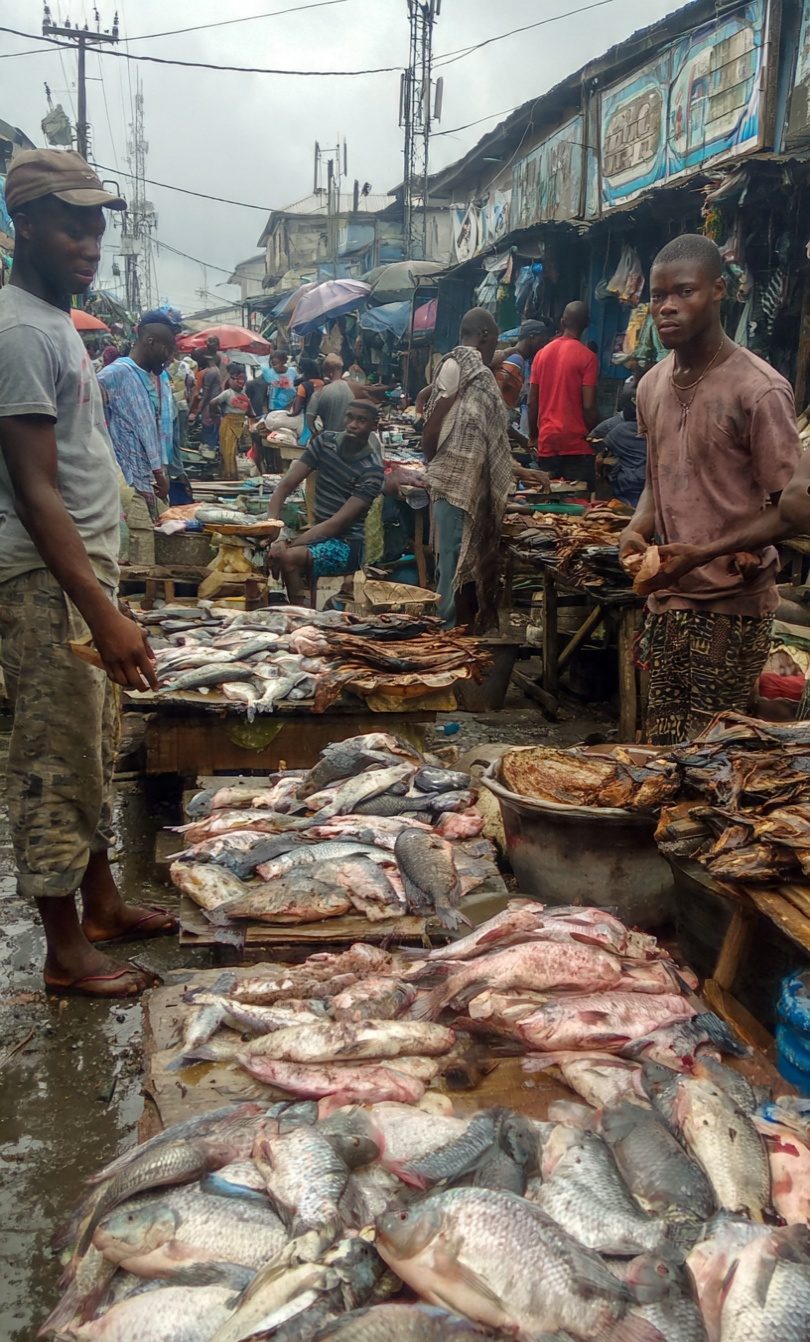
The marketing value of fish refers to the economic value generated through the sale and distribution of fish and fish products from producers (fishers/fish farmers) to consumers, including the value added through processing (smoking, drying, freezing, canning, filleting), packaging, branding, and distribution (Okonkwo, 2020). The fish marketing chain in Nigeria involves multiple actors: producers (fishers, fish farmers), assemblers, transporters, wholesalers, processors, retailers, and consumers (Okafor & Ugwu, 2021). The marketing value of fish is influenced by factors such as product form (fresh, smoked, dried, frozen, canned), quality (size, freshness, appearance), season (dry vs. rainy season), location (urban vs. rural), and market access (direct sales, middlemen, cooperatives) (Nwosu & Okafor, 2021).
Fish Marketing Channels in Nigeria:
| Channel | Description | Typical Price | Share of Marketing |
| Producer → Consumer | Direct sale from fisher/fish farmer to consumer | Highest (no middlemen) | Low (10-15%) |
| Producer → Retailer → Consumer | Producer sells to retailer, retailer sells to consumer | Moderate | Moderate (30-40%) |
| Producer → Assembler → Wholesaler → Retailer → Consumer | Multiple intermediaries | Lowest (many middlemen) | High (50-60%) |
(Source: Okafor & Ugwu, 2021)
Fish Products and Their Marketing Value:
| Product Form | Processing Method | Shelf Life | Price (₦/kg) | Value Addition (%) |
| Fresh (whole) | None (iced) | 1-2 days | 500-800 | 0% (baseline) |
| Smoked | Smoking (kiln) | 2-4 weeks | 1,000-1,500 | +100-150% |
| Dried | Sun drying | 2-6 months | 800-1,200 | +60-100% |
| Frozen | Freezing | 3-6 months | 600-1,000 | +20-60% |
| Fillets | Filleting, packing | 1-2 days (fresh), 3-6 months (frozen) | 1,200-2,000 | +140-300% |
| Canned | Canning | 12-24 months | 1,500-2,500 | +200-400% |
(Source: Nwosu & Okafor, 2021)
Factors Affecting Fish Marketing Value:
| Factor | Effect on Price | Mechanism |
| Product form | Processed (smoked, dried, frozen, fillet, canned) > fresh | Value addition, longer shelf life |
| Quality | High quality (fresh, intact scales, bright eyes, red gills) > low quality | Consumer preference |
| Size | Large > small (premium for large fish) | Consumer preference (more meat) |
| Species | Catfish and tilapia (popular) > other species | Consumer preference |
| Season | Dry season (scarcity) > rainy season (abundance) | Supply and demand |
| Location | Urban > rural (transport cost, higher demand) | Market access, purchasing power |
| Marketing channel | Direct sale (fewer middlemen) > multiple intermediaries | Middlemen margins |
(Source: Okafor & Ugwu, 2021)
Challenges in Fish Marketing:
| Challenge | Description | Impact |
| Perishability | Fresh fish spoils within 1-2 days without ice/refrigeration | High post-harvest losses (20-40%) |
| Poor storage facilities | Lack of cold storage, ice plants, freezers | Forced to sell immediately at low prices |
| Poor roads | Rural roads impassable in rainy season | High transport costs, spoilage |
| Middlemen exploitation | Intermediaries offer low prices, delay payment | Low producer prices |
| Price volatility | Prices fluctuate seasonally | Uncertainty |
| Lack of market information | Producers unaware of prices elsewhere | Cannot negotiate |
| High processing costs | Smoking kilns, freezers, ice expensive | Limited processing capacity |
| Poor packaging | Traditional packaging (baskets, sacks) inadequate | Quality loss, lower prices |
(Source: Nwosu & Okafor, 2021)
From a theoretical perspective, this study is supported by three theories: Supply and Demand Theory (Mankiw, 2020), which explains how fish prices are determined by the interaction of supply (production) and demand (consumption); Value Chain Theory (Porter, 1985; Kaplinsky & Morris, 2019), which analyzes the sequence of activities from production to consumption and identifies opportunities to add value; and Marketing Theory (Kotler & Keller, 2019), which explains the principles of product, price, place, and promotion (the 4 Ps) in marketing.
In summary, fish production is critically important for Nigeria’s food security, nutrition, employment, income, and foreign exchange. However, domestic production (1.2 MMT) meets only one-third of demand (3.6 MMT), with the deficit met by imports (over ₦300 billion annually). The marketing value of fish is influenced by product form, quality, size, species, season, location, and marketing channel. Processing (smoking, drying, freezing, filleting, canning) adds significant value (100-400% over fresh fish). However, fish marketing faces challenges: perishability, poor storage facilities, poor roads, middlemen exploitation, price volatility, lack of market information, and high processing costs. This study aims to examine the importance of fish production and its marketing value, assessing production levels, marketing channels, value addition, challenges, and prospects.
1.2 Statement of Problems
Despite Nigeria’s abundant water resources and the recognized importance of fish for food security, nutrition, and livelihoods, the domestic fish production sector is underperforming relative to its potential. The specific problems addressed by this study include:
Low domestic production: Domestic fish production (1.2 MMT) meets only one-third of demand (3.6 MMT), with a deficit of 2.4 MMT met by imports (over ₦300 billion annually).
Declining capture fisheries: Overfishing, pollution, climate change, and habitat destruction have reduced wild fish stocks in rivers, lakes, and marine waters.
Underdeveloped aquaculture: Aquaculture contributes only 25-35% of domestic production, despite the potential for expansion (ponds, cages, tanks).
High production costs: Fish feed (60-70% of operating costs) is expensive (₦500-1,000/kg); fingerlings, equipment (pumps, aerators), and labour are costly.
High post-harvest losses: 20-40% of harvested fish is lost due to spoilage (lack of ice, refrigeration, cold storage), poor handling, and inadequate processing facilities.
Poor marketing infrastructure: Lack of cold storage facilities, ice plants, rural roads, and market stalls leads to spoilage and low prices.
Middlemen exploitation: Multiple intermediaries (assemblers, wholesalers, retailers) capture most of the marketing margin, leaving producers with low prices.
Price volatility: Fish prices fluctuate seasonally (lower during rainy season harvest, higher during dry season), creating uncertainty for producers and consumers.
Limited value addition: Most fish is sold fresh or smoked using traditional methods (low quality, low price). Limited processing (filleting, canning, packaging) reduces marketing value.
Limited access to credit: <20% of fishers and fish farmers access formal credit, limiting investment in equipment (boats, nets, cages, aerators, cold storage).
Weak extension services: Farmer:agent ratio >3,000:1, limiting technology adoption (improved fish farming practices, processing techniques).
Climate change: Changing rainfall patterns, flooding, drought, and rising water temperatures affect fish production.
Limited empirical data: There is limited empirical data on fish production levels, marketing channels, value addition, challenges, and prospects in the study area.
The problem this study addresses is the need to examine the importance of fish production and its marketing value, assessing production levels, marketing channels, value addition, challenges, and prospects, and proposing evidence-based recommendations for improving fish production and marketing.
1.3 Aim of the Study
The specific aim of this research work is to examine the importance of fish production and its marketing value in selected areas, by assessing production levels (capture fisheries and aquaculture), identifying marketing channels (direct, retailer, assembler-wholesaler-retailer), evaluating value addition (smoking, drying, freezing, filleting, canning), identifying challenges (perishability, storage, roads, middlemen, price volatility, market information, processing costs), and proposing evidence-based recommendations for improving fish production and marketing.
1.4 Objectives of the Study
- To describe the socioeconomic characteristics (age, gender, education, experience, cooperative membership) of fish producers (fishers and fish farmers) in the study area.
- To assess the production levels of capture fisheries (wild) and aquaculture (farmed) fish in the study area.
- To identify the marketing channels (direct sale, retailer, assembler-wholesaler-retailer) for fish in the study area.
- To evaluate the value addition (processing: smoking, drying, freezing, filleting, canning; packaging; branding) and marketing value (price per kg, marketing margin) of fish in the study area.
- To identify the challenges (perishability, storage, roads, middlemen, price volatility, market information, processing costs) facing fish production and marketing, and propose recommendations.
1.5 Research Questions
- What are the socioeconomic characteristics (age, gender, education, experience, cooperative membership) of fish producers (fishers and fish farmers) in the study area?
- What are the production levels of capture fisheries (wild) and aquaculture (farmed) fish in the study area?
- What are the marketing channels (direct sale, retailer, assembler-wholesaler-retailer) for fish in the study area?
- What is the value addition (processing: smoking, drying, freezing, filleting, canning; packaging; branding) and marketing value (price per kg, marketing margin) of fish in the study area?
- What are the challenges (perishability, storage, roads, middlemen, price volatility, market information, processing costs) facing fish production and marketing, and what recommendations can be proposed?
1.6 Research Hypotheses
Hypothesis One
- H₀ (Null): Fish production (capture fisheries and aquaculture) is not significantly contributing to food security and livelihoods in the study area.
- H₁ (Alternative): Fish production is significantly contributing to food security and livelihoods.
Hypothesis Two
- H₀ (Null): There is no significant difference in marketing value between processed fish (smoked, dried, frozen, fillet, canned) and fresh fish.
- H₁ (Alternative): There is a significant difference in marketing value between processed fish and fresh fish.
Hypothesis Three
- H₀ (Null): There is no significant difference in producer prices between different marketing channels (direct sale vs. retailer vs. assembler-wholesaler-retailer).
- H₁ (Alternative): There is a significant difference in producer prices between different marketing channels.
Hypothesis Four
- H₀ (Null): There are no significant challenges (perishability, storage, roads, middlemen, price volatility, market information, processing costs) facing fish production and marketing.
- H₁ (Alternative): There are significant challenges facing fish production and marketing.
Hypothesis Five
- H₀ (Null): There are no significant evidence-based recommendations that can be proposed for improving fish production and marketing.
- H₁ (Alternative): There are significant evidence-based recommendations that can be proposed for improving fish production and marketing.
1.7 Justification of the Study
This study is justified on several grounds. First, fish is a critical source of animal protein for millions of Nigerians, but domestic production meets only one-third of demand, with a huge import bill (over ₦300 billion annually). Second, there is limited empirical data on fish production levels, marketing channels, value addition, challenges, and prospects in the study area. Third, understanding which marketing channels yield the highest producer prices (direct sale vs. fewer middlemen) can inform marketing strategies. Fourth, understanding which processing methods add the most value (smoking, drying, freezing, filleting, canning) can guide investment in processing equipment. Fifth, identifying challenges will inform interventions (cold storage, ice plants, rural roads, market information systems, processing equipment, credit). Sixth, the findings will inform fisheries policy (FMARD, State Ministries of Fisheries), development partners (World Bank, FAO, IFAD), and fishers/fish farmers.
1.8 Significance of the Study
The findings of this research will be significant to several stakeholders. To fishers and fish farmers, the study will provide information on profitable marketing channels (direct sales, cooperatives) and value addition (processing methods) to increase income. To processors and marketers, the findings will identify profitable processing methods (smoking, drying, freezing, filleting, canning) and market opportunities. To government agencies (FMARD, State Ministries of Fisheries, NAFDAC, SON) , the findings will inform fisheries policy (aquaculture development, cold storage infrastructure, ice plants, rural roads, market information systems), credit programmes, and training. To development partners (World Bank, FAO, IFAD, AfDB) , the findings will inform project design and investment priorities for fisheries development programmes. To academic researchers, the study will contribute empirical data on fish production and marketing, testing and extending supply and demand theory, value chain theory, and marketing theory.
1.9 Scope of the Study
The scope of this study is delimited to the importance of fish production and its marketing value in selected areas (specific state(s) or local government areas to be specified). The study focuses on capture fisheries (wild fish from rivers, lakes, reservoirs) and aquaculture (farmed fish from ponds, cages, tanks). Fish species: catfish (Clarias gariepinus), tilapia (Oreochromis niloticus), and other locally important species. Production assessment: capture fisheries (annual catch in kg, fishing methods: nets, hooks, traps); aquaculture (pond size, stocking density, feed type, production cycle, annual harvest). Marketing channels: direct sale (producer to consumer), retailer (producer to retailer to consumer), assembler-wholesaler-retailer (producer to assembler to wholesaler to retailer to consumer). Value addition: processing (smoking, drying, freezing, filleting, canning), packaging (plastic, polythene, vacuum), branding (label, logo). Marketing value: price per kg (fresh, smoked, dried, frozen, fillet, canned), marketing margin (difference between producer price and consumer price). Challenges: perishability, storage (ice, cold storage, freezer), roads (rural roads impassable in rainy season), middlemen (assemblers, wholesalers, retailers), price volatility (seasonal), market information (lack of price information), processing costs (smoking kilns, freezers, ice, packaging). The study includes primary data collection (fisher/fish farmer surveys, processor/marketer surveys, key informant interviews) and secondary data (fisheries statistics, market price data). The study covers the period 2019-2024. The study does not extend to marine capture fisheries beyond coastal areas, to fish feed production, to fish breeding/hatchery operations (except as inputs), or to export markets beyond domestic marketing.
1.10 Definition of Terms
Fish Production: The cultivation (aquaculture) or capture (capture fisheries) of fish for food, including freshwater and marine species.
Capture Fisheries: The harvesting of wild fish from natural water bodies (rivers, lakes, reservoirs, oceans) using nets, hooks, traps, and other fishing gear.
Aquaculture (Fish Farming): The cultivation of fish in controlled environments (ponds, cages, tanks, raceways) for food production.
Marketing Value: The economic value generated through the sale and distribution of fish and fish products, including the value added through processing, packaging, branding, and distribution.
Value Addition: The process of increasing the economic value of fish through processing (smoking, drying, freezing, filleting, canning), packaging (plastic, polythene, vacuum), and branding (label, logo).
Marketing Channel: The path or route through which fish moves from the producer (fisher/fish farmer) to the final consumer, including intermediaries such as assemblers, wholesalers, and retailers.
Marketing Margin: The difference between the price paid by the consumer and the price received by the producer, representing the costs and profits of intermediaries.
Post-Harvest Loss: The loss of fish after harvest due to spoilage (lack of ice, refrigeration), poor handling, inadequate processing, or pest infestation, estimated at 20-40% in Nigeria.
Smoking (Fish): A processing method where fish is exposed to smoke from burning wood or sawdust, which dries and preserves the fish, adding flavor. Smoked fish has a shelf life of 2-4 weeks.
Drying (Fish): A processing method where fish is dried in the sun or using dryers to remove moisture, preserving the fish. Dried fish has a shelf life of 2-6 months.
Freezing (Fish): A processing method where fish is frozen (below -18°C) to preserve it. Frozen fish has a shelf life of 3-6 months.
Filleting (Fish): The process of cutting fish flesh away from the bone, producing boneless fillets. Fillets have higher value than whole fish.
Canning (Fish): A processing method where fish is cooked, sealed in cans, and sterilized, preserving it for 12-24 months.
Cold Storage: Refrigerated storage facilities (4-10°C) for fresh fish, extending shelf life from 1-2 days to 1-2 weeks.
Freezer Storage: Frozen storage facilities (-18°C or lower) for frozen fish, extending shelf life to 3-6 months or longer.
Supply and Demand Theory: A theory (Mankiw, 2020) explaining how prices are determined by the interaction of supply (quantity of fish produced) and demand (quantity of fish consumers are willing to buy at various prices).
Value Chain Theory: A theory (Porter, 1985; Kaplinsky & Morris, 2019) analyzing the sequence of activities from production to consumption, identifying opportunities to add value, improve efficiency, and increase income for primary producers.
Marketing Theory: A theory (Kotler & Keller, 2019) explaining the principles of the 4 Ps: Product (fish and fish products), Price (pricing strategies), Place (distribution channels), and Promotion (advertising, branding).