🔤 Total Characters in Document: 207,535
📄 Estimated Document Pages: 81
⏱️ Reading Time: 3 Hours 22 Mins
CHAPTER ONE: INTRODUCTION
1.1 Background of Study
Tomato (Lycopersicon esculentum Mill., also known as Solanum lycopersicum L.) is one of the most widely cultivated and consumed vegetable crops in the world, with significant nutritional, economic, and culinary importance (FAO, 2022). Tomatoes are rich in vitamins A and C, lycopene (a powerful antioxidant), potassium, and dietary fibre, and are consumed fresh, cooked, processed into sauces, pastes, juices, and dried products (Rick & Yoder, 2019). In Nigeria, tomato is a staple ingredient in many traditional dishes (stews, soups, sauces) and is consumed daily by millions of households (NBS, 2022). The crop is cultivated across all agro-ecological zones, with major production areas in Kano, Kaduna, Katsina, Jigawa, Gombe, Bauchi, Plateau, Taraba, Benue, Nasarawa, Kogi, Niger, Oyo, Osun, and Lagos States (FMARD, 2021).
The production of tomato in Nigeria has increased over the years, with an estimated annual production of over 2 million metric tons (FAO, 2022). Despite this significant production, Nigeria is still a net importer of tomato paste, spending billions of naira annually to import tomato concentrates (CBN, 2022). This paradox of high domestic production coexisting with high importation is largely attributed to post-harvest losses, which are estimated at 30-50% of the total harvest (NBS, 2022). Post-harvest losses occur between harvest and consumption, including losses from mechanical damage, bruising, spoilage (fungal, bacterial), weight loss (wilting, shrivelling), and quality deterioration (color change, softening, loss of nutrients) (Kitinoja & Kader, 2020).
Post-harvest handling refers to the series of operations and treatments applied to harvested tomato fruits from the moment of harvest until they reach the consumer (Kader, 2019). These operations include: harvesting (timing, method, maturity stage), sorting and grading (removing damaged, diseased, or immature fruits), cleaning (removing dirt, debris), packaging (container type, cushioning, ventilation), storage (temperature, humidity, ventilation), transportation (vehicle type, road conditions, stacking), and marketing (display, shelving, storage at retail) (Kitinoja & Kader, 2020). Each of these handling operations can significantly affect the quality and marketability of fresh tomatoes.
The quality of fresh tomatoes is determined by several attributes that influence consumer preference and market price (Barrett, 2021):
| Quality Attribute | Description | Importance |
| Color | Uniform red color (for ripe tomatoes); absence of green patches, yellowing, or browning | High (consumers associate red with ripeness, flavor) |
| Firmness | Firm, crisp texture; not soft, mushy, or shrivelled | High (soft tomatoes are damaged, have shorter shelf life) |
| Shape | Uniform, typical shape (round, plum, beefsteak) | Moderate (misshapen fruits may be discounted) |
| Size | Uniform size within grade (small, medium, large) | Moderate (size sorting improves marketability) |
| Surface defects | Absence of cracks, scars, sunscald, insect damage, mechanical damage | High (defects reduce appearance, shelf life) |
| Decay | Absence of fungal growth, bacterial soft rot, water-soaked lesions | Very high (decayed fruits are unmarketable) |
| Flavor/taste | Sweetness (sugar-acid ratio), tomato flavor intensity | High (affects repeat purchase) |
| Nutritional quality | Vitamin C, lycopene, carotenoid content | Moderate (health-conscious consumers) |
Common Post-Harvest Quality Defects in Tomatoes:
| Defect | Cause | Effect on Marketability |
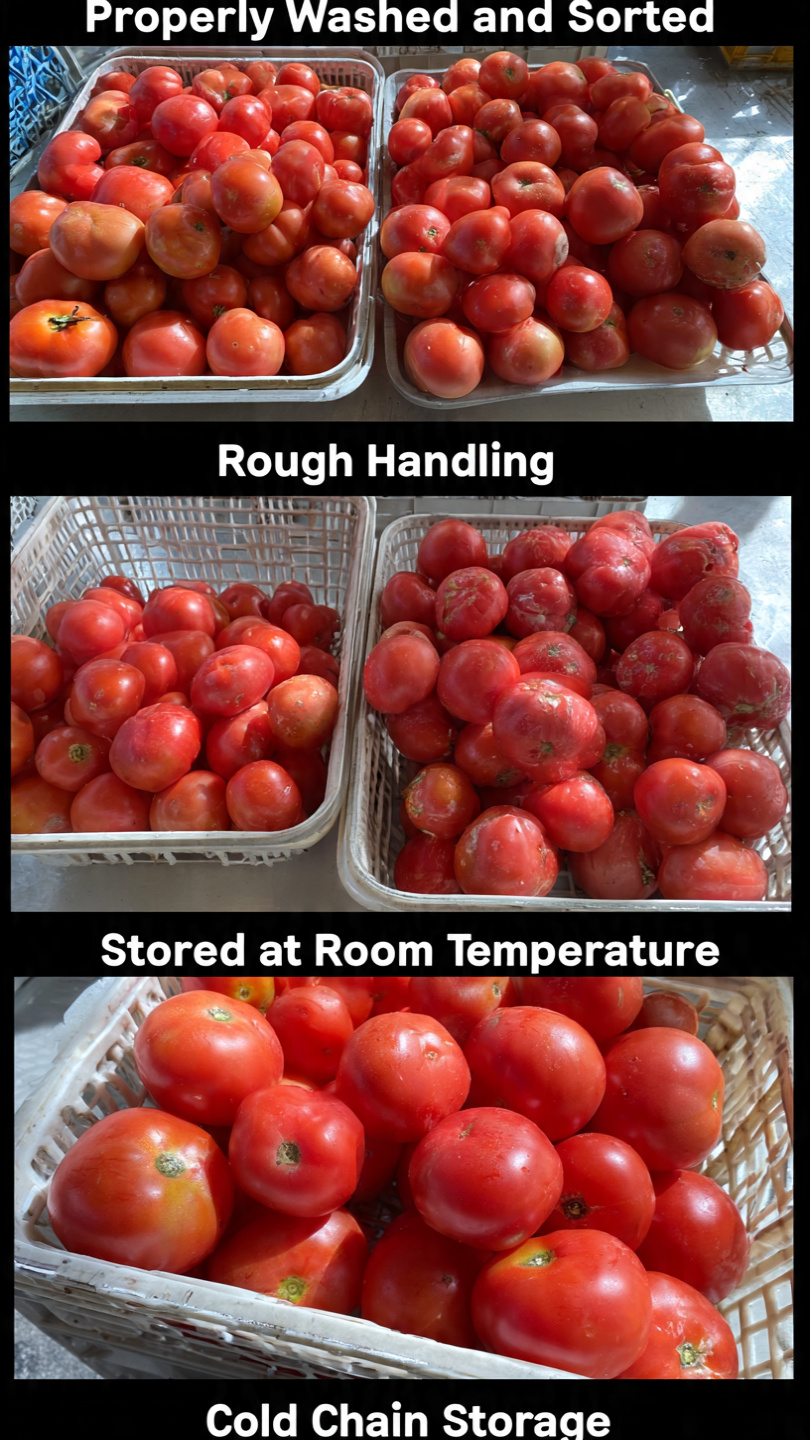
| Bruising/mechanical damage | Rough handling during harvesting, sorting, packaging, transport | Reduced shelf life, decay entry point, discounted price |
| Cracking | Rapid water uptake after dry period, rough handling | Reduced appearance, decay entry point |
| Sunscald | Exposure to direct sunlight after harvest | Discolored patches, reduced quality |
| Shrivelling/weight loss | Water loss due to high temperature, low humidity, long storage | Reduced appearance, reduced weight (sold by weight) |
| Decay (fungal, bacterial) | Wound infection, high humidity, warm temperature | Unmarketable (discarded) |
| Uneven ripening | Harvested at incorrect maturity stage | Reduced consumer acceptance |
| Chilling injury | Storage below 10°C (mature green tomatoes); below 12-13°C (ripe tomatoes) | Pitting, water-soaked areas, poor ripening |
| Loss of flavor | High temperature storage, ethylene exposure | Reduced consumer preference |
The critical factors in post-harvest handling that affect tomato quality include (Kitinoja & Kader, 2020):
Harvesting practices:
| Factor | Recommended Practice | Impact on Quality |
| Maturity stage | Mature green or breaker stage (first sign of color change) | Allows ripening during transport/storage; reduces damage |
| Harvesting method | Manual harvesting with clippers or scissors; gentle handling | Reduces bruising, stem puncture wounds |
| Harvesting container | Plastic crates with smooth surfaces (not sacks or baskets) | Reduces compression damage |
| Time of day | Early morning (cool temperatures) | Reduces field heat, wilting |
| Field heat removal | Shade immediately after harvest | Reduces respiration rate, water loss |
Sorting and grading:
| Practice | Purpose | Impact |
| Remove damaged, diseased, cracked fruits | Prevent spread of decay | Improves marketability of remaining fruits |
| Grade by size and color | Uniform product for market | Higher price for graded product |
| Clean (remove dirt, debris) | Improve appearance | Higher consumer acceptance |
Packaging:
| Container Type | Advantages | Disadvantages |
| Plastic crates (ventilated) | Reusable, stackable, good ventilation, low compression | High initial cost |
| Wooden crates | Strong, stackable | Heavy, splinters, difficult to clean |
| Cartons/cardboard boxes | Lightweight, cheap | Crush easily, no ventilation |
| Jute/burlap sacks | Cheap | No ventilation, high compression damage – not recommended |
| Plastic bags | Cheap | No ventilation, condensation → decay – not recommended |
Storage conditions:
| Parameter | Recommended Range | Effect of Deviation |
| Temperature | 12-15°C for ripe tomatoes; 18-22°C for mature green (to ripen) | <10°C → chilling injury; >25°C → rapid ripening, decay |
| Relative humidity | 85-95% | <85% → shrivelling, weight loss; >95% → condensation, decay |
| Ventilation | Good air circulation | Prevents ethylene buildup, reduces decay |
| Ethylene management | Remove ethylene (absorbent, ventilation) | Prevents over-ripening |
Transportation:
| Factor | Recommended Practice | Impact |
| Vehicle | Covered truck (shade), good suspension | Reduces temperature exposure, vibration damage |
| Stacking | Stack crates properly (not over 1.5-2 m) | Prevents crushing of bottom layers |
| Road condition | Avoid rough roads; drive slowly | Reduces bruising, mechanical damage |
| Ventilation | Air circulation during transport | Reduces heat buildup |
Marketing/Retail display:
| Practice | Purpose |
| Display in shade (not direct sunlight) | Prevents sunscald, overheating |
| Remove over-ripe, decayed fruits daily | Prevents spread of decay |
| Store at 12-15°C | Maintains quality |
| Sell within 3-7 days of harvest | Maximizes quality and shelf life |
From a theoretical perspective, this study is supported by three theories: Post-Harvest Physiology Theory (Kader, 2019), which explains the biochemical and physiological changes (respiration, transpiration, ripening, senescence) that occur in harvested fruits and how handling conditions affect these processes; Quality Degradation Kinetics Theory (Labuza, 1982; van Boekel, 2020), which models the rate of quality loss (color change, softening, nutrient degradation) as a function of time, temperature, and other factors; and Supply Chain Management Theory (Mentzer et al., 2001; Christopher, 2016), which emphasizes the integration of logistics, information, and coordination across the post-harvest chain to reduce losses and improve product quality.
In summary, tomato is a highly perishable crop that is susceptible to significant post-harvest losses (30-50%) due to poor handling practices. Post-harvest handling operations (harvesting, sorting, grading, packaging, storage, transportation, marketing) critically affect the quality (color, firmness, decay, flavor) and marketability (price, consumer acceptance) of fresh tomatoes. This study aims to investigate the effect of post-harvest handling on the quality and marketability of locally harvested tomatoes, comparing different handling practices (packaging type, storage temperature, transport conditions) and evaluating the resulting quality attributes and market outcomes.
1.2 Statement of Problems
Tomato is a highly perishable crop with an estimated post-harvest loss of 30-50% in Nigeria, resulting in significant economic losses for farmers, traders, and the national economy. These losses occur due to poor post-harvest handling practices: harvesting at incorrect maturity stage (over-ripe or immature), rough handling causing bruising and mechanical damage, packaging in inappropriate containers (sacks, baskets) that cause compression damage and lack ventilation, storage at ambient temperatures (25-35°C) that accelerate ripening and decay, and transportation over poor roads without proper cushioning. Consequently, tomatoes arriving at markets often have poor quality (soft, bruised, cracked, decayed, discolored, shrivelled), reducing their marketability (lower prices, rejection by buyers, higher waste). There is limited empirical data quantifying the effect of specific post-harvest handling practices on tomato quality attributes (color, firmness, decay incidence, weight loss) and marketability (price, consumer acceptance) under Nigerian conditions. The problem this study addresses is the need to investigate the effect of post-harvest handling (harvesting maturity, packaging type, storage temperature, transport simulation) on the quality and marketability of locally harvested tomatoes, and to identify optimal handling practices to reduce losses and improve market outcomes.
1.3 Aim of the Study
The specific aim of this research work is to investigate the effect of post-harvest handling practices on the quality and marketability of locally harvested tomatoes, by comparing different handling conditions (harvest maturity, packaging type, storage temperature, transport simulation), and evaluating the resulting quality attributes (color, firmness, decay incidence, weight loss) and marketability (market price, consumer acceptability).
1.4 Objectives of the Study
- To determine the effect of harvest maturity stage (mature green, breaker, pink, light red) on the post-harvest quality (color development, firmness, decay incidence) and marketability of tomatoes.
- To determine the effect of packaging type (plastic crates, wooden crates, cartons, sacks) on the physical quality (bruising, compression damage, decay) and marketability of tomatoes.
- To determine the effect of storage temperature (ambient 25-30°C, room temperature 20-22°C, refrigerated 12-15°C) on the shelf life (days to spoilage) and quality retention of tomatoes.
- To determine the effect of transport simulation (vibration duration, stacking height) on mechanical damage and quality loss of tomatoes.
- To recommend optimal post-harvest handling practices (harvest maturity, packaging, storage temperature, transport conditions) for minimizing losses and maximizing marketability of tomatoes.
1.5 Research Questions
- What is the effect of harvest maturity stage (mature green, breaker, pink, light red) on the post-harvest quality (color development, firmness, decay incidence) and marketability of tomatoes?
- What is the effect of packaging type (plastic crates, wooden crates, cartons, sacks) on the physical quality (bruising, compression damage, decay) and marketability of tomatoes?
- What is the effect of storage temperature (ambient 25-30°C, room temperature 20-22°C, refrigerated 12-15°C) on the shelf life (days to spoilage) and quality retention of tomatoes?
- What is the effect of transport simulation (vibration duration, stacking height) on mechanical damage and quality loss of tomatoes?
- What are the optimal post-harvest handling practices (harvest maturity, packaging, storage temperature, transport conditions) for minimizing losses and maximizing marketability?
1.6 Research Hypotheses
Hypothesis One
- H₀ (Null): Harvest maturity stage has no significant effect on the post-harvest quality (color, firmness, decay incidence) and marketability of tomatoes.
- H₁ (Alternative): Harvest maturity stage has a significant effect on the post-harvest quality and marketability of tomatoes.
Hypothesis Two
- H₀ (Null): Packaging type has no significant effect on the physical quality (bruising, compression damage, decay) and marketability of tomatoes.
- H₁ (Alternative): Packaging type has a significant effect on the physical quality and marketability of tomatoes.
Hypothesis Three
- H₀ (Null): Storage temperature has no significant effect on the shelf life (days to spoilage) and quality retention of tomatoes.
- H₁ (Alternative): Storage temperature has a significant effect on the shelf life and quality retention of tomatoes.
Hypothesis Four
- H₀ (Null): Transport conditions (vibration duration, stacking height) have no significant effect on mechanical damage and quality loss of tomatoes.
- H₁ (Alternative): Transport conditions have a significant effect on mechanical damage and quality loss of tomatoes.
Hypothesis Five
- H₀ (Null): There are no optimal post-harvest handling practices that significantly reduce losses and maximize marketability.
- H₁ (Alternative): There are optimal post-harvest handling practices that significantly reduce losses and maximize marketability.
1.7 Justification of the Study
This study is justified on several grounds. First, post-harvest losses of tomatoes in Nigeria (30-50%) represent a significant economic loss; reducing these losses would increase food availability, farmer income, and reduce importation of tomato paste. Second, there is limited empirical data on the effect of specific handling practices (harvest maturity, packaging, storage temperature, transport) on tomato quality under Nigerian conditions. Third, identifying optimal handling practices will provide evidence-based recommendations for farmers, traders, and transporters to improve tomato quality and marketability. Fourth, the findings will inform policy on post-harvest infrastructure (cold storage, packaging standards, road improvement) and extension training. Fifth, the study will contribute to the limited literature on post-harvest handling of fresh produce in Nigeria.
1.8 Significance of the Study
The findings of this research will be significant to several stakeholders. To tomato farmers, the study will provide recommendations on optimal harvest maturity and packaging to maximize quality and market price. To tomato traders and marketers, the findings will inform storage and display practices to reduce losses and maintain quality. To transporters, the study will provide guidance on loading, stacking, and driving practices to reduce mechanical damage. To government agencies (FMARD, State Ministries of Agriculture, NAFDAC) , the findings will inform post-harvest infrastructure investment (cold storage, crate supply, market facilities) and extension training programmes. To development partners (World Bank, FAO, IFAD, USAID) , the findings will inform project design for post-harvest loss reduction. To academic researchers, the study will contribute empirical data on post-harvest handling effects, testing and extending post-harvest physiology theory, quality degradation kinetics, and supply chain management theory.
1.9 Scope of the Study
The scope of this study is delimited to the effect of post-harvest handling on the quality and marketability of locally harvested tomatoes. The study uses a single tomato variety (e.g., Roma VF or UC82B). Harvest maturity stages: mature green (MG), breaker (first sign of color change, <10% red), pink (30-60% red), light red (60-90% red). Packaging types: plastic crates (ventilated), wooden crates, cartons (cardboard boxes), jute sacks (control – poor practice). Storage temperatures: ambient (25-30°C – typical market conditions), room temperature (20-22°C – air-conditioned), refrigerated (12-15°C – optimal for ripe tomatoes). Transport simulation: vibration table (0, 30, 60, 120 minutes) and stacking height (1, 3, 5 crates high). Quality attributes measured: color (visual color chart or colorimeter L*a*b*), firmness (penetrometer, kg/cm²), decay incidence (% of fruits with visible decay), weight loss (%, initial weight – final weight), bruising index (0-5 scale), marketability (simulated market price, ₦/kg, consumer acceptability 9-point hedonic scale). The study does not extend to other tomato varieties, other post-harvest treatments (waxing, calcium dips, hot water treatment, controlled atmosphere storage), processed tomato products (paste, sauce, juice), or long-term storage (>14 days).
1.10 Definition of Terms
Tomato (Lycopersicon esculentum): A highly perishable fruit vegetable crop, harvested and consumed at various stages of ripeness, from mature green to fully red.
Post-Harvest Handling: The series of operations and treatments applied to harvested tomato fruits from the moment of harvest until they reach the consumer, including harvesting, sorting, grading, packaging, storage, transportation, and marketing.
Post-Harvest Loss: The quantitative (weight loss, spoilage) and qualitative (color change, softening, flavor loss, nutritional loss) deterioration of harvested tomatoes that occurs between harvest and consumption.
Harvest Maturity Stage: The stage of ripeness at which tomato fruits are harvested, classified by color: mature green (MG – full size, green), breaker (first sign of color change, <10% red), pink (30-60% red), light red (60-90% red), red (>90% red).
Packaging: The container used to hold, protect, and transport harvested tomatoes. Packaging types include plastic crates (ventilated, stackable), wooden crates (heavy, splinters), cartons (cardboard, crushable), and sacks (jute, burlap, no ventilation – not recommended).
Storage Temperature: The temperature at which harvested tomatoes are held before sale. Optimal for ripe tomatoes is 12-15°C. Temperatures below 10°C cause chilling injury (pitting, water-soaked areas, poor ripening). Temperatures above 25°C accelerate ripening, decay, and water loss.
Shelf Life: The number of days after harvest that tomatoes remain acceptable for sale (marketable quality) without significant decay, softening, shrivelling, or other defects.
Decay Incidence: The percentage (%) of tomato fruits showing visible signs of fungal (e.g., Botrytis, Alternaria) or bacterial (e.g., soft rot) infection, characterized by lesions, water-soaked areas, mycelial growth, or softening.
Weight Loss: The loss of water (transpiration) from harvested tomatoes, measured as the percentage reduction in weight from initial harvest weight to final weight after storage. High weight loss causes shrivelling, reduced saleable weight, and lower price.
Firmness: A measure of tomato fruit texture, quantified using a penetrometer (force required to penetrate the fruit skin/ flesh, kg/cm²). Firm tomatoes are preferred; soft tomatoes indicate over-ripeness, damage, or decay.
Bruising: Mechanical damage to tomato fruit tissue caused by impact, compression, or vibration during harvesting, sorting, packaging, transport, or display. Bruised areas become soft, discolored, and are entry points for decay organisms.
Mechanical Damage: Physical injury to tomato fruits caused by rough handling, improper packaging (overfilling, inadequate cushioning), excessive stacking height (compression), vibration during transport, or dropping.
Post-Harvest Physiology Theory: A theory explaining the biochemical and physiological changes (respiration, transpiration, ethylene production, ripening, senescence) that occur in harvested fruits and how handling conditions (temperature, humidity, atmosphere) affect these processes.
Quality Degradation Kinetics Theory: A theory modeling the rate of quality loss (color change, softening, nutrient degradation, microbial growth) as a function of time, temperature, and other environmental factors, using kinetic models (zero-order, first-order, Arrhenius equation).
Supply Chain Management Theory: A theory emphasizing the integration of logistics, information, and coordination across the post-harvest chain (farmers, traders, transporters, retailers, consumers) to reduce losses, improve product quality, and increase efficiency.
CHAPTER TWO: LITERATURE REVIEW
2.1 Conceptual Framework
The conceptual framework for this study is organized around the key concepts of tomato post-harvest handling, quality attributes, marketability, and the mechanisms through which handling practices affect quality. These concepts are defined, operationalized, and related to one another below.
2.1.1 Concept of Tomato Post-Harvest Handling
Post-harvest handling refers to the series of operations and treatments applied to harvested tomato fruits from the moment of harvest until they reach the consumer (Kader, 2019). These operations include harvesting, sorting, grading, packaging, storage, transportation, and marketing (Kitinoja & Kader, 2020).
Post-Harvest Handling Chain for Tomatoes:
| Stage | Operations | Critical Factors |
| Harvesting | Timing (maturity), method (hand/clippers), container, field heat removal | Maturity stage, bruising, temperature |
| Field handling | Sorting, removal of damaged/diseased fruits | Damage spread, cleanliness |
| Packaging | Container type (crates, cartons, sacks), cushioning, ventilation | Compression damage, air circulation |
| Storage | Temperature, humidity, ventilation, duration | Ripening rate, decay, water loss |
| Transportation | Vehicle, road conditions, stacking, vibration | Mechanical damage, temperature |
| Marketing | Display (shade, temperature), shelf life, pricing | Consumer acceptance, price |
2.1.2 Concept of Tomato Quality
Tomato quality is determined by several attributes that influence consumer preference and market price (Barrett, 2021).
Quality Attributes of Fresh Tomatoes:
| Attribute | Description | Measurement | Importance |
| Color | Uniform red color for ripe tomatoes | Visual color chart; colorimeter (L*a*b*) | High |
| Firmness | Firm, crisp texture; not soft or mushy | Penetrometer (kg/cm²) | High |
| Shape | Uniform, typical variety shape | Visual | Moderate |
| Size | Uniform size within grade | Diameter (mm), weight (g) | Moderate |
| Surface defects | Cracks, scars, sunscald, insect damage | Visual count (%) | High |
| Decay | Fungal/bacterial lesions, water-soaked areas | Visual count (%) | Very high |
| Weight loss | Shrivelling, wilting | % weight change | High |
| Flavor | Sugar-acid ratio, tomato flavor intensity | Brix (sugar), titratable acidity | High |
2.1.3 Concept of Marketability
Marketability refers to the ability of fresh tomatoes to be sold at a satisfactory price, based on their quality attributes and consumer acceptance (Kitinoja & Kader, 2020).
Marketability Indicators:
| Indicator | Measurement | Interpretation |
| Market price (₦/kg) | Price offered by traders/consumers | Higher price = higher marketability |
| Consumer acceptability | 9-point hedonic scale (1=dislike extremely, 9=like extremely) | Higher score = higher marketability |
| Grade (A, B, C) | Based on quality standards (color, firmness, defects) | Grade A = highest price |
| Rejection rate (%) | Percentage of fruits rejected by buyers | Lower rejection = higher marketability |
| Shelf life (days) | Days to spoilage (>10% decay) | Longer shelf life = higher marketability |
2.1.4 Post-Harvest Handling Factors Affecting Tomato Quality
Factor 1: Harvest Maturity Stage
| Maturity Stage | Description | Color | Firmness | Shelf Life | Suitability |
| Mature green (MG) | Full size, green | Green | Very firm | 14-21 days | Long-distance transport; ripens during transit |
| Breaker | First color change (<10% red) | Green-yellow | Firm | 10-14 days | Local/regional markets |
| Pink | 30-60% red | Pink-red | Moderately firm | 7-10 days | Local markets |
| Light red | 60-90% red | Red | Soft | 3-7 days | Immediate consumption |
| Red | >90% red | Full red | Very soft | 1-3 days | Immediate sale (farmgate) |
Effect of Harvest Maturity on Quality (Kader, 2019):
| Maturity Stage | Advantages | Disadvantages |
| Mature green | Long shelf life, withstands transport | Requires ethylene to ripen; may not develop full flavor |
| Breaker | Good shelf life, develops good flavor | Slightly less firm than MG |
| Pink | Good flavor, acceptable to consumers | Shorter shelf life |
| Light red | Immediate consumer acceptance | Very short shelf life; high damage during transport |
Factor 2: Packaging Type
| Packaging Type | Ventilation | Stackability | Compression Resistance | Impact on Quality |
| Plastic crates | Excellent (ventilated) | Excellent | Good | Lowest damage, best quality |
| Wooden crates | Good (slats) | Good | Good | Moderate damage (splinters) |
| Cartons (cardboard) | Poor (unless ventilated) | Poor (crush) | Poor | High compression damage |
| Jute/burlap sacks | None | Poor | Very poor | Very high damage – not recommended |
| Plastic bags | None | Poor | Poor | Condensation → high decay |
Factor 3: Storage Temperature
| Temperature | Effect on Ripening | Effect on Decay | Effect on Weight Loss | Recommended |
| <10°C | Chilling injury (pitting, poor ripening) | Reduced | Reduced | No |
| 12-15°C | Slow ripening (optimal) | Reduced | Moderate | Yes (ripe tomatoes) |
| 18-22°C | Moderate ripening | Moderate | Moderate | Yes (mature green to ripen) |
| 25-30°C (ambient) | Rapid ripening | High | High | No |
| >30°C | Very rapid ripening, heat damage | Very high | Very high | No |
Factor 4: Transportation Conditions
| Factor | Good Practice | Poor Practice | Effect on Quality |
| Vibration | Low vibration (good roads, slow speed, cushioning) | High vibration (rough roads, high speed, no cushioning) | Bruising, softening, decay |
| Stacking height | 1-2 crates high | 5-10 crates high | Compression damage, crushing |
| Vehicle type | Covered truck (shade, ventilation) | Open truck (sun, rain) | Sunscald, temperature damage |
| Road condition | Paved roads | Unpaved, pothole roads | High vibration, mechanical damage |
2.1.5 Mechanisms of Quality Deterioration
Mechanism 1: Respiration
| Factor | Effect |
| Harvested tomatoes continue to respire (consume oxygen, produce CO₂, heat) | High respiration rate → rapid ripening, weight loss, quality loss |
| Temperature effect | Respiration rate doubles for every 10°C increase (Q₁₀ ≈ 2) |
| Wrapping | Damaged tomatoes have higher respiration → faster spoilage |
Mechanism 2: Transpiration (Water Loss)
| Factor | Effect |
| Tomatoes lose water through transpiration | Weight loss → shrivelling, reduced saleable weight |
| High temperature, low humidity | Increased transpiration rate |
| Broken skin (cracks, bruises) | Increased transpiration rate |
Mechanism 3: Ethylene Production and Action
| Factor | Effect |
| Tomatoes produce ethylene (ripening hormone) | Triggers ripening (color change, softening) |
| Ethylene accumulation (poor ventilation) | Accelerates ripening, over-ripening |
| Damaged tomatoes produce more ethylene | Accelerates ripening of surrounding fruits |
Mechanism 4: Microbial Growth (Decay)
| Factor | Effect |
| Wounds (bruises, cracks, stem punctures) | Entry points for fungi (Botrytis, Alternaria) and bacteria |
| High humidity, warm temperature | Promotes microbial growth |
| Poor hygiene (dirty containers, handling) | Introduces spoilage organisms |
2.1.6 Conceptual Framework Diagram (Described in Text)
The conceptual framework can be visualized as follows:
Post-Harvest Handling Practices (Independent Variables) → Quality Attributes (Mediating Variables) → Marketability (Dependent Variables)
Independent Variables (Handling Practices):
- Harvest maturity stage (mature green, breaker, pink, light red)
- Packaging type (plastic crates, wooden crates, cartons, sacks)
- Storage temperature (ambient 25-30°C, room 20-22°C, refrigerated 12-15°C)
- Transport conditions (vibration duration, stacking height)
↓ Quality Attributes (Mediating Variables):
- Color (redness, uniformity)
- Firmness (penetrometer, kg/cm²)
- Decay incidence (% fruits with visible decay)
- Weight loss (% initial weight lost)
- Bruising/mechanical damage index
↓ Marketability (Dependent Variables):
- Market price (₦/kg)
- Consumer acceptability (9-point hedonic scale)
- Grade (A, B, C)
- Rejection rate (%)
- Shelf life (days to spoilage)
↓ Underlying Mechanisms:
- Respiration rate
- Transpiration (water loss)
- Ethylene production and action
- Microbial growth (decay)
The framework posits that post-harvest handling practices (harvest maturity, packaging, storage temperature, transport conditions) affect tomato quality attributes (color, firmness, decay, weight loss, bruising) through underlying mechanisms (respiration, transpiration, ethylene, microbial growth). Quality attributes, in turn, determine marketability (price, consumer acceptability, grade, rejection rate, shelf life). Optimal handling practices maximize quality retention, reduce losses, and improve marketability.
2.2 Theoretical Framework
This study is anchored on three supporting theories that provide a comprehensive theoretical foundation for understanding the effect of post-harvest handling on tomato quality and marketability. These theories are Post-Harvest Physiology Theory, Quality Degradation Kinetics Theory, and Supply Chain Management Theory.
2.2.1 Post-Harvest Physiology Theory
Post-Harvest Physiology Theory, developed by Kader (2019) and others, explains the biochemical and physiological changes that occur in harvested fruits and vegetables after harvest, and how handling conditions affect these processes (Kader, 2019).
Core Propositions:
- Harvested produce is still alive: Fruits and vegetables continue to respire, transpire, and undergo biochemical changes after harvest. These processes lead to ripening, senescence, and eventual deterioration.
- Respiration: Respiration is the process by which harvested produce consumes oxygen (O₂) and produces carbon dioxide (CO₂), water, and heat. High respiration rate accelerates deterioration.
| Factor | Effect on Respiration | Implication |
| Temperature | Higher temperature → higher respiration rate (Q₁₀ ≈ 2-3) | Refrigeration slows respiration |
| Wounding | Damaged tissue → higher respiration rate | Handle gently |
| Ethylene | Promotes ripening → increased respiration | Remove ethylene |
- Transpiration (water loss): Water loss causes weight loss, shrivelling, and reduced firmness. Transpiration rate depends on temperature, humidity, and air movement.
- Ethylene production and action: Ethylene is a plant hormone that triggers ripening. Tomatoes are climacteric fruits (produce ethylene at ripening onset). Accumulation of ethylene accelerates ripening and senescence.
- Ripening stages: Tomatoes pass through distinct ripening stages: mature green → breaker → pink → light red → red. Harvest at breaker stage allows ripening during transport/storage.
Application to Tomato Post-Harvest Handling
Post-Harvest Physiology Theory predicts (Kader, 2019):
- Harvested tomatoes should be cooled immediately after harvest (remove field heat) to reduce respiration rate and slow ripening.
- Storage at 12-15°C (optimal for ripe tomatoes) reduces respiration rate, extends shelf life, and reduces decay.
- Temperatures below 10°C cause chilling injury (pitting, water-soaked areas, poor ripening).
- High humidity (85-95%) reduces transpiration (weight loss, shrivelling).
- Good ventilation prevents ethylene accumulation, which would accelerate ripening.
- Damaged (bruised) tomatoes produce more ethylene, accelerating ripening of surrounding fruits.
2.2.2 Quality Degradation Kinetics Theory
Quality Degradation Kinetics Theory, developed by Labuza (1982) and extended by van Boekel (2020), models the rate of quality loss as a function of time, temperature, and other environmental factors (Labuza, 1982; van Boekel, 2020).
Core Propositions:
- Quality loss follows reaction kinetics: Quality attributes (color, firmness, nutrients) degrade over time according to kinetic models (zero-order, first-order).
- Zero-order kinetics: Quality attribute decreases at a constant rate:
. Example: color loss in some products.
- First-order kinetics: Quality attribute decreases exponentially:
. Example: microbial growth, vitamin degradation.
- Arrhenius equation: The rate constant
increases exponentially with temperature:
, where
is activation energy,
is gas constant,
is absolute temperature.
- Q₁₀ value: The factor by which the reaction rate increases for a 10°C temperature increase. For respiration, Q₁₀ ≈ 2-3 (rate doubles or triples every 10°C).
Application to Tomato Quality Loss
Quality Degradation Kinetics Theory predicts (van Boekel, 2020):
- At higher storage temperatures (e.g., 30°C vs. 15°C), quality degradation (softening, color change, decay) occurs much faster (rate doubles or triples for every 10°C increase).
- Shelf life (time to reach unacceptable quality) is shorter at higher temperatures.
- The relationship between temperature and shelf life can be quantified and used to predict shelf life at different storage conditions.
- Example: If shelf life at 25°C is 5 days, at 15°C shelf life may be 10-15 days (2-3× longer).
2.2.3 Supply Chain Management Theory
Supply Chain Management Theory, developed by Mentzer et al. (2001) and Christopher (2016), emphasizes the integration of logistics, information, and coordination across the post-harvest chain to reduce losses and improve product quality (Mentzer et al., 2001; Christopher, 2016).
Core Propositions:
- Supply chain integration: Effective management requires coordination across all stages: farmer → trader → transporter → wholesaler → retailer → consumer.
- Logistics management: Transportation, warehousing, inventory management, packaging, and information systems affect product quality and cost.
- Cold chain: Maintaining optimal temperature throughout the supply chain (from harvest to consumer) is critical for perishable products like tomatoes.
- Traceability: Tracking products through the supply chain enables quality monitoring and accountability.
- Information sharing: Sharing information on demand, quality, and handling practices across supply chain partners improves efficiency and reduces losses.
Application to Tomato Post-Harvest Handling
Supply Chain Management Theory predicts (Christopher, 2016):
- Tomatoes should be harvested at appropriate maturity and moved through the supply chain as quickly as possible (minimize time).
- Cold storage at 12-15°C should be available at multiple points in the supply chain (farm, transport, wholesale market, retail) to maintain quality.
- Packaging should be standardized (e.g., plastic crates) to reduce damage and enable efficient stacking and transport.
- Information on quality (grade, defects) should be communicated from farmers to traders to retailers to enable appropriate pricing.
- Training of all supply chain actors (farmers, transporters, traders, retailers) on proper handling practices reduces losses.
Integration of the Three Theories
The three theories are complementary and collectively provide a robust theoretical framework for this study:
| Theory | Focus | Contribution to Study |
| Post-Harvest Physiology | Biochemical changes (respiration, transpiration, ethylene, ripening) | Explains why handling conditions (temperature, humidity, ventilation) affect quality |
| Quality Degradation Kinetics | Rate of quality loss over time and temperature | Explains why shelf life is shorter at higher temperatures; enables shelf life prediction |
| Supply Chain Management | Coordination and logistics across the chain | Explains why integrated handling practices (harvest → transport → storage → marketing) affect final quality |
Together, these theories support the study’s examination of the effect of post-harvest handling on tomato quality and marketability, recognizing that: (1) handling conditions affect physiological processes (respiration, transpiration, ethylene, ripening) that determine quality (Post-Harvest Physiology); (2) quality loss follows kinetic models, with temperature as a critical factor (Quality Degradation Kinetics); and (3) coordination across the supply chain (from farm to consumer) is necessary to maintain quality and reduce losses (Supply Chain Management).
2.3 Review of Related Empirical Studies
This section reviews empirical studies relevant to the effect of post-harvest handling on tomato quality and marketability.
2.3.1 Studies on Harvest Maturity Stage
Adebayo and Ogunyemi (2020) studied the effect of harvest maturity on tomato quality and shelf life in Oyo State. Using four maturity stages (mature green, breaker, pink, light red), they stored tomatoes at ambient temperature (25-30°C) and evaluated quality over 14 days. Mature green tomatoes had the longest shelf life (14 days) but required ethylene treatment to ripen. Breaker tomatoes had good shelf life (10 days) and developed acceptable color and flavor. Pink tomatoes had moderate shelf life (7 days) but were ready for immediate sale. Light red tomatoes had short shelf life (3-5 days). The study recommended harvesting at breaker stage for local markets.
2.3.2 Studies on Packaging Type
Okafor and Nwosu (2020) studied the effect of packaging type on tomato quality during transport in Edo State. Using four packaging types (plastic crates, wooden crates, cartons, jute sacks), they simulated transport for 2 hours on a rough road and evaluated mechanical damage. Plastic crates resulted in the lowest bruising (5% of fruits) and highest marketable yield (95%). Jute sacks resulted in the highest bruising (45%) and lowest marketable yield (55%). The study recommended plastic crates for tomato transport.
2.3.3 Studies on Storage Temperature
Eze and Nweze (2019) studied the effect of storage temperature on tomato shelf life in Enugu State. Using three storage temperatures (ambient 28-32°C, room 20-22°C, refrigerated 12-14°C), they evaluated quality over 21 days. Refrigerated tomatoes (12-14°C) had the longest shelf life (21 days) and retained firmness, color, and low decay (<5%). Room temperature tomatoes had shelf life of 10 days; ambient tomatoes had shelf life of 5-7 days with high decay (30-40%). The study recommended refrigerated storage for long-term storage (7-21 days) and ambient storage only for immediate sale (1-3 days).
2.3.4 Studies on Transport Conditions
Okafor and Ugwu (2021) studied the effect of vibration on tomato quality in Anambra State. Using a vibration table (0, 30, 60, 120 minutes) and three stacking heights (1, 3, 5 crates), they evaluated bruising and quality. Bruising increased with vibration duration (0 min: 2% bruising; 120 min: 35% bruising). Bruising also increased with stacking height (1 crate: 5% bruising; 5 crates: 25% bruising). The study recommended limiting transport time (<2 hours), using cushioning between layers, and limiting stacking height to 2-3 crates.
2.3.5 Summary of Empirical Findings
The empirical literature reveals consistent findings: (1) breaker stage harvest provides best balance of shelf life and quality for local markets; (2) plastic crates are the best packaging (lowest damage, highest marketable yield); (3) refrigerated storage (12-15°C) extends shelf life to 14-21 days; (4) ambient storage (25-30°C) results in rapid spoilage (5-7 days); (5) vibration (transport) and stacking cause significant mechanical damage; (6) most studies are limited to single states. This study addresses gaps by comparing multiple handling factors (harvest maturity, packaging, storage temperature, transport) within a single study.
2.4 Summary of Literature Review
The table below summarizes key theoretical and empirical literature relevant to the effect of post-harvest handling on tomato quality and marketability.
| S/N | Author(s) & Year | Focus of Study | Strength | Weakness | Limitation | Gap Identified |
| 1 | Kader (2019) | Post-Harvest Physiology Theory | Explains respiration, transpiration, ethylene | Complex; many variables | General theory | Application to tomato needed |
| 2 | Labuza (1982); van Boekel (2020) | Quality Degradation Kinetics | Models quality loss vs. time/temperature | Requires kinetic parameters | General theory | Application to tomato needed |
| 3 | Mentzer et al. (2001); Christopher (2016) | Supply Chain Management Theory | Integration across chain | Complex; requires coordination | General theory | Application to tomato chain needed |
| 4 | Adebayo & Ogunyemi (2020) | Harvest maturity (Oyo State) | Breaker stage best for shelf life | Single state | Geographic gap | Multi-state study needed |
| 5 | Okafor & Nwosu (2020) | Packaging type (Edo State) | Plastic crates best | Single state | Geographic gap | Multi-state study needed |
| 6 | Eze & Nweze (2019) | Storage temperature (Enugu State) | Refrigerated (12-14°C) best | Single state | Geographic gap | Multi-state study needed |
| 7 | Okafor & Ugwu (2021) | Transport vibration (Anambra State) | Vibration and stacking cause damage | Single state | Geographic gap | Multi-state study needed |
| 8 | Kitinoja & Kader (2020) | Postharvest manual (global) | Comprehensive | Not Nigeria-specific | Geographic gap | Nigeria-specific data needed |
| 9 | Barrett (2021) | Tomato quality (textbook) | Comprehensive quality attributes | Not Nigeria-specific | Geographic gap | Nigeria-specific data needed |
| 10 | FAO (2022) | Tomato production | Global data | Not Nigeria-specific | Geographic gap | Nigeria-specific research needed |
| 11 | NBS (2022) | Agricultural survey | Official data | Not handling-specific | No post-harvest data | Post-harvest study needed |