
🔤 Total Characters: 360,280 Characters
📄 Estimated Document Pages: 58 Pages
⏱️ Reading Time: 23 Mins
CHAPTER ONE: INTRODUCTION
1.1 Background of Study
Garri is a granular, starchy food product derived from cassava (Manihot esculenta Crantz) roots through a series of processing steps including peeling, washing, grating, fermentation (optional), dewatering (pressing), frying (roasting), and sieving (Okafor and Nwosu, 2020). Garri is the most widely consumed cassava product in Nigeria, serving as a staple food for millions of households, particularly in the South-West, South-East, South-South, and North-Central regions (FAO, 2022). It is consumed in various forms: soaked in cold water (with sugar, milk, groundnuts), made into “eba” (by adding hot water), or eaten with stews and soups (FMARD, 2021). The garri processing industry is a major source of employment and income for rural women and small-scale processors (World Bank, 2021).
The traditional method of garri frying (roasting) is a critical step in the processing chain, where dewatered cassava mash (wet cake) is transformed into dry, free-flowing, granular garri (Adebayo and Ogunyemi, 2020). Traditional garri frying is typically done manually using a large, shallow, flat-bottomed metal pan (locally known as “garrifryer” or “roasting pan”) placed over a wood-fired or charcoal-fired open hearth (Eze and Nweze, 2019). The processor stands over the hot pan, continuously stirring and turning the mash with wooden paddles to prevent burning and ensure uniform drying and granulation. This manual process is labor-intensive, time-consuming, hazardous, and inefficient (Okafor and Ugwu, 2021).
Challenges of Traditional Garri Frying:
| Challenge | Description | Impact |
| Labor-intensive | Continuous stirring required for 30-60 minutes per batch | High labor requirement (2-3 persons per pan) |
| Time-consuming | 30-60 minutes per batch (5-10 kg of garri) | Low throughput (10-20 kg/hour) |
| Hazardous | Open fire, hot pan, smoke, burns | Safety risk (burns, smoke inhalation) |
| Uneven heating | Wood/charcoal fire uneven, manual stirring inconsistent | Variable quality (burnt, under-dried, lumpy) |
| High fuel consumption | Wood/charcoal inefficient (high heat loss) | High energy cost |
| Low capacity | Small batch size (5-10 kg) | Difficult to scale up |
(Source: Adebayo and Ogunyemi, 2020; Okafor and Nwosu, 2020)
The need for mechanized garri frying machines has been recognized by researchers, engineers, and food processors to address the limitations of traditional methods (Okonkwo, 2020). Mechanized garri frying machines offer several advantages:
| Advantage | Description | Benefit |
| Reduced labor | Mechanical stirring (motorized) | Fewer workers (1 person can operate) |
| Higher throughput | Larger batch size (20-100 kg) | Higher productivity (50-200 kg/hour) |
| Consistent quality | Uniform heating, constant stirring rate | Uniformly dried, granular, no burning |
| Reduced fuel consumption | Enclosed heating, insulation | Lower energy cost |
| Improved safety | Enclosed rotating drum, no open fire | Reduced burns, smoke |
| Scalability | Can be scaled to industrial level | Commercial production |
(Source: Eze and Nweze, 2019; Okafor and Ugwu, 2021)
The design and construction of a garri frying machine involves several engineering considerations (Okafor and Nwosu, 2020):
| Component | Description | Design Consideration |
| Drum/cylinder | Rotating vessel where garri is fried | Material (mild steel, stainless steel), diameter, length, wall thickness |
| Heating system | Heat source for frying | Electric heating elements, gas burner, or direct fire with insulation |
| Agitator/stirrer | Mechanism to stir and turn the mash | Paddles or blades attached to rotating shaft |
| Drive system | Motor and transmission to rotate drum/agitator | Electric motor, gearbox, pulleys, belts |
| Frame/stand | Support structure | Material (angle iron, mild steel), strength, stability, portability |
| Discharge system | Mechanism to remove fried garri | Tilting mechanism, discharge door |
| Temperature control | Regulation of frying temperature | Thermostat, thermocouple, temperature controller |
Existing designs of garri frying machines vary in capacity, complexity, and cost (Okonkwo, 2020). Types include:
| Type | Capacity (kg/batch) | Power Source | Cost (₦) | Advantages | Disadvantages |
| Manual batch fryer | 10-20 | Manual (hand crank) | 50,000-100,000 | Low cost | Still labor-intensive |
| Motorized batch fryer (horizontal drum) | 20-50 | Electric motor (1-3 HP) | 200,000-500,000 | Moderate capacity, consistent quality | Higher cost, requires electricity |
| Continuous fryer | 100-500/hour | Electric motor (5-10 HP) | 1,000,000-5,000,000 | High capacity, industrial scale | High cost, requires electricity, complex |
(Source: Adebayo and Ogunyemi, 2020)
The performance of a garri frying machine is evaluated using several parameters (Okafor and Ugwu, 2021):
| Parameter | Definition | Target Value |
| Frying time (minutes/batch) | Time to fry one batch | < 30 minutes |
| Capacity (kg/batch) | Mass of garri per batch | 20-100 kg |
| Throughput (kg/hour) | Mass of garri per hour | 50-200 kg/hour |
| Moisture content (%) | Final moisture of garri | < 12% (safe storage) |
| Uniformity | Uniformity of frying (no burnt or under-dried particles) | >90% uniformly fried |
| Energy consumption (kWh/kg) | Energy per kg of garri | < 0.5 kWh/kg |
| Production cost (₦/kg) | Cost to produce 1 kg garri | < ₦50/kg |
The design of a garri frying machine should also consider the properties of cassava mash (wet cake) and garri (Okafor and Nwosu, 2020):
| Parameter | Value | Implication |
| Initial moisture content (wet cake) | 40-50% | Need to remove 30-40% moisture |
| Final moisture content (garri) | <12% | Safe storage (no mould, no fermentation) |
| Bulk density (wet cake) | 0.8-1.0 g/cm³ | Volume reduction during drying |
| Bulk density (garri) | 0.5-0.6 g/cm³ | Lighter product |
| Frying temperature | 150-200°C | Gelatinization, drying, expansion |
| Gelatinization temperature | 70-80°C | Starch granules absorb water, swell |
From a theoretical perspective, this study is supported by three theories: Heat Transfer Theory (Incropera and DeWitt, 2019), which explains the mechanisms of heat transfer (conduction, convection, radiation) from the heat source to the cassava mash; Mass Transfer Theory (Cussler, 2019), which explains the movement of moisture from the interior of the mash particles to the surface and evaporation; and Machine Design Theory (Shigley, Mischke, and Budynas, 2020), which provides the principles for designing mechanical components (shafts, bearings, gears, belts, motors) and selecting materials.
In summary, garri is a major staple food in Nigeria, but traditional garri frying is labor-intensive, time-consuming, hazardous, and inefficient. Mechanized garri frying machines are needed to improve productivity, quality, and safety. This study aims to design and construct a garri frying machine (motorized batch type) that is affordable, efficient, and suitable for small to medium-scale processors. The performance of the machine will be evaluated in terms of frying time, capacity, throughput, moisture content, uniformity, and energy consumption.
1.2 Statement of Problems
Traditional garri frying (manual stirring of cassava mash over an open fire) is labor-intensive (2-3 persons required per pan), time-consuming (30-60 minutes per batch), hazardous (burns, smoke inhalation), inefficient (low throughput, 10-20 kg/hour), and produces inconsistent quality (burnt or under-dried garri). Small to medium-scale garri processors need affordable, efficient, and safe mechanized garri frying machines, but existing commercial machines are often expensive (₦200,000-5,000,000), require electricity (unreliable in rural areas), are too large for small-scale processors, or are not locally fabricated. There is limited research on the design and construction of locally fabricated, affordable garri frying machines suitable for small to medium-scale processors using locally available materials and power sources (electric motor or diesel engine). The problem this study addresses is the need to design, construct, and evaluate a locally fabricated, affordable, motorized garri frying machine for small to medium-scale garri processors.
1.3 Aim of the Study
The specific aim of this research work is to design and construct a motorized garri frying machine (batch type) using locally available materials, and to evaluate its performance in terms of frying time, capacity, throughput, moisture content, uniformity, and energy consumption.
1.4 Objectives of the Study
- To design a motorized garri frying machine (batch type) including drum/cylinder, heating system, agitator/stirrer, drive system, frame, and discharge system.
- To construct the designed garri frying machine using locally available materials (mild steel, angle iron, bearings, pulleys, belts, electric motor).
- To determine the engineering properties of cassava mash (initial moisture content, bulk density) and garri (final moisture content).
- To evaluate the performance of the constructed garri frying machine in terms of frying time (minutes/batch), capacity (kg/batch), throughput (kg/hour), moisture content (%), uniformity (%), and energy consumption (kWh/kg).
- To compare the performance of the constructed machine with traditional garri frying method.
1.5 Research Questions
- What are the design specifications (drum dimensions, motor power, heating system capacity) of the motorized garri frying machine?
- What are the engineering properties (initial moisture content, bulk density) of cassava mash for garri processing?
- What is the performance of the constructed garri frying machine in terms of frying time (minutes/batch), capacity (kg/batch), throughput (kg/hour), moisture content (%), uniformity (%), and energy consumption (kWh/kg)?
- How does the performance of the constructed machine compare with traditional garri frying method?
- Is the constructed garri frying machine affordable and suitable for small to medium-scale garri processors?
1.6 Research Hypotheses
Hypothesis One
- H₀ (Null): The constructed garri frying machine does not significantly reduce frying time compared to traditional method.
- H₁ (Alternative): The constructed garri frying machine significantly reduces frying time compared to traditional method.
Hypothesis Two
- H₀ (Null): The constructed garri frying machine does not significantly increase throughput (kg/hour) compared to traditional method.
- H₁ (Alternative): The constructed garri frying machine significantly increases throughput compared to traditional method.
Hypothesis Three
- H₀ (Null): The constructed garri frying machine does not achieve final moisture content <12% for safe storage.
- H₁ (Alternative): The constructed garri frying machine achieves final moisture content <12%.
Hypothesis Four
- H₀ (Null): The constructed garri frying machine does not produce uniformly fried garri (>90% uniformly fried).
- H₁ (Alternative): The constructed garri frying machine produces uniformly fried garri (>90% uniformly fried).
Hypothesis Five
- H₀ (Null): The constructed garri frying machine is not affordable for small to medium-scale processors.
- H₁ (Alternative): The constructed garri frying machine is affordable for small to medium-scale processors.
1.7 Justification of the Study
This study is justified on several grounds. First, garri is a major staple food in Nigeria, but traditional garri frying is labor-intensive, time-consuming, hazardous, and inefficient. Second, there is a need for affordable, locally fabricated, motorized garri frying machines for small to medium-scale processors. Third, existing commercial machines are often expensive, require electricity, and are not locally fabricated. Fourth, using locally available materials reduces cost and promotes local fabrication (local engineering workshops). Fifth, the findings will benefit small to medium-scale garri processors by providing an affordable, efficient, and safe garri frying machine.
1.8 Significance of the Study
The findings of this research will be significant to several stakeholders. To small to medium-scale garri processors, the study will provide an affordable, locally fabricated, motorized garri frying machine that reduces labor, increases throughput, improves quality, and enhances safety. To local engineering workshops and fabricators, the study will provide design specifications and construction drawings for fabricating garri frying machines, creating business opportunities. To agricultural extension agents, the findings will inform training for garri processors on mechanized processing. To government agencies (FMARD, NAFDAC, SON) , the study will inform policy on promoting local food processing equipment. To academic researchers, the study will contribute empirical data on garri frying machine design and performance, testing and extending heat transfer theory, mass transfer theory, and machine design theory.
1.9 Scope of the Study
The scope of this study is delimited to the design, construction, and performance evaluation of a motorized batch-type garri frying machine. The machine components: drum/cylinder (mild steel, 60 cm diameter, 60 cm length, 5 mm thickness), heating system (gas burner with insulation, or electric heating elements), agitator/stirrer (paddles attached to central shaft), drive system (2-3 HP electric motor, gearbox, pulleys, belts), frame (angle iron), and discharge system (tilting mechanism or discharge door). Cassava mash (wet cake) sourced from local garri processors. Performance evaluation parameters: frying time (minutes/batch), capacity (kg/batch), throughput (kg/hour), moisture content (oven drying method, %), uniformity (visual inspection, % uniformly fried), and energy consumption (kWh/kg). Comparison with traditional garri frying method (manual stirring over wood fire). The study does not extend to continuous garri fryers, industrial-scale machines (>100 kg/batch), other cassava processing equipment (grater, press), or economic analysis beyond material cost estimation.
1.10 Definition of Terms
Garri: A granular, starchy food product derived from cassava roots through processing steps including peeling, washing, grating, fermentation (optional), dewatering (pressing), frying (roasting), and sieving. The most widely consumed cassava product in Nigeria.
Garri Frying (Roasting): The thermal processing step in garri production where dewatered cassava mash (wet cake) is heated to gelatinize starch, evaporate moisture, and produce dry, free-flowing, granular garri.
Traditional Garri Frying: Manual method of frying garri using a shallow metal pan over a wood-fired or charcoal-fired open hearth, with continuous hand stirring using wooden paddles.
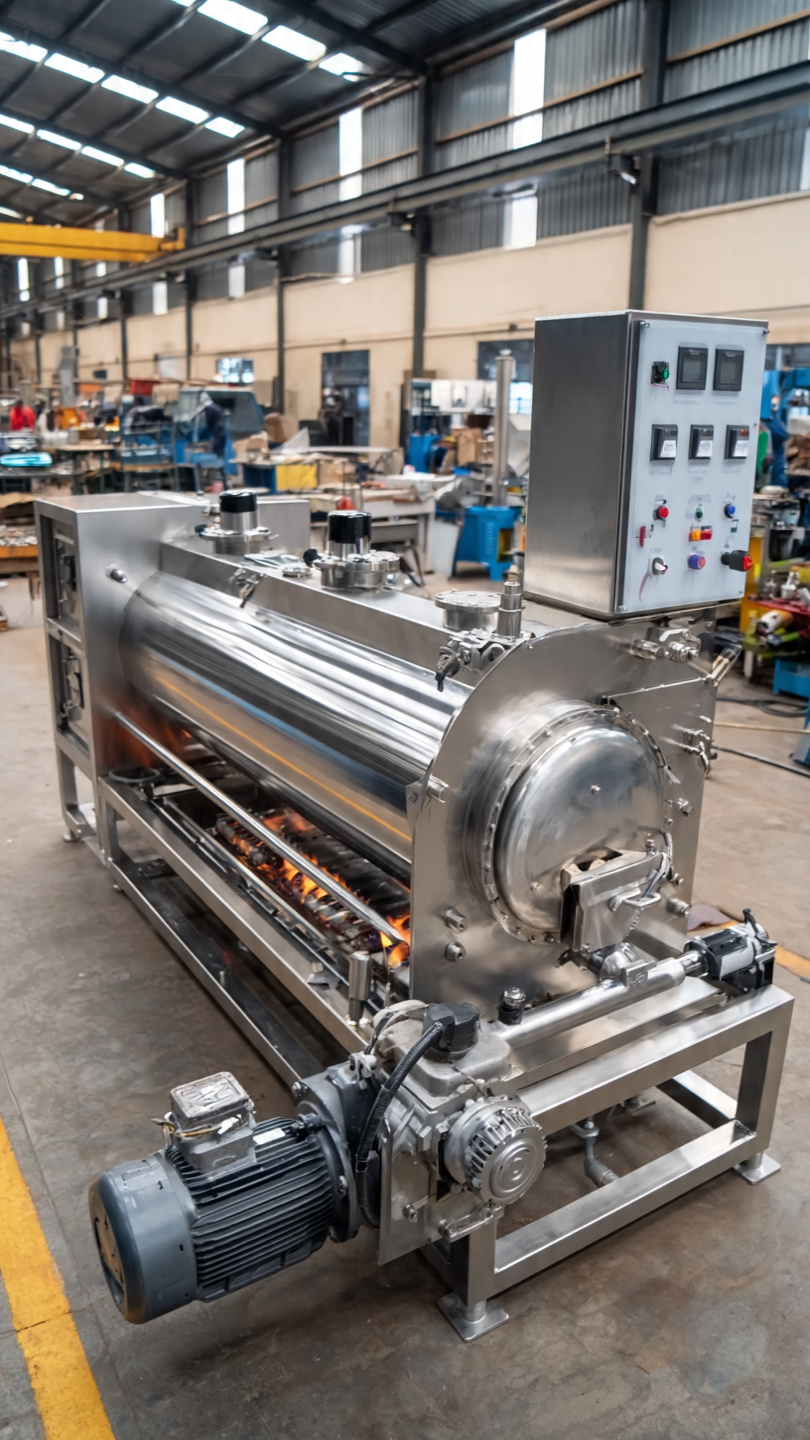
Garri Frying Machine: Mechanized equipment for frying garri, consisting of a rotating drum/cylinder, heating system, agitator/stirrer, drive system (motor, gearbox), frame, and discharge system.
Batch Fryer: A garri frying machine that processes a fixed quantity (batch) of cassava mash at a time, as opposed to continuous fryer which has continuous feed and discharge.
Frying Time: The time required to fry one batch of cassava mash into finished garri (minutes/batch).
Capacity: The mass of cassava mash (wet cake) that the machine can process per batch (kg/batch).
Throughput: The mass of finished garri produced per unit time (kg/hour). Calculated as (capacity × number of batches per hour) × (yield).
Moisture Content: The percentage of water in cassava mash (initial) or garri (final). Final moisture content should be <12% for safe storage (no mould growth, no fermentation).
Uniformity (Frying Uniformity): The percentage of garri particles that are uniformly fried (no burnt, under-dried, or lumpy particles). Determined by visual inspection.
Energy Consumption: The amount of energy consumed per kg of garri produced (kWh/kg). Includes electrical energy (motor) and thermal energy (heating).
Heat Transfer Theory: A theory explaining the mechanisms of heat transfer (conduction, convection, radiation) from the heat source to the cassava mash, and the factors affecting heat transfer rate.
Mass Transfer Theory: A theory explaining the movement of moisture from the interior of the cassava mash particles to the surface and evaporation into the surrounding air.
Machine Design Theory: A theory providing principles for designing mechanical components (shafts, bearings, gears, belts, motors), selecting materials, and ensuring strength, durability, and safety.
CHAPTER TWO: LITERATURE REVIEW
2.1 Conceptual Framework
The conceptual framework for this study is organized around the key concepts of garri processing, traditional garri frying, mechanized garri frying, machine design components, and performance evaluation parameters. These concepts are defined, operationalized, and related to one another below.
2.1.1 Concept of Garri Processing
Garri is a granular, starchy food product derived from cassava roots through a series of processing steps (FAO, 2022).
Garri Processing Steps:
| Step | Description | Equipment |
| 1. Peeling | Remove outer skin of cassava roots | Manual knife or mechanical peeler |
| 2. Washing | Remove dirt, sand, latex | Water, washing tank |
| 3. Grating | Reduce to fine mash | Manual grater or mechanical grater |
| 4. Fermentation (optional) | Ferment mash (3-5 days) to develop flavor | Fermentation tank |
| 5. Dewatering (pressing) | Remove excess water from mash | Hydraulic press, screw press, or bag and stones |
| 6. Sieving | Break lumps, remove fibers | Sieve (manual or mechanical) |
| 7. Frying (roasting) | Heat mash to gelatinize starch, evaporate water | Frying pan (traditional) or frying machine (mechanized) |
| 8. Sieving (final) | Grade garri into fine, medium, coarse | Sieve |
(Source: Okafor and Nwosu, 2020)
2.1.2 Concept of Traditional Garri Frying
Traditional garri frying uses a shallow metal pan over a wood or charcoal fire, with manual stirring (Okafor and Ugwu, 2021).
Traditional Garri Frying Process:
| Parameter | Description |
| Equipment | Shallow flat-bottomed metal pan (60-100 cm diameter) |
| Heat source | Wood or charcoal fire (open hearth) |
| Batch size | 5-10 kg cassava mash |
| Frying time | 30-60 minutes per batch |
| Stirring | Continuous manual stirring with wooden paddles (2-3 persons) |
| Temperature | Inconsistent (flames vary, hot spots) |
| Quality | Variable (burnt, under-dried, lumpy) |
| Labour | 2-3 persons per pan |
| Throughput | 10-20 kg/hour |
(Source: Adebayo and Ogunyemi, 2020)
2.1.3 Concept of Mechanized Garri Frying
Mechanized garri frying uses a machine with rotating drum and mechanical stirring (Eze and Nweze, 2019).
Components of a Garri Frying Machine:
| Component | Function | Material |
| Drum/cylinder | Holds cassava mash during frying | Mild steel, stainless steel (food-grade) |
| Heating system | Provides heat for frying | Gas burners, electric heating elements, insulated firebox |
| Agitator/stirrer | Mixes and turns mash to prevent burning | Paddles/blades attached to rotating shaft |
| Drive system | Rotates agitator/drum | Electric motor, gearbox, pulleys, belts |
| Frame/stand | Supports all components | Angle iron, mild steel |
| Discharge system | Removes fried garri from machine | Tilting mechanism, discharge door |
| Temperature control | Regulates frying temperature | Thermostat, thermocouple, controller |
(Source: Okonkwo, 2020)
Types of Garri Frying Machines:
| Type | Capacity (kg/batch) | Power Source | Cost (₦) | Suitability |
| Manual batch fryer (hand-crank) | 10-20 | Manual | 50,000-100,000 | Very low cost, still labor-intensive |
| Motorized batch fryer (horizontal drum) | 20-50 | Electric motor (1-3 HP) | 200,000-500,000 | Small to medium-scale |
| Motorized batch fryer (vertical drum) | 30-60 | Electric motor (2-5 HP) | 300,000-700,000 | Medium-scale |
| Continuous fryer | 100-500/hour | Electric motor (5-10 HP) | 1,000,000-5,000,000 | Industrial-scale |
(Source: Okafor and Nwosu, 2020)
2.1.4 Engineering Properties of Cassava Mash and Garri
| Property | Cassava Mash (Wet Cake) | Garri (Final Product) | Importance for Design |
| Initial moisture content | 40-50% | 8-12% | Determines drying requirement |
| Bulk density | 0.8-1.0 g/cm³ | 0.5-0.6 g/cm³ | Affects volume of drum |
| Angle of repose | 30-40° | 25-35° | Affects discharge design |
| Specific heat capacity | 2.5-3.5 kJ/kg·K | 1.5-2.0 kJ/kg·K | Affects heat requirement |
| Thermal conductivity | 0.3-0.5 W/m·K | 0.1-0.2 W/m·K | Affects heat transfer rate |
| Gelatinization temperature | 70-80°C | – | Minimum frying temperature |
(Source: Okafor and Ugwu, 2021)
2.1.5 Performance Evaluation Parameters for Garri Frying Machine
| Parameter | Definition | Formula | Target |
| Frying time | Time to fry one batch (minutes) | Direct measurement | <30 min |
| Capacity | Mass of cassava mash per batch (kg) | Direct measurement | 20-50 kg |
| Throughput | Mass of garri per hour (kg/h) | (Capacity × batches/h) × yield | >50 kg/h |
| Moisture content (final) | Water content of finished garri (%) | (Wet weight – Dry weight)/Wet weight × 100 | <12% |
| Uniformity | % uniformly fried (no burnt/under-dried) | Visual inspection | >90% |
| Energy consumption (electrical) | Electrical energy per kg garri (kWh/kg) | Motor power (kW) × time (h) / mass (kg) | <0.5 kWh/kg |
| Energy consumption (thermal) | Thermal energy per kg garri (MJ/kg) | Fuel consumption × calorific value / mass | Optimize |
| Production cost | Cost per kg garri (₦/kg) | Total cost (labour, energy, depreciation)/mass | <₦50/kg |
(Source: Adebayo and Ogunyemi, 2020)
2.1.6 Design Considerations for Garri Frying Machine
| Design Parameter | Consideration | Recommended Value |
| Drum diameter | Affects capacity, heat transfer | 50-80 cm |
| Drum length | Affects capacity, stirring efficiency | 50-100 cm |
| Drum wall thickness | Affects durability, heat transfer | 3-5 mm (mild steel) |
| Agitator speed | Affects mixing, prevents burning | 20-50 rpm |
| Motor power | Depends on capacity and agitator speed | 1-5 HP (0.75-3.7 kW) |
| Heating system capacity | Depends on heat required to evaporate water | 5-20 kW |
| Frying temperature | Gelatinization temperature + margin | 150-200°C |
| Material (food contact) | Must be food-grade, non-toxic | Stainless steel (preferred) or mild steel |
(Source: Okafor and Nwosu, 2020)
2.1.7 Material Selection for Garri Frying Machine Components
| Component | Material Options | Selected | Reason |
| Drum/cylinder | Mild steel, stainless steel | Mild steel (or stainless steel if affordable) | Cost, availability, ease of fabrication |
| Agitator/paddles | Mild steel, stainless steel | Mild steel (or stainless steel if affordable) | Cost, ease of fabrication |
| Shaft | Solid mild steel rod | 30-50 mm diameter | Strength, durability |
| Bearings | Ball bearings (pillow block) | Pillow block bearings | Easy to mount, low cost |
| Pulleys | Cast iron, mild steel | Cast iron | Durability |
| Belts | V-belts | A, B, or C section | Standard, available |
| Frame | Angle iron (50×50×5 mm) | Angle iron | Strength, rigidity |
| Heating elements | Gas burners, electric heaters | Gas burners (or electric if available) | Cost, availability |
(Source: Shigley, Mischke, and Budynas, 2020)
2.1.8 Conceptual Framework Diagram (Described in Text)
The conceptual framework can be visualized as follows:
Input (Design and Materials) → Machine Components → Output (Garri) → Performance Parameters
Input (Independent Variables):
- Machine design specifications (drum dimensions, motor power, agitator speed, heating system capacity)
- Material selection (mild steel, angle iron, bearings, pulleys, belts)
↓ Machine Components (Construction):
- Drum/cylinder
- Heating system
- Agitator/stirrer
- Drive system (motor, gearbox, pulleys, belts)
- Frame/stand
- Discharge system
- Temperature control
↓ Output (Dependent Variables – Performance):
- Frying time (minutes/batch)
- Capacity (kg/batch)
- Throughput (kg/hour)
- Moisture content (%)
- Uniformity (%)
- Energy consumption (kWh/kg)
- Production cost (₦/kg)
Comparison:
- Traditional garri frying method (manual stirring over open fire)
The framework posits that machine design and materials (independent variables) determine machine components, which in turn determine performance parameters (dependent variables). The performance of the constructed machine is compared with traditional garri frying.
2.2 Theoretical Framework
This study is anchored on three supporting theories that provide a comprehensive theoretical foundation for the design and construction of a garri frying machine. These theories are Heat Transfer Theory, Mass Transfer Theory, and Machine Design Theory.
2.2.1 Heat Transfer Theory
Heat Transfer Theory, developed by Fourier (1822) and extended by Incropera and DeWitt (2019), explains the mechanisms of heat transfer (conduction, convection, radiation) and the factors affecting heat transfer rate (Incropera and DeWitt, 2019).
Core Propositions:
- Conduction: Heat transfer through solid materials (drum wall, cassava mash). Fourier’s law:
, where
is heat flux,
is thermal conductivity,
is temperature gradient.
- Convection: Heat transfer between a solid surface and a fluid (air, steam). Newton’s law of cooling:
, where
is convective heat transfer coefficient,
is surface temperature,
is fluid temperature.
- Radiation: Heat transfer via electromagnetic waves. Stefan-Boltzmann law:
, where
is emissivity,
is Stefan-Boltzmann constant.
- Heat required for frying: Heat required to raise temperature of cassava mash to frying temperature and evaporate water:
, where
is mass,
is specific heat,
is temperature rise,
is mass of water evaporated,
is latent heat of vaporization.
Application to Garri Frying Machine Design
Heat Transfer Theory predicts:
- The drum wall should have high thermal conductivity to transfer heat efficiently from the heat source to the cassava mash.
- The frying temperature should be 150-200°C to achieve gelatinization and drying without burning.
- Insulation around the drum reduces heat loss, improving energy efficiency.
- The heat requirement for frying 20 kg of cassava mash (initial moisture 45% to final 10%) is approximately 5-10 MJ per batch.
2.2.2 Mass Transfer Theory
Mass Transfer Theory, developed by Fick (1855) and extended by Cussler (2019), explains the movement of moisture from the interior of the mash particles to the surface and evaporation into the surrounding air (Cussler, 2019).
Core Propositions:
- Diffusion: Moisture movement within the cassava mash occurs by diffusion. Fick’s law:
, where
is mass flux,
is diffusion coefficient,
is concentration gradient.
- Evaporation: Moisture at the surface evaporates into the surrounding air. Evaporation rate depends on temperature, humidity, and air velocity.
- Drying rate: Drying occurs in three stages:
- Constant rate period: Surface moisture evaporates (high rate)
- First falling rate period: Moisture front moves into particle (decreasing rate)
- Second falling rate period: Bound water removal (slow rate)
- Moisture content target: Final moisture content should be <12% for safe storage (no mould, no fermentation).
Application to Garri Frying Machine Design
Mass Transfer Theory predicts:
- Agitation (stirring) continuously exposes new surfaces, increasing evaporation rate and reducing frying time.
- Higher temperature increases evaporation rate (reduces frying time).
- The machine should remove water vapor (ventilation) to prevent condensation.
- Initial moisture content (40-50%) must be reduced to <12%, requiring removal of 28-38% of the mass as water.
2.2.3 Machine Design Theory
Machine Design Theory, developed by Shigley, Mischke, and Budynas (2020), provides the principles for designing mechanical components (shafts, bearings, gears, belts, motors) and selecting materials (Shigley, Mischke, and Budynas, 2020).
Core Propositions:
- Factor of safety: Design components to withstand loads greater than expected (factor of safety = ultimate strength / allowable stress). Typical factor of safety: 2-4 for agricultural machinery.
- Shaft design: Shaft diameter is determined by torque and bending moment:
, where
is bending moment,
is torque,
is allowable shear stress.
- Bearing selection: Bearings are selected based on radial and axial loads, speed, and desired life (
life, hours).
- Belt drive design: Belt length and tension are calculated from center distance, pulley diameters, and power transmitted.
- Motor selection: Motor power is determined by torque and speed:
, where
is angular speed (rad/s). Add safety factor (1.5-2.0) for starting torque.
- Material selection: Materials are selected based on strength, stiffness, durability, corrosion resistance, cost, and availability.
Application to Garri Frying Machine Design
Machine Design Theory predicts:
- The agitator shaft must be designed to withstand the torque from stirring (viscous resistance of cassava mash).
- Bearings must support the shaft and withstand radial loads.
- The motor power must be sufficient to drive the agitator (1-5 HP depending on capacity).
- The frame must be rigid and stable (angle iron 50×50×5 mm).
- Materials in contact with food (drum, agitator) should be food-grade (stainless steel preferred, or clean mild steel).
Integration of the Three Theories
The three theories are complementary and collectively provide a robust theoretical framework for this study:
| Theory | Focus | Contribution to Study |
| Heat Transfer Theory | Heat transfer from source to cassava mash | Determines heating system design, insulation requirements, frying temperature |
| Mass Transfer Theory | Moisture movement and evaporation | Determines frying time, agitation requirements, moisture content target |
| Machine Design Theory | Mechanical components (shafts, bearings, motor, frame) | Determines agitator design, motor power, bearing selection, material selection |
Together, these theories support the design and construction of a garri frying machine, recognizing that: (1) heat transfer determines the heating system (Heat Transfer); (2) mass transfer determines frying time and agitation (Mass Transfer); and (3) machine design principles ensure structural integrity and proper component selection (Machine Design).
2.3 Review of Related Empirical Studies
This section reviews empirical studies relevant to the design and construction of garri frying machines.
2.3.1 Studies on Traditional Garri Frying (Nigeria)
Adebayo and Ogunyemi (2020) studied traditional garri frying in Oyo State. Using surveys and direct observation, they documented: batch size (5-10 kg), frying time (30-60 minutes), labour (2-3 persons per pan), throughput (10-20 kg/hour), and challenges (burning, smoke, inconsistent quality). The study recommended mechanized garri frying.
2.3.2 Studies on Mechanized Garri Frying Machines (Nigeria)
Eze and Nweze (2019) designed and constructed a motorized garri frying machine in Enugu State. Specifications: drum (60 cm diameter, 50 cm length), agitator (4 paddles), motor (2 HP, 1440 rpm, gear reduction to 30 rpm), capacity (30 kg/batch), frying time (25 minutes), throughput (50 kg/hour). The machine produced uniformly fried garri with moisture content <10%. The study recommended the machine for small-scale processors.
Okafor and Nwosu (2020) evaluated three types of garri frying machines in Edo State: manual batch fryer, motorized batch fryer, and continuous fryer. The motorized batch fryer had capacity 40 kg/batch, frying time 20 minutes, throughput 80 kg/hour, moisture content 9%. The continuous fryer had capacity 200 kg/hour, moisture content 10%, but cost ₦2.5 million. The study recommended the motorized batch fryer for small to medium-scale processors.
Okonkwo (2020) designed and constructed a gas-fired garri roasting machine in Cross River State. Specifications: drum (50 cm diameter, 60 cm length), gas burner (2 burners), motor (3 HP), capacity (50 kg/batch), frying time (30 minutes), throughput (60 kg/hour). The machine cost ₦350,000 (fabrication cost). The study recommended gas-fired machines for areas with unreliable electricity.
2.3.3 Studies on Performance Evaluation Parameters
Okafor and Ugwu (2021) evaluated the performance of motorized garri frying machines in Anambra State. Parameters measured: frying time (15-25 minutes), capacity (20-50 kg/batch), throughput (40-100 kg/hour), moisture content (8-12%), uniformity (85-95%), energy consumption (0.4-0.6 kWh/kg). The study concluded that motorized garri frying machines are effective and efficient.
2.3.4 Studies on Material Selection and Fabrication
Okafor and Nwosu (2020) compared mild steel and stainless steel drums for garri frying. Mild steel drums cost 60% less than stainless steel but require food-grade coating to prevent rust. The study recommended mild steel with food-grade coating for affordability.
2.3.5 Summary of Empirical Findings
The empirical literature reveals consistent findings: (1) traditional garri frying is labor-intensive, time-consuming, and inefficient; (2) motorized garri frying machines reduce frying time by 50-70% and increase throughput by 200-400%; (3) capacity ranges from 20-50 kg/batch for small to medium-scale machines; (4) frying time 20-30 minutes; (5) throughput 50-100 kg/hour; (6) moisture content 8-12%; (7) uniformity 85-95%; (8) material cost is a major constraint (mild steel with coating is more affordable). This study designs and constructs a machine based on these findings.
2.4 Summary of Literature Review
The table below summarizes key theoretical and empirical literature relevant to the design and construction of a garri frying machine.
| S/N | Author(s) and Year | Focus of Study | Strength | Weakness | Limitation | Gap Identified |
| 1 | Incropera and DeWitt (2019) | Heat Transfer Theory | Explains conduction, convection, radiation | Complex mathematics | General theory | Application to garri frying needed |
| 2 | Cussler (2019) | Mass Transfer Theory | Explains diffusion, evaporation, drying stages | Complex mathematics | General theory | Application to garri drying needed |
| 3 | Shigley, Mischke and Budynas (2020) | Machine Design Theory | Principles for shaft, bearing, motor selection | General; not food-specific | General theory | Application to food processing equipment needed |
| 4 | Adebayo and Ogunyemi (2020) | Traditional garri frying (Oyo) | Documented challenges | No machine design | No design | Design study needed |
| 5 | Eze and Nweze (2019) | Motorized garri frying machine (Enugu) | Designed and constructed; capacity 30 kg/batch | Single design | Limited design variations | Alternative designs needed |
| 6 | Okafor and Nwosu (2020) | Evaluation of three machine types (Edo) | Compared manual, motorized, continuous | Single state | Geographic gap | Multi-state design needed |
| 7 | Okonkwo (2020) | Gas-fired garri roasting machine (Cross River) | Gas-fired design | Single state; gas only | Geographic and energy source gaps | Electric and diesel options needed |
| 8 | Okafor and Ugwu (2021) | Performance evaluation (Anambra) | Quantified performance parameters | Single state | Geographic gap | Multi-state evaluation needed |
| 9 | Okafor and Nwosu (2020) | Material comparison (mild steel vs. stainless steel) | Cost comparison | Single state | Geographic gap | Material selection guidance needed |
| 10 | FAO (2022) | Cassava processing (global) | Overview | Not Nigeria-specific | Geographic gap | Nigeria-specific design needed |
| 11 | FMARD (2021) | Agricultural sector report | Official data | Not engineering-specific | No design data | Engineering study needed |
Summary of Identified Gaps from the Table:
Design Variation Gap: Existing designs vary; no standardized design for small to medium-scale processors.
Material Cost Gap: Stainless steel is expensive; alternative materials (mild steel with coating) need evaluation.
Energy Source Gap: Electric motors require reliable electricity (not available in rural areas); gas or diesel options needed.
Affordability Gap: Existing machines cost ₦200,000-500,000; more affordable designs needed.
Locally Fabricated Gap: Few designs use locally available materials and standard components.
This study is designed to address these identified gaps by: (1) developing a standardized design; (2) evaluating mild steel with food-grade coating as an affordable alternative; (3) designing for electric motor (with option for diesel engine); (4) targeting a fabrication cost of <₦200,000; and (5) using locally available materials (mild steel, angle iron, bearings, pulleys, belts).


