🔤 Total Characters in Document: 246,900
📄 Estimated Document Pages: 102
⏱️ Reading Time: 4 Hours 15 Mins
CHAPTER ONE: INTRODUCTION
1.1 Background of Study
Plantain (Musa paradisiaca) is a staple food crop of significant economic and nutritional importance in Nigeria, particularly in the southern and central regions where it is widely cultivated and consumed (FAO, 2022). Plantain is a member of the Musaceae family (banana and plantain) and is a perennial herbaceous plant that produces starchy fruits that are typically cooked before consumption (Robinson, 2019). Nigeria is one of the largest producers of plantain in the world, with an estimated annual production of over 3 million metric tons, second only to Cameroon and Ghana in Africa (FAO, 2022). The major plantain-producing states in Nigeria include Akwa Ibom, Cross River, Delta, Edo, Ondo, Ogun, Osun, Ekiti, Rivers, Imo, Abia, Enugu, Anambra, Ebonyi, Benue, Kogi, and Taraba (NBS, 2022).
The importance of plantain in Nigeria cannot be overstated (Federal Ministry of Agriculture and Rural Development, 2021). Plantain contributes to: food security (staple food for millions of Nigerians, particularly in the South-East, South-South, and South-West); nutrition (rich in carbohydrates, potassium, magnesium, vitamins A, B6, and C, and dietary fibre); income generation (sale of fresh plantain, dried plantain chips, plantain flour, plantain fufu); employment (production, processing, marketing); and export potential (dried plantain chips, plantain flour) (Okafor and Nwosu, 2020). A small plot of plantain (0.1-0.5 hectares) can generate substantial income for a smallholder family, with plantain bunches sold weekly or monthly providing a steady cash flow (Eze and Nweze, 2019).
The production of plantain involves several agronomic practices that significantly affect yield and quality (Robinson, 2019). Land preparation: Clearing, ploughing, harrowing (manual or mechanized). Planting: Suckers (vegetative propagules) planted at spacing of 2m × 2m or 3m × 3m (1,111-2,500 plants/ha). Fertilizer application: Organic manure (poultry, cow dung) or inorganic fertilizer (NPK 15-15-15). Weeding: Manual (hoe) or chemical (herbicides). Pest and disease control: Nematodes, banana weevils, black Sigatoka leaf spot, Panama disease. Harvesting: 9-18 months after planting, depending on variety and management. Marketing: Fresh bunches sold to local markets, wholesalers, or processors.
Despite the potential for high productivity and profitability, plantain production in Nigeria faces numerous challenges (Adebayo and Ogunyemi, 2020). Low adoption of improved practices: Many farmers use traditional methods (no fertilizer, no pest control, poor spacing) resulting in low yields (5-10 tons/ha vs. potential 20-30 tons/ha). Poor suckers: Use of low-quality suckers (diseased, small, from old fields) leads to poor establishment and low yields. Pest and disease pressure: Nematodes, banana weevils, and black Sigatoka can reduce yields by 30-70%. Soil fertility decline: Continuous cultivation without adequate fertilizer leads to declining yields. Post-harvest losses: Plantain ripens quickly after harvest; losses can be 20-40% without proper handling and storage.
Lack of extension education: Many plantain farmers have never received training from agricultural extension workers on improved plantain production practices (Okafor and Ugwu, 2021). The farmer-to-extension agent ratio in Nigeria is estimated at >3,000:1, far above the recommended 400:1 (FMARD, 2021). Most extension contacts are with crop farmers (cassava, maize, yam, rice) rather than plantain farmers.
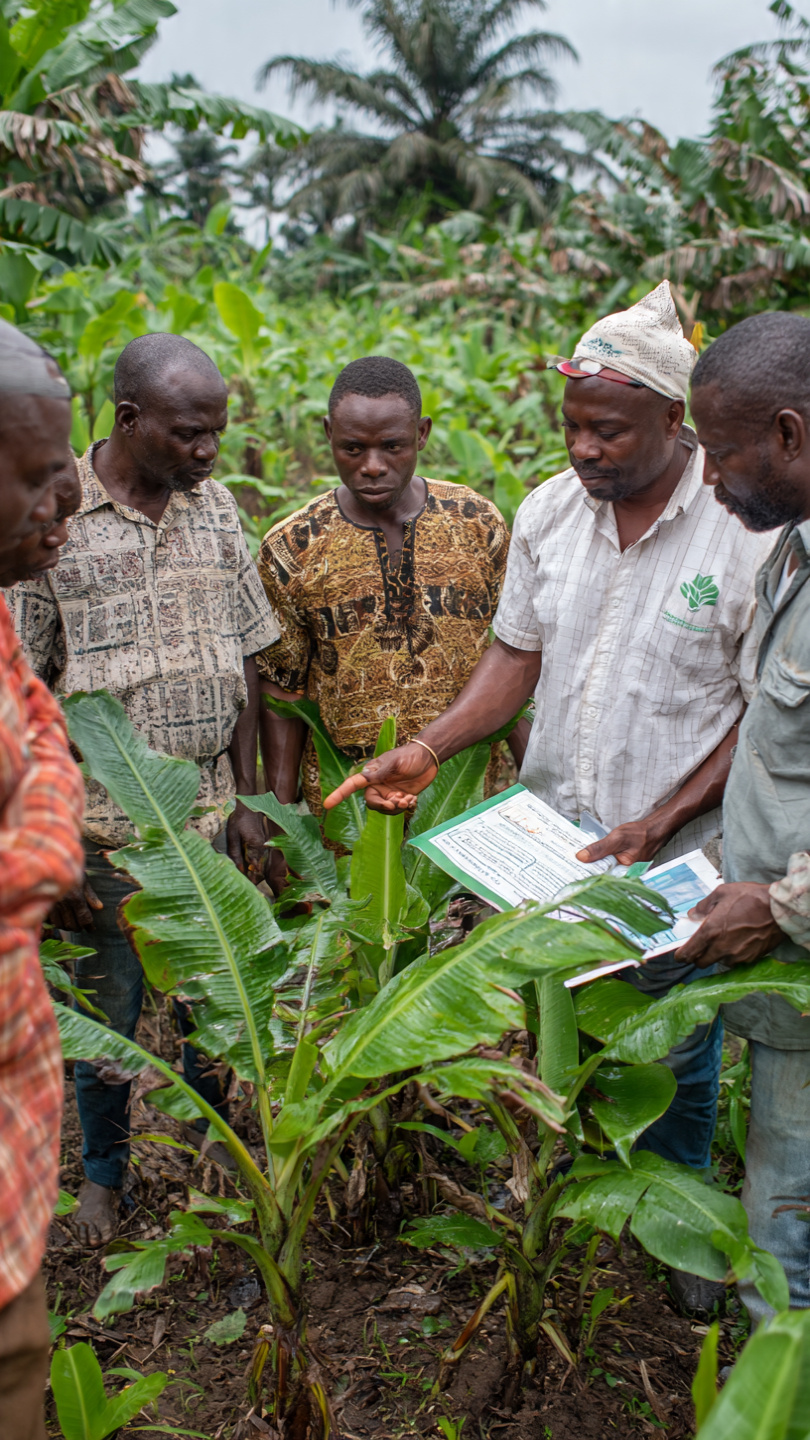
The agricultural extension worker (extension agent) is a professional who serves as a bridge between research institutions and farmers, disseminating improved agricultural technologies, providing training and advisory services, and facilitating farmer learning and adoption (Akinbile and Ogunlade, 2020). Extension workers are employed by Agricultural Development Programmes (ADPs), state ministries of agriculture, research institutes, universities, NGOs, and private companies. The roles of extension workers in plantain production include: training farmers on improved production practices (spacing, fertilization, pest/disease control, harvesting, post-harvest handling); demonstration (demonstration plots, field days); farm visits (individual farmer advisory visits); group meetings (farmer cooperatives, discussion groups); technology transfer (dissemination of research findings); and feedback to researchers (farmers’ problems and needs).
The extension education process involves several key elements (Akinbile and Ogunlade, 2020): Needs assessment: Identify farmers’ knowledge gaps and training needs. Programme planning: Design extension programmes and materials. Implementation: Deliver training (lectures, demonstrations, field days, farm visits). Evaluation: Assess learning outcomes, adoption rates, and impact on productivity. Feedback: Report findings to researchers and policymakers.
The effectiveness of agricultural extension workers in educating farmers is influenced by several factors (Eze and Nweze, 2019): Extension agent characteristics: Age, education, experience, training, motivation, communication skills, technical knowledge. Farmer characteristics: Age, education, farm size, experience, membership in cooperatives, access to credit. Institutional factors: Ratio of extension agents to farmers, availability of transport (motorcycles, vehicles), availability of training materials, supervision, salary and incentives, budget. Environmental factors: Road infrastructure, communication networks, security.
Extension methods used in plantain production education:
| Method | Description | Advantages | Limitations |
| Farm visits | Agent visits individual farmer’s farm | Personalized, practical | Time-consuming, limited reach |
| Group meetings | Farmers gather at central location (village square, cooperative hall) | Economical (reach many farmers at once), peer learning | Less personalized |
| Demonstration plots | Agent establishes plot showing improved practices (e.g., proper spacing, fertilization) | Visual learning, farmers see results before adopting | Requires land, materials, time |
| Field days | Organized event where farmers visit demonstration plot, see results, discuss | High impact, social learning, many farmers reached | Requires planning, resources |
| Training workshops | Structured training sessions (classroom or field) | Systematic coverage of topics | Requires venue, materials, per diems |
| Mass media | Radio, television, mobile phones, WhatsApp | Wide reach, low cost per farmer | No interaction, limited feedback |
| Farmer-to-farmer extension | Trained farmers (contact farmers) train other farmers | Low cost, sustainable, culturally appropriate | Quality varies, limited monitoring |
Plantain production practices that extension workers educate farmers on (Robinson, 2019):
| Practice | Description | Impact on Yield |
| Land preparation | Clearing, ploughing, harrowing | Higher establishment rate |
| Sucker selection | Use of healthy, disease-free, medium-sized suckers from high-yielding fields | Higher survival, faster growth |
| Sucker treatment | Hot water treatment (55°C for 10 minutes) to kill nematodes and weevil eggs | Reduced pest damage, higher yield |
| Spacing | 3m × 3m (1,111 plants/ha) or 2.5m × 2.5m (1,600 plants/ha) | Optimal plant population, higher yield |
| Fertilizer application | NPK 15-15-15 (200-400 g/plant) + organic manure | Higher bunch weight, faster growth |
| Mulching | Apply organic mulch (dry grass, leaves) around plants | Moisture conservation, weed suppression |
| Desuckering | Remove excess suckers, leaving 2-3 per plant (mother + 1-2 daughters) | Focuses energy on fruit production |
| Pest control | Nematode control (nematicides), weevil control (pheromone traps, insecticides) | Reduced damage, higher yield |
| Disease control | Black Sigatoka (fungicide spray, resistant varieties), Panama disease (avoid infected fields) | Reduced leaf loss, higher yield |
| Propping | Support bunches with wooden props to prevent snapping | Reduced post-harvest losses |
| Harvesting | Cut bunch when fruit angle changes from angular to rounded | Optimal maturity, better quality |
| Post-harvest handling | Clean, sort, store in cool, ventilated area; use plantain shade | Reduced losses, higher prices |
From a theoretical perspective, this study is supported by three theories: Diffusion of Innovations Theory (Rogers, 2003), which explains how new agricultural technologies (improved plantain production practices) spread through social systems (farm communities) and the role of change agents (extension workers) in facilitating adoption; Andragogy (Adult Learning Theory) (Knowles, 1984), which provides principles for effectively educating adult farmers (self-directed, experiential, relevant, problem-centred); and Technology Transfer Theory, which describes the process of moving research findings from scientists to farmers through extension agents, demonstration, and training.
In summary, agricultural extension workers play a critical role in educating farmers on improved plantain production practices, but there is limited empirical data on the effectiveness of extension workers in plantain production education. Information is needed on: extension methods used, topics covered, farmer adoption rates, constraints to extension delivery, and impact of extension on plantain productivity and income. This study aims to assess the role of agricultural extension workers in educating farmers in plantain production in selected local government areas.
1.2 Statement of Problems
Despite the economic and nutritional importance of plantain in Nigeria, productivity remains low (5-10 tons/ha) relative to potential (20-30 tons/ha). Low adoption of improved production practices (proper spacing, fertilizer application, pest/disease control, sucker selection) is a major cause of low productivity. Agricultural extension workers are responsible for educating farmers on improved practices, but the farmer-to-extension agent ratio is very high (>3,000:1), limiting the reach and effectiveness of extension services. Many plantain farmers report never receiving any extension visit or training. Even where extension services exist, the quality of extension education may be poor (inadequate training materials, lack of demonstration plots, limited follow-up). There is limited empirical data on the specific role of extension workers in plantain production: what topics they cover, what methods they use, how many farmers they reach, what adoption rates are, and what constraints they face. The problem this study addresses is the need to assess the role of agricultural extension workers in educating farmers in plantain production, identifying the extension methods used, topics covered, farmer adoption rates, constraints to extension delivery, and recommendations for improving extension effectiveness.
1.3 Aim of the Study
The specific aim of this research work is to assess the role of agricultural extension workers in educating farmers in plantain production in selected local government areas, with a view to identifying the extension methods used, topics covered, farmer adoption rates of improved practices, constraints to extension delivery, and recommendations for improving extension effectiveness.
1.4 Objectives of the Study
- To identify the socioeconomic characteristics (age, gender, education, farming experience, farm size, cooperative membership) of plantain farmers in the study area.
- To identify the extension methods (farm visits, group meetings, demonstrations, field days, training workshops, mass media) used by extension workers to educate plantain farmers.
- To identify the plantain production practices (land preparation, sucker selection, spacing, fertilization, pest/disease control, harvesting) that extension workers educate farmers on.
- To assess the level of adoption of improved plantain production practices by farmers who have received extension education compared to those who have not.
- To identify the constraints facing extension workers in delivering plantain production education (ratio of farmers to agents, transport, materials, funding, supervision, farmer attitudes).
- What are the socioeconomic characteristics (age, gender, education, farming experience, farm size, cooperative membership) of plantain farmers in the study area?
- What extension methods (farm visits, group meetings, demonstrations, field days, training workshops, mass media) do extension workers use to educate plantain farmers?
- What plantain production practices (land preparation, sucker selection, spacing, fertilization, pest/disease control, harvesting) do extension workers educate farmers on?
- What is the level of adoption of improved plantain production practices by farmers who have received extension education compared to those who have not?
- What are the constraints facing extension workers in delivering plantain production education (ratio of farmers to agents, transport, materials, funding, supervision, farmer attitudes)?
Hypothesis One
- H₀ (Null): There is no significant difference in adoption of improved plantain production practices between farmers who have received extension education and farmers who have not.
- H₁ (Alternative): There is a significant difference in adoption of improved plantain production practices between farmers who have received extension education and farmers who have not.
- H₀ (Null): There is no significant relationship between extension methods used (farm visits, demonstrations, field days, etc.) and farmer adoption of improved plantain production practices.
- H₁ (Alternative): There is a significant relationship between extension methods used and farmer adoption of improved practices.
- H₀ (Null): There is no significant relationship between farmer socioeconomic characteristics (age, education, farm size, cooperative membership) and adoption of improved plantain production practices.
- H₁ (Alternative): There is a significant relationship between farmer socioeconomic characteristics and adoption of improved practices.
- H₀ (Null): There are no significant constraints (ratio of farmers to agents, transport, materials, funding, supervision, farmer attitudes) facing extension workers in delivering plantain production education.
- H₁ (Alternative): There are significant constraints facing extension workers in delivering plantain production education.
- H₀ (Null): There is no significant difference in plantain yield and income between farmers who have received extension education and farmers who have not.
- H₁ (Alternative): There is a significant difference in plantain yield and income between farmers who have received extension education and farmers who have not.
1.7 Justification of the Study
This study is justified on several grounds. First, plantain is an important staple and cash crop in Nigeria, but productivity is low. Improving productivity requires adoption of improved practices, which depends on effective extension education. Second, there is limited empirical data on the specific role of extension workers in plantain production: what they do, what methods they use, what topics they cover, and how effective they are. Third, understanding adoption rates of improved practices (with vs. without extension) is essential for evaluating extension effectiveness. Fourth, identifying constraints to extension delivery (transport, materials, funding, ratio) will inform policy on extension funding and staffing. Fifth, the findings will inform extension policy (Agricultural Development Programmes, State Ministries of Agriculture) and farmer training programmes.
1.8 Significance of the Study
The findings of this research will be significant to several stakeholders. To plantain farmers, the study will provide information on which extension methods and practices are most effective, enabling farmers to demand better extension services. To agricultural extension workers, the findings will identify gaps in their training and resources, enabling advocacy for improved support. To Agricultural Development Programmes (ADPs) and State Ministries of Agriculture, the study will provide evidence on extension effectiveness, adoption rates, and constraints, informing extension policy, training priorities, and resource allocation. To research institutes (National Horticultural Research Institute, National Root Crops Research Institute) , the findings will identify gaps in extension coverage and farmer knowledge, informing research-extension linkage. To development partners (World Bank, FAO, IFAD) , the findings will inform project design for extension capacity building. To academic researchers, the study will contribute empirical data on agricultural extension and adoption, testing and extending diffusion of innovations theory, andragogy, and technology transfer theory.
1.9 Scope of the Study
The scope of this study is delimited to the role of agricultural extension workers in educating farmers in plantain production in selected local government areas. The study focuses on plantain farmers (not other crops) who cultivate plantain as a sole crop or intercropped with other crops. The study examines extension methods used (farm visits, group meetings, demonstrations, field days, training workshops, mass media). The study examines plantain production practices: land preparation, sucker selection, sucker treatment, spacing, fertilizer application, mulching, desuckering, pest control (nematodes, weevils), disease control (black Sigatoka, Panama), propping, harvesting, and post-harvest handling. The study measures adoption (percentage of farmers using each practice). The study examines extension constraints: ratio of extension agents to farmers, transport availability, extension materials, funding, supervision, farmer attitudes. The study includes primary data collection (farmer surveys, extension worker surveys, key informant interviews). The study covers selected LGAs (specific state(s) to be specified). The study does not extend to other crops (cassava, maize, yam, cocoyam, vegetables), to livestock extension, to fisheries extension, or to processing and marketing of plantain beyond farm-level practices.
1.10 Definition of Terms
Agricultural Extension Worker (Extension Agent): A professional employed by Agricultural Development Programme (ADP), state ministry of agriculture, research institute, university, NGO, or private company, responsible for disseminating improved agricultural technologies, providing training and advisory services to farmers, and facilitating farmer learning and adoption.
Extension Education: The process of teaching farmers new agricultural knowledge, skills, and practices through training, demonstrations, farm visits, group meetings, field days, and mass media, with the goal of improving productivity, profitability, and sustainability.
Plantain (Musa paradisiaca): A perennial herbaceous plant of the Musaceae family, producing starchy fruits that are cooked before consumption. Plantain is a staple food crop in southern and central Nigeria, rich in carbohydrates, potassium, magnesium, and vitamins.
Sucker: The vegetative propagule (planting material) of plantain, which grows from the base of the mother plant. Healthy, disease-free suckers of medium size (1-2 kg) produce the best yields.
Sucker Treatment: The practice of treating suckers with hot water (55°C for 10 minutes) or dipping in a nematicide/insecticide solution to kill nematodes and banana weevil eggs before planting.
Spacing (Plantain): The distance between plantain plants. Recommended spacing is 3m × 3m (1,111 plants/ha) for optimal growth and yield. Closer spacing increases competition for light, water, and nutrients.
Desuckering: The practice of removing excess suckers from a plantain mat, leaving only 2-3 suckers (mother plant + 1-2 daughter suckers) to concentrate energy on fruit production rather than vegetative growth.
Propping: The practice of supporting heavy plantain bunches with wooden props (bamboo, hardwood) to prevent the plant from snapping (breaking) under the weight of the bunch, which causes loss of the entire bunch.
Black Sigatoka: A fungal disease (Mycosphaerella fijiensis) of plantain and banana, causing leaf spots, leaf death, reduced photosynthesis, and reduced bunch weight. Controlled by fungicide sprays and resistant varieties.
Banana Weevil (Corn Weevil): A pest (Cosmopolites sordidus) of plantain and banana; larvae bore into the corm (underground stem), damaging the plant and reducing yield. Controlled by clean suckers, traps, and insecticides.
Nematodes: Microscopic roundworms (e.g., Radopholus similis, Pratylenchus goodeyi) that infect plantain roots and corms, causing root rot, poor anchorage, and reduced yield. Controlled by clean suckers, hot water treatment, nematicides.
Panama Disease (Fusarium Wilt): A fungal disease (Fusarium oxysporum f. sp. cubense) of plantain and banana, causing yellowing, wilting, and death of plants. Controlled by resistant varieties (e.g., FHIA hybrids) and avoiding infected fields.
Adoption (Agricultural Technology): The decision by a farmer to use an improved agricultural practice (e.g., fertilizer, proper spacing, pest control) on a regular basis, following exposure to the practice through extension, mass media, or other farmers.
Diffusion of Innovations Theory: A theory explaining how new ideas and technologies spread through social systems over time; adoption follows an S-curve (innovators → early adopters → early majority → late majority → laggards). Extension workers are “change agents” who facilitate diffusion.
Andragogy (Adult Learning Theory): A theory of adult learning emphasizing that adults are self-directed, have accumulated life experiences as learning resources, are motivated by relevance and practicality, prefer problem-centred learning, and need to know why they are learning something.
Technology Transfer: The process of moving agricultural research findings from scientists (research institutes, universities) to farmers through extension workers, using methods such as demonstration, training, publications, and mass media.
CHAPTER TWO: LITERATURE REVIEW
2.1 Conceptual Framework
The conceptual framework for this study is organized around the key concepts of agricultural extension workers, extension education, plantain production practices, adoption of improved practices, and the factors affecting extension effectiveness. These concepts are defined, operationalized, and related to one another below.
2.1.1 Concept of Agricultural Extension Worker
An agricultural extension worker (extension agent) is a professional employed by an Agricultural Development Programme (ADP), state ministry of agriculture, research institute, university, NGO, or private company, responsible for disseminating improved agricultural technologies, providing training and advisory services to farmers, and facilitating farmer learning and adoption (Akinbile and Ogunlade, 2020). Extension workers serve as the bridge between research institutions (where new technologies are developed) and farmers (who need to adopt those technologies to improve productivity) (Van den Ban and Hawkins, 2019).
Roles of Agricultural Extension Workers:
| Role | Description |
| Technology transfer | Disseminate improved agricultural practices from researchers to farmers |
| Training | Conduct training workshops, demonstrations, and field days |
| Farm visits | Visit individual farmers on their farms to provide personalized advice |
| Group facilitation | Organize and facilitate farmer groups, cooperatives, and discussion groups |
| Problem diagnosis | Identify farmers’ problems (pests, diseases, soil fertility, etc.) and recommend solutions |
| Feedback to research | Report farmers’ problems and needs to researchers for further research |
| Input supply linkage | Link farmers to suppliers of improved seeds, fertilizers, pesticides |
| Credit linkage | Link farmers to financial institutions (banks, microfinance banks) |
| Market linkage | Link farmers to markets (processors, wholesalers, retailers) |
| Monitoring and evaluation | Track adoption rates and impact of extension programmes |
Extension Agent Characteristics Affecting Effectiveness:
| Characteristic | Expected Effect |
| Age | Mature agents may have more experience but may be less open to new methods |
| Education | Higher education (B.Sc., M.Sc.) improves technical knowledge |
| Experience (years) | More experience improves problem-solving and communication |
| Training (in-service) | Regular training updates knowledge on new technologies |
| Motivation | Motivated agents work harder and have better farmer relationships |
| Communication skills | Better communication leads to better farmer understanding |
| Technical knowledge | More knowledge leads to better advice and farmer confidence |
| Transport availability | Motorcycle/vehicle enables more farm visits |
| Supervision | Regular supervision improves performance |
2.1.2 Concept of Extension Education
Extension education is the process of teaching farmers new agricultural knowledge, skills, and practices through training, demonstrations, farm visits, group meetings, field days, and mass media, with the goal of improving productivity, profitability, and sustainability (Akinbile and Ogunlade, 2020). Extension education is based on the principles of adult learning (andragogy) (Knowles, 1984).
Extension Methods Used in Plantain Production Education:
| Method | Description | Advantages | Limitations |
| Farm visit | Agent visits farmer’s plantain farm, observes practices, provides personalized advice | Practical, personalized, builds trust | Time-consuming, limited reach |
| Group meeting | Farmers gather at central location (village square, cooperative hall) for discussion and training | Economical (reaches many), peer learning | Less personalized |
| Demonstration plot | Agent establishes plot showing improved practices (spacing, fertilizer, pest control) | Visual learning, farmers see results | Requires land, materials, time |
| Field day | Organized event where farmers visit demonstration plot, see results, discuss with agent and researchers | High impact, social learning, many farmers | Requires planning, resources |
| Training workshop | Structured training (classroom or field) on specific topics (e.g., plantain sucker selection, pest control) | Systematic coverage of topics | Requires venue, materials |
| Mass media | Radio, television, mobile phones, WhatsApp messages | Wide reach, low cost per farmer | No interaction, limited feedback |
| Farmer-to-farmer | Trained farmers (contact farmers) train other farmers | Low cost, sustainable, culturally appropriate | Quality varies |
Extension Topics for Plantain Production:
| Topic | Description |
| Land preparation | Clearing, ploughing, harrowing for plantain |
| Sucker selection | Choosing healthy, disease-free, medium-sized suckers |
| Sucker treatment | Hot water treatment (55°C for 10 minutes) for nematodes and weevils |
| Spacing | 3m × 3m (1,111 plants/ha) or 2.5m × 2.5m (1,600 plants/ha) |
| Fertilizer application | NPK 15-15-15 (200-400 g/plant), organic manure |
| Mulching | Apply dry grass, leaves around plants to conserve moisture |
| Desuckering | Remove excess suckers, leave 2-3 per plant |
| Pest control | Nematodes, banana weevils (traps, nematicides, insecticides) |
| Disease control | Black Sigatoka (fungicide), Panama disease (resistant varieties) |
| Propping | Support bunches with wooden props |
| Harvesting | Harvest at correct maturity (fruit angle changes from angular to rounded) |
| Post-harvest handling | Cleaning, sorting, storage in cool ventilated area |
2.1.3 Concept of Plantain Production Practices
Plantain (Musa paradisiaca) production involves several agronomic practices that significantly affect yield and quality (Robinson, 2019).
Plantain Production Practices and Expected Yield Impact:
| Practice | Traditional Practice | Improved Practice | Yield Impact |
| Sucker selection | Any sucker (diseased, small) | Healthy, medium-sized, from high-yielding field | +30-50% |
| Sucker treatment | No treatment | Hot water (55°C, 10 min) | +20-40% |
| Spacing | Random, crowded | 3m × 3m (1,111 plants/ha) | +40-60% |
| Fertilizer | None or low (50g/plant) | NPK 200-400g/plant + manure | +50-100% |
| Mulching | No | Dry grass/leaves around plant | +20-30% |
| Desuckering | All suckers left (5-10 per plant) | 2-3 suckers per plant | +30-50% |
| Pest control | None | Nematicides, weevil traps | +30-60% |
| Disease control | None | Fungicide for black Sigatoka | +40-70% |
| Propping | No | Support bunches with props | -20% losses |
| Harvesting | At maturity (know when) | Harvest at correct angle change | +20-30% quality |
Plantain Yield Potential:
| Management Level | Yield (tons/ha/year) | Source |
| Traditional (no inputs) | 5-10 | Robinson (2019) |
| Good management (fertilizer + pest control) | 15-20 | Robinson (2019) |
| Intensive (all improved practices) | 20-30 | Robinson (2019) |
2.1.4 Concept of Adoption of Improved Practices
Adoption is the decision by a farmer to use an improved agricultural practice on a regular basis, following exposure to the practice through extension, mass media, or other farmers (Rogers, 2003).
Stages of Adoption (Rogers, 2003):

| Stage | Description |
| Awareness | Farmer learns of the practice (through extension, radio, other farmers) |
| Interest | Farmer seeks more information about the practice |
| Evaluation | Farmer mentally evaluates the practice (cost, benefit, risk, suitability to their farm) |
| Trial | Farmer tries the practice on a small scale (e.g., small plot, few plants) |
| Adoption | Farmer decides to use the practice on a regular basis on their farm |
Adoption Measurement:
| Measure | Definition |
| Adoption rate | Percentage of farmers using the practice |
| Intensity of adoption | Extent of use (e.g., % of farm area, % of plants) |
| Duration of adoption | Number of years practice has been used |
| Discontinuance | Farmers who adopted but stopped using the practice |
2.1.5 Factors Affecting Extension Effectiveness and Adoption
Extension Agent Factors:
| Factor | Expected Effect |
| Ratio of farmers to agents | Lower ratio → more contact → higher adoption |
| Transport availability | Motorcycle/vehicle → more farm visits → higher adoption |
| Extension materials | Availability of leaflets, posters → better farmer understanding |
| Training (in-service) | Regular training → agent knowledge up-to-date → better advice |
| Supervision | Regular supervision → agent performs better |
Farmer Factors:
| Factor | Expected Effect |
| Age | Younger farmers may be more open to new practices |
| Education | More education → better understanding → higher adoption |
| Farm size | Larger farms → more benefit from adoption |
| Experience | Experienced farmers may be set in traditional ways (negative) |
| Cooperative membership | Members share information, may have higher adoption |
| Access to credit | Credit enables purchase of inputs (fertilizer, pesticides) |
| Contact with extension | More contact → higher adoption |
Institutional Factors:
| Factor | Expected Effect |
| Extension policy | Supportive policy → more resources → better extension |
| Funding | Adequate funding → transport, materials, training → better extension |
| Research-extension linkage | Strong linkage → relevant technologies → higher adoption |
2.1.6 Conceptual Framework Diagram (Described in Text)
The conceptual framework can be visualized as follows:
Extension Inputs → Extension Process → Extension Outputs → Outcomes → Impact
Extension Inputs (Independent Variables):
- Extension agent characteristics (age, education, experience, training, motivation)
- Extension resources (transport, materials, budget)
- Institutional support (supervision, policy, funding)
↓ Extension Process (Interventions):
- Extension methods (farm visits, group meetings, demonstrations, field days, training, mass media)
- Extension topics (spacing, fertilizer, pest control, sucker selection, etc.)
↓ Extension Outputs (Mediating Variables):
- Farmer knowledge gain (know improved practices)
- Farmer skill gain (can perform improved practices)
- Farmer attitude change (believe practices are beneficial)
↓ Outcomes (Dependent Variables):
- Adoption of improved practices (use spacing, fertilizer, pest control, etc.)
- Plantain yield (tons/ha) – increase
- Plantain income (₦/ha) – increase
↓ Impact (Ultimate Outcomes):
- Household food security
- Household poverty reduction
- Rural employment
Moderating Variables (Contextual Factors):
- Farmer characteristics (age, education, farm size, cooperative membership)
- Environmental factors (rainfall, soil fertility)
- Market factors (prices, demand)
The framework posits that extension inputs (agent characteristics, resources, institutional support) determine the extension process (methods used, topics covered). The extension process produces extension outputs (farmer knowledge, skills, attitude change). These outputs lead to outcomes (adoption of improved practices, higher yield, higher income). The ultimate impact is improved household food security and poverty reduction. The strength of these relationships is moderated by farmer characteristics (age, education, farm size) and environmental/market factors.
This study is anchored on three supporting theories that provide a comprehensive theoretical foundation for understanding the role of agricultural extension workers in educating farmers. These theories are Diffusion of Innovations Theory, Andragogy (Adult Learning Theory), and Technology Transfer Theory.
2.2.1 Diffusion of Innovations Theory
Diffusion of Innovations Theory, developed by Everett Rogers (2003), explains how new ideas, technologies, and practices spread through social systems over time (Rogers, 2003).
Core Propositions (Rogers, 2003):
- Innovation: An idea, practice, or object perceived as new by an individual. For this study, improved plantain production practices (spacing, fertilizer, pest control) are the innovation.
- Diffusion: The process by which an innovation spreads through communication channels over time among members of a social system.
- Adoption S-curve: Adoption follows an S-shaped curve: slow at first (innovators), then rapid (early adopters, early majority), then slow again (late majority, laggards).
| Adopter Category | Proportion | Characteristics |
| Innovators | 2.5% | First to adopt, willing to take risks, connected to external networks |
| Early adopters | 13.5% | Respected by peers, opinion leaders, adopt after innovators |
| Early majority | 34% | Deliberate adopters, adopt before average person |
| Late majority | 34% | Skeptical adopters, adopt after most others |
| Laggards | 16% | Last to adopt, traditionalists |
- Factors influencing adoption rate:
| Factor | Description |
| Relative advantage | Degree to which innovation is perceived as better than existing practice |
| Compatibility | Degree to which innovation is consistent with existing values, past experiences |
| Complexity | Degree to which innovation is perceived as difficult to understand and use |
| Trialability | Degree to which innovation can be experimented with on a limited basis |
| Observability | Degree to which results of innovation are visible to others |
- Change agents: Individuals (including extension workers) who influence adoption decisions. Change agents have contact with innovators and early adopters, provide technical information, and facilitate adoption.
Application to Extension Worker Role in Plantain Production
Diffusion of Innovations Theory predicts (Rogers, 2003):
- Extension workers act as change agents, facilitating the diffusion of improved plantain production practices.
- Farmers who have contact with extension workers are more likely to be in the innovator or early adopter categories.
- The adoption of improved practices (spacing, fertilizer, pest control) will follow the S-curve: initial slow adoption (innovators), then rapid adoption (early adopters, early majority), then slowing (late majority, laggards).
- To increase adoption, extension workers should:
- Demonstrate relative advantage (show higher yield, higher income from improved practices)
- Ensure compatibility (fit with farmer values, traditions, resources)
- Reduce complexity (simplify practices, use local language)
- Enable trialability (demonstration plots, small-scale trials)
- Increase observability (field days where farmers see results)
Limitations: Diffusion theory assumes that adoption is voluntary and rational; in some cases, farmers may lack resources (credit) to adopt even if they want to (Rogers, 2003).
2.2.2 Andragogy (Adult Learning Theory)
Andragogy, popularized by Malcolm Knowles (1984), is the theory and practice of adult learning, distinguishing it from pedagogy (child learning) (Knowles, 1984; Knowles, Holton, and Swanson, 2019).
Core Principles of Andragogy (Knowles, 1984):
| Principle | Description | Implication for Extension Education |
| Need to know | Adults need to know why they need to learn something before undertaking it | Explain the benefits of improved practices (higher yield, higher income) first |
| Self-concept | Adults are self-directed and responsible for their own decisions | Allow farmers to make own decisions, not dictate; provide options |
| Experience | Adults bring life experiences to learning; experience is a learning resource | Use farmers’ experiences as examples; build on what they already know |
| Readiness to learn | Adults become ready to learn when they experience a need to cope with real-life tasks | Link learning to real problems farmers face (low yield, pest damage) |
| Orientation to learning | Adults are life-centred (or problem-centred), not subject-centred | Focus on solving practical problems, not abstract theory |
| Motivation | Adults respond to internal motivators (self-esteem, quality of life) more than external | Emphasize personal benefits (higher income, better family welfare) |
Application to Extension Worker Education of Plantain Farmers
Andragogy predicts (Knowles et al., 2019):
- Extension workers should explain the “why” first – why improved spacing leads to higher yield, why fertilizer is needed, why pest control matters. Farmers need to understand the benefits before adopting.
- Respect farmer self-direction – allow farmers to make their own adoption decisions; do not dictate. Provide options (e.g., different fertilizer rates, different spacing options).
- Use farmers’ experience – ask farmers about their current practices, successes, failures. Build on their existing knowledge.
- Focus on real problems – low yield, pest damage, declining soil fertility. Learning should help farmers solve these problems.
- Make learning practical – demonstrations, farm visits, hands-on practice. Avoid long lectures.
- Use internal motivation – appeal to farmers’ desire for higher income, better family welfare, community respect.
Limitations: Andragogy was developed in Western educational contexts; its application to Nigerian smallholder farmers (with low literacy) may require adaptation (Knowles et al., 2019).
2.2.3 Technology Transfer Theory
Technology Transfer Theory describes the process of moving agricultural research findings from scientists (research institutes, universities) to farmers through extension workers, using methods such as demonstration, training, publications, and mass media (Van den Ban and Hawkins, 2019).
Core Components of Technology Transfer:
| Component | Description |
| Research | Scientists develop new agricultural technologies (improved seeds, fertilizer recommendations, pest control methods) |
| Technology verification | On-farm trials to verify technology works under local conditions |
| Extension | Extension workers trained on new technologies |
| Dissemination | Extension workers train farmers through demonstrations, field days, farm visits |
| Adoption | Farmers adopt technologies on their own farms |
| Feedback | Farmers’ experiences reported back to researchers for further improvement |
Linear Model of Technology Transfer (Van den Ban and Hawkins, 2019):
text
Research → Extension → Farmers
(Transfer of technology from researchers to extension to farmers)
Limitations of Linear Model (Critiques):
| Limitation | Implication |
| Top-down | Farmers not involved in technology development; technologies may not fit their needs |
| One-way | No feedback from farmers to researchers |
| Assumes farmer passivity | Farmers are active experimenters, not passive recipients |
| Ignores local knowledge | Indigenous knowledge may be as valuable as scientific knowledge |
Participatory Extension Model (Alternative):
text
Research ↔ Extension ↔ Farmers
(Bidirectional: farmers’ needs inform research, research informs farmers)
Application to Extension Worker Role in Plantain Production
Technology Transfer Theory predicts (Van den Ban and Hawkins, 2019):
- Extension workers should receive training on improved plantain production practices (from research institutes: National Horticultural Research Institute, National Root Crops Research Institute, universities).
- Extension workers should then train farmers using demonstrations, field days, and farm visits.
- The linear model (research → extension → farmers) is simple but may not address farmers’ specific needs.
- Participatory approaches (farmers involved in technology testing, feedback to researchers) are more effective.
Limitations: The linear model has been criticized for being top-down and ignoring farmers’ local knowledge (Van den Ban and Hawkins, 2019). Participatory approaches are more effective but require more time and resources.
Integration of the Three Theories
The three theories are complementary and collectively provide a robust theoretical framework for this study:
| Theory | Focus | Contribution to Study |
| Diffusion of Innovations | How new practices spread; adopter categories; change agents | Explains adoption process, role of extension as change agent, factors affecting adoption (relative advantage, compatibility, complexity, trialability, observability) |
| Andragogy (Adult Learning) | How adults learn best | Provides principles for extension education: explain “why”, respect self-direction, use experience, focus on real problems, practical learning, internal motivation |
| Technology Transfer | How research findings reach farmers | Explains the research-extension-farmer linkage, training of extension workers, dissemination methods (demonstrations, field days, farm visits) |
Together, these theories support the study’s examination of the role of agricultural extension workers in educating farmers in plantain production, recognizing that: (1) adoption of improved practices is a diffusion process influenced by perceived relative advantage, compatibility, complexity, trialability, and observability (Diffusion); (2) adult farmers learn best when extension respects self-direction, uses experience, focuses on real problems, and provides practical learning (Andragogy); and (3) technology transfer requires research-extension-farmer linkage, training of extension workers, and effective dissemination methods (Technology Transfer).
2.3 Review of Related Empirical Studies
This section reviews empirical studies relevant to the role of agricultural extension workers in educating farmers, organized by geographic focus and key findings.
2.3.1 Studies on Extension Worker Role in Plantain Production (Nigeria)
Eze and Nweze (2019) studied the role of extension workers in plantain production in Enugu State. Using a survey of 120 plantain farmers and 20 extension workers, they found that extension contact was low: only 35% of farmers had received any extension visit in the past year. Extension methods used: farm visits (45% of agents), group meetings (30%), demonstrations (15%), radio (10%). Topics covered: sucker selection (60% of farmers), spacing (45%), fertilizer (30%), pest control (25%). Adoption rates among farmers who received extension: spacing (65%), fertilizer (45%), pest control (30%). Adoption rates among farmers without extension: spacing (25%), fertilizer (10%), pest control (5%). The study concluded that extension contact significantly increased adoption.
Okafor and Ugwu (2021) assessed extension needs of plantain farmers in Anambra State. Using a survey of 150 farmers, they identified training needs: pest and disease control (90% of farmers rated as high need), fertilizer application (85%), sucker selection (80%), spacing (75%), post-harvest handling (70%). Farmers preferred extension methods: farm visits (85%), demonstrations (80%), group meetings (70%), field days (60%). Constraints to extension access: distance to extension office (75% of farmers), lack of transport (70%), extension agent not available (65%), no demonstration plots (60%). The study recommended that ADP increase the number of extension agents and provide motorcycles for farm visits.
2.3.2 Studies on Extension Effectiveness and Adoption (Nigeria)
| Study | Crop | Location | Key Findings |
| Adebayo and Ogunyemi (2020) | Cassava | Oyo State | Extension contact increased adoption of improved varieties (55% vs. 20%) and fertilizer (45% vs. 15%) |
| Ogundare and Adebayo (2019) | Maize | Kwara State | Farmers with extension contact had 40% higher yield than those without |
| Nwosu and Okafor (2021) | Rice | Anambra State | Extension contact positively correlated with adoption (r=0.65, p<0.01) |
| Okonkwo (2020) | Plantain | Cross River State | Farmers who attended field days had 60% higher yield than non-attendees |
2.3.3 Studies on Extension Constraints (Nigeria)
Okafor and Nwosu (2020) studied constraints facing extension workers in Edo State. Using a survey of 50 extension workers, they identified constraints: inadequate transport (90% of agents reported), high farmer-to-agent ratio (85%), inadequate extension materials (80%), poor supervision (70%), low salary (75%), lack of in-service training (65%), poor roads (60%), insecurity (55%). Agents recommended: provision of motorcycles (95%), increased salary (90%), regular training (85%), more extension agents (80%), and improved supervision (75%).
2.3.4 Studies on Andragogy in Extension (International)
| Study | Country | Key Findings |
| Rogers (2003) | USA (theory) | Diffusion of innovations theory; adoption S-curve; change agents |
| Knowles et al. (2019) | USA (theory) | Andragogy principles apply to adult farmer education |
| Van den Ban and Hawkins (2019) | Global (textbook) | Technology transfer requires research-extension-farmer linkage |
2.3.5 Summary of Empirical Findings
The empirical literature reveals consistent findings: (1) extension contact is low in Nigeria (<40% of farmers receive visits); (2) farm visits and demonstrations are preferred extension methods; (3) pest/disease control, fertilizer, and sucker selection are high-priority training needs; (4) extension contact significantly increases adoption of improved practices and yield; (5) constraints include high farmer-to-agent ratio, inadequate transport, poor materials, low salary; (6) most studies focus on cassava, maize, rice; few focus specifically on plantain; (7) few studies include both farmer and extension worker perspectives. This study addresses these gaps.
2.4 Summary of Literature Review
The table below summarizes key theoretical and empirical literature relevant to the role of agricultural extension workers in educating farmers.
| Author(s) and Year | Focus of Study | Strength | Weakness | Limitation | Gap Identified |
| Rogers (2003) | Diffusion of Innovations Theory | Explains adoption S-curve, change agents | Assumes rational decision-making | General theory | Application to plantain extension needed |
| Knowles (1984); Knowles et al. (2019) | Andragogy (Adult Learning Theory) | Principles for adult learning | Developed in Western context | General theory | Application to Nigerian plantain farmers needed |
| Van den Ban and Hawkins (2019) | Technology Transfer Theory | Research-extension-farmer linkage | Linear model (top-down) criticised | General theory | Application to plantain extension needed |
| Eze and Nweze (2019) | Extension role in plantain (Enugu State) | Farmer + agent survey; adoption rates | Single state | Geographic gap | Multi-state study needed |
| Okafor and Ugwu (2021) | Extension needs of plantain farmers (Anambra) | Training needs identified | Single state | Geographic gap | Multi-state study needed |
| Okafor and Nwosu (2020) | Extension constraints (Edo State) | Agent survey; constraints identified | Single state | Geographic gap | Multi-state study needed |
| Adebayo and Ogunyemi (2020) | Extension and cassava adoption (Oyo) | Adoption rates compared | Cassava, not plantain | Crop gap | Plantain study needed |
| Ogundare and Adebayo (2019) | Extension and maize yield (Kwara) | Yield difference quantified | Maize, not plantain | Crop gap | Plantain study needed |
| Nwosu and Okafor (2021) | Extension and rice adoption (Anambra) | Correlation coefficient | Rice, not plantain | Crop gap | Plantain study needed |
| Okonkwo (2020) | Field days and plantain yield (Cross River) | Yield difference quantified | Single state | Geographic gap | Multi-state study needed |
| Robinson (2019) | Plantain production (textbook) | Comprehensive agronomic guide | Not extension-specific | No extension data | Extension study needed |
| Akinbile and Ogunlade (2020) | Extension principles (textbook) | Comprehensive extension guide | Not plantain-specific | No plantain data | Plantain extension study needed |