
🔤 Total Characters in Document: 271,410
📄 Estimated Document Pages: 103
⏱️ Reading Time: 4 Hours 18 Mins
CHAPTER ONE: INTRODUCTION
1.1 Background of Study
Mechanized farming refers to the use of agricultural machinery and equipment to perform farming operations that were traditionally done by human labour or animal power (FAO, 2020). These operations include land clearing, ploughing, harrowing, ridging, planting, fertilizer application, weeding, pest control (spraying), harvesting, threshing, winnowing, drying, milling, and transportation (World Bank, 2021). Agricultural machinery ranges from simple hand tools (improved hoes, cutlasses) to animal-drawn implements (ploughs, harrows) to engine-powered equipment (tractors, combine harvesters, planters, sprayers, dryers, mills) (Adebayo & Ogunyemi, 2020). The level of mechanization in a farming system is measured by the proportion of operations performed by machinery versus human or animal labour (FAO, 2020).
Mechanized farming is widely recognized as a critical driver of agricultural transformation and economic development (Timmer, 2019). Throughout history, countries that have successfully transitioned from subsistence agriculture to modern, commercial agriculture have done so through mechanization, alongside other inputs (improved seeds, fertilizers, irrigation) (Ruttan & Hayami, 1984). The Green Revolution in Asia (1960s-1980s) combined high-yielding varieties, fertilizers, irrigation, and mechanization (particularly tractors, threshers, and pumps) to dramatically increase food production, reduce hunger, and create surplus labour for industrial development (Timmer, 2019). Similarly, the agricultural revolutions in Europe and North America were enabled by mechanization (John Deere plough, reaper, combine harvester) (Cochrane, 2019).
The relationship between mechanized farming and economic development operates through multiple channels (World Bank, 2021). First, productivity channel: Mechanization increases labour productivity (output per worker) and land productivity (output per hectare) by enabling timelier operations (planting at optimal time), higher quality operations (uniform depth, spacing), and larger scale cultivation (more hectares per farmer) (FAO, 2020). Higher productivity means more food and fibre from the same land and labour, contributing to food security and agricultural growth (Adebayo & Ogunyemi, 2020).
Second, surplus labour channel: As mechanization replaces human labour, agricultural workers are freed to move to non-agricultural sectors (manufacturing, services, construction) (Lewis, 1954; Timmer, 2019). This structural transformation is a hallmark of economic development: employment shifts from agriculture (low productivity) to industry and services (higher productivity). Countries with more advanced mechanization typically have lower agricultural employment shares (e.g., USA <2% in agriculture) and higher GDP per capita (World Bank, 2021).
Third, income and consumption channel: Farmers who adopt mechanization increase their output and income; this increased income is spent on goods and services, stimulating local economies (multiplier effect) (Okafor & Nwosu, 2020). Higher farm incomes also enable farmers to invest in improved seeds, fertilizers, irrigation, and post-harvest equipment, creating a virtuous cycle of productivity growth (Eze & Nweze, 2019).
Fourth, agribusiness and value chain channel: Mechanization creates demand for machinery, spare parts, fuel, lubricants, repair services, and training, stimulating the growth of local agribusinesses (tractor hire services, mechanic workshops, spare parts dealers) (Okonkwo, 2020). This creates non-farm employment and diversifies rural economies. Processing machinery (mills, dryers, shellers, threshers) enables value addition (e.g., rice milling, cassava processing, palm oil extraction), capturing more value locally rather than exporting raw commodities (Nwosu & Okafor, 2021).
Fifth, poverty reduction channel: By increasing productivity and income, mechanization contributes to poverty reduction among farming households (World Bank, 2021). Higher incomes enable better nutrition, healthcare, housing, and education for farmers’ children (breaking intergenerational poverty) (FAO, 2020). Food security improves as more food is produced and incomes enable purchase of food even if household does not produce it (Okafor & Ugwu, 2021).
Sixth, environmental channel: Appropriate mechanization can reduce environmental damage. No-till planters reduce soil erosion (compared to ploughing). Precision application of fertilizers and pesticides reduces runoff and pollution. Mechanical weed control (cultivators) reduces herbicide use. Efficient irrigation pumps reduce water waste. However, inappropriate mechanization (over-ploughing, excessive compaction) can cause soil degradation (FAO, 2020).
Despite the theoretical benefits, mechanized farming in Nigeria faces numerous challenges (Adebayo & Ogunyemi, 2020). Nigeria’s agricultural mechanization level is among the lowest in the world: less than 10% of farming operations are mechanized, compared to over 90% in developed countries and 40-60% in Asian Green Revolution countries (World Bank, 2021). The tractor density in Nigeria is estimated at 0.27 tractors per 1,000 hectares of arable land, far below the FAO recommended density of 1.5-2.0 tractors per 1,000 hectares (FAO, 2020). Most small scale farmers (over 80% of farmers) still use hand hoes and cutlasses for land preparation, manual planting, hand weeding, and hand harvesting (FMARD, 2021).
The history of mechanization in Nigeria is characterized by policy failures and implementation gaps (Okonkwo, 2020). In the 1970s and 1980s, the government established Agricultural Development Projects (ADPs) and tractor hiring units (THUs) to provide mechanization services to smallholders. However, these units were plagued by poor maintenance, lack of spare parts, corruption, and mismanagement (CBN, 2022). Most THUs collapsed or operate at minimal capacity. Subsequent programmes (e.g., FADAMA, Agricultural Equipment Hiring Enterprise) have had limited reach. Private sector mechanization (tractor hire services, custom hiring) is emerging but remains expensive and concentrated in a few areas (Okafor & Nwosu, 2020).
The current state of agricultural mechanization in Nigeria varies by region, crop, and farm size (NBS, 2022). By region: Mechanization is higher in the North (savanna zone) where large, flat fields are suitable for tractors, and lower in the South (forest zone) where fields are smaller, fragmented, and hilly. By crop: Mechanization is higher for grains (maize, rice, sorghum) where combines can harvest, and lower for root crops (cassava, yam) where harvesting is manual (no commercial harvester). By farm size: Larger farms (>5 hectares) are more mechanized; small scale farms (<2 hectares) are rarely mechanized (World Bank, 2021).
Constraints to Mechanized Farming in Nigeria:
| Constraint | Description |
| High cost of machinery | Tractors (₦5-15 million), combine harvesters (₦20-50 million), planters, sprayers are unaffordable for smallholders |
| Small, fragmented fields | Most smallholders have <2 hectares, often in multiple plots, making tractor use inefficient |
| Lack of credit | Farmers cannot access loans to purchase machinery; hire services require cash upfront |
| Poor maintenance | Lack of spare parts, skilled mechanics, repair facilities |
| Fuel cost | Diesel for tractors, petrol for pumps is expensive |
| Poor roads | Machinery cannot reach fields in rainy season; transport costly |
| Lack of training | Farmers and operators lack skills to operate and maintain machinery |
| Policy inconsistency | Import tariffs on machinery (high), subsidy programmes start and stop |
Evidence of Impact of Mechanized Farming on Economic Development (International):
| Country/Region | Period | Mechanization Impact | Economic Development Outcome |
| India (Green Revolution) | 1960s-1980s | Tractors, threshers, pumps | Doubled food grain production; poverty reduced; industrial growth |
| China | 1970s-1990s | Tractors, combines, irrigation pumps | Food self-sufficiency; rural incomes rose; massive poverty reduction |
| Vietnam | 1980s-1990s | Small tractors, pumps, rice mills | From rice importer to exporter; rural poverty halved |
| Brazil (Cerrado) | 1970s-2000s | Large-scale mechanization (tractors, combines) | Became agricultural superpower; GDP growth |
(Source: FAO, 2020; World Bank, 2021; Timmer, 2019)
Evidence from Nigeria (Limited):
| Study | Finding |
| ADPs (1980s-1990s) | Tractor hire services increased area cultivated (30-50%) and yields (20-30%) for users |
| FADAMA (2000s) | Irrigation pumps increased dry-season cultivation; income increased 40-60% |
| Private tractor hire (recent) | Users have higher yields (maize: 3.5 vs. 1.5 tons/ha), higher income (2-3x) |
| Rice mills | Processing increases value (paddy to milled rice: value +50-100%) |
(Source: Adebayo & Ogunyemi, 2020; Okafor & Nwosu, 2020; World Bank, 2021)
From a theoretical perspective, this study is supported by three theories: Lewis Dual Sector Model (Lewis, 1954), which explains how surplus labour from agriculture (released by mechanization) is absorbed by modern industry, driving economic development; Induced Innovation Theory (Ruttan & Hayami, 1984), which explains that mechanization is induced by rising labour costs (as wages increase, farmers substitute capital for labour); and Agricultural Transformation Theory (Timmer, 2019), which describes the stages of agricultural development from subsistence to commercial to industrial, with mechanization playing a critical role in each stage.
In summary, mechanized farming has the potential to significantly impact economic development by increasing agricultural productivity, releasing labour for industry, increasing farm incomes, stimulating agribusiness, and reducing poverty. However, Nigeria’s mechanization level remains very low (less than 10% of operations), and empirical evidence on the impact of mechanization on economic development in the Nigerian context is limited. This study aims to examine the impact of mechanized farming on economic development, using selected mechanized farms as case studies, with a view to quantifying the economic benefits, identifying constraints to mechanization adoption, and proposing evidence-based recommendations for promoting mechanization as a driver of economic development.
1.2 Statement of Problems
Despite the theoretical recognition that mechanized farming is a critical driver of agricultural transformation and economic development, and despite government policies and programmes (Agricultural Development Projects, Tractor Hiring Units, FADAMA, Agricultural Equipment Hiring Enterprise) aimed at promoting mechanization, Nigeria’s agricultural mechanization level remains very low (less than 10% of farming operations mechanized, compared to over 90% in developed countries). Small scale farmers (over 80% of farmers) still rely on hand hoes and cutlasses, resulting in low labour productivity, low yields, high post-harvest losses, and low incomes. The potential economic development benefits of mechanization (increased agricultural GDP, release of labour for industry, increased farm incomes, poverty reduction, agribusiness development) are not being realized. There is limited empirical evidence quantifying the actual impact of mechanized farming on economic development indicators (output, income, employment, value addition) in the Nigerian context. Furthermore, the constraints to mechanization adoption (high cost, small fragmented fields, lack of credit, poor maintenance, fuel cost, poor roads, lack of training, policy inconsistency) have not been systematically assessed and prioritized. The problem this study addresses is the need to empirically examine the impact of mechanized farming on economic development, quantify the economic benefits (productivity, income, employment, value addition), identify the constraints to mechanization adoption, and propose evidence-based recommendations for promoting mechanization as a driver of economic development.
1.3 Aim of the Study
The specific aim of this research work is to examine the impact of mechanized farming on economic development in Nigeria, with a view to quantifying the effects of mechanization on agricultural productivity, farm income, employment generation, value addition, and rural economic development, and to identify constraints and enablers of mechanization adoption.
1.4 Objectives of the Study
- To compare agricultural productivity (output per hectare, output per worker) between mechanized and non-mechanized farms.
- To compare farm income (gross margin, net profit) between mechanized and non-mechanized farms.
- To assess the employment effects of mechanization (labour savings per hectare, off-farm employment of displaced workers).
- To evaluate the value addition and agribusiness development effects of processing machinery (mills, dryers, shellers, threshers) on farm profitability.
- To identify the constraints to mechanization adoption (cost, field size, credit, maintenance, fuel, roads, training, policy) and propose recommendations for promoting mechanized farming.
1.5 Research Questions
- What is the difference in agricultural productivity (output per hectare, output per worker) between mechanized and non-mechanized farms?
- What is the difference in farm income (gross margin, net profit) between mechanized and non-mechanized farms?
- What are the employment effects of mechanization (labour savings per hectare, off-farm employment of displaced workers)?
- How does processing machinery (mills, dryers, shellers, threshers) affect value addition and farm profitability?
- What are the constraints to mechanization adoption (cost, field size, credit, maintenance, fuel, roads, training, policy) and what recommendations can be proposed?
1.6 Research Hypotheses
Hypothesis One
- H₀ (Null): There is no significant difference in agricultural productivity (output per hectare, output per worker) between mechanized and non-mechanized farms.
- H₁ (Alternative): There is a significant difference in agricultural productivity between mechanized and non-mechanized farms.
Hypothesis Two
- H₀ (Null): There is no significant difference in farm income (gross margin, net profit) between mechanized and non-mechanized farms.
- H₁ (Alternative): There is a significant difference in farm income between mechanized and non-mechanized farms.
Hypothesis Three
- H₀ (Null): Mechanization has no significant employment effects (labour savings, off-farm employment) on rural labour markets.
- H₁ (Alternative): Mechanization has significant employment effects on rural labour markets.
Hypothesis Four
- H₀ (Null): Processing machinery (mills, dryers, shellers, threshers) has no significant effect on value addition and farm profitability.
- H₁ (Alternative): Processing machinery has a significant effect on value addition and farm profitability.
Hypothesis Five
- H₀ (Null): There are no significant constraints (cost, field size, credit, maintenance, fuel, roads, training, policy) to mechanization adoption.
- H₁ (Alternative): There are significant constraints to mechanization adoption.
1.7 Justification of the Study
This study is justified on several grounds. First, despite the theoretical importance of mechanization for economic development, there is limited empirical evidence quantifying the actual impact of mechanization in the Nigerian context. Second, understanding the magnitude of productivity gains (e.g., tractor use increases yield by X%, reduces labour by Y hours per hectare) is essential for cost-benefit analysis of mechanization investments. Third, identifying the constraints to mechanization adoption (which are most binding: cost? credit? field size?) is essential for prioritizing policy interventions. Fourth, the study will provide evidence to inform agricultural mechanization policy (FMARD, CBN, State Ministries of Agriculture), development partners (World Bank, FAO, IFAD), machinery manufacturers and dealers, tractor hire service providers, and farmers considering mechanization. Fifth, the study will contribute to the literature on agricultural transformation and structural change in Nigeria.
1.8 Significance of the Study
The findings of this research will be significant to several stakeholders. To small scale farmers and commercial farmers, the study will provide evidence on the profitability of mechanization, enabling informed investment decisions (whether to purchase machinery, hire services, or continue manual farming). To the Federal Ministry of Agriculture and Rural Development (FMARD) and State Ministries of Agriculture, the findings will inform mechanization policy: subsidy programmes (targeting which machinery, for which farmers), credit programmes (mechanization loans), tractor hire service regulation, and training programmes. To the Central Bank of Nigeria (CBN) , the findings will inform agricultural credit policy (Anchor Borrowers’ Programme, Commercial Agriculture Credit Scheme) for mechanization. To development partners (World Bank, FAO, IFAD, African Development Bank) , the findings will inform project design and investment priorities for agricultural mechanization programmes. To machinery manufacturers, dealers, and tractor hire service providers, the findings will identify market opportunities and constraints. To academic researchers, the study will contribute empirical evidence on agricultural mechanization and economic development, testing and extending the Lewis dual sector model, induced innovation theory, and agricultural transformation theory.
1.9 Scope of the Study
The scope of this study is delimited to the impact of mechanized farming on economic development. The study focuses on mechanized farming operations including: land preparation (tractor ploughing, harrowing), planting (mechanical planters), fertilizer application (mechanical spreaders), weeding (mechanical cultivators), pest control (motorized sprayers), harvesting (combine harvesters, mechanical harvesters for specific crops), threshing/shelling (mechanical threshers, shellers), drying (mechanical dryers), and milling (mills for rice, cassava, maize, etc.). The study compares mechanized farms (using at least one major mechanized operation, e.g., tractor ploughing) with non-mechanized farms (manual or animal labour only). The study covers selected crops (cereals: maize, rice; root crops: cassava; legumes: soybean) and selected states/agricultural zones. The study examines economic development indicators: agricultural productivity (output per hectare, output per worker), farm income (gross margin, net profit), employment (labour hours per hectare, off-farm employment), value addition (processing margins), and rural economic activity (multiplier effects). The study includes primary data collection (farm surveys, machinery operator surveys, agribusiness surveys) and secondary data (agricultural statistics, policy documents). The study covers the period 2019-2024. The study does not extend to livestock mechanization (poultry, dairy), fisheries mechanization, or forestry mechanization.
1.10 Definition of Terms
Mechanized Farming: The use of agricultural machinery and equipment (tractors, combine harvesters, planters, sprayers, dryers, mills) to perform farming operations (land preparation, planting, weeding, pest control, harvesting, threshing, drying, processing) that were traditionally done by human labour or animal power.
Tractor: A powerful motor vehicle with large rear wheels and thick tyres, used for pulling agricultural machinery (ploughs, harrows, planters, trailers, sprayers) and for power take-off (PTO) to operate stationary machinery (pumps, mills, generators).
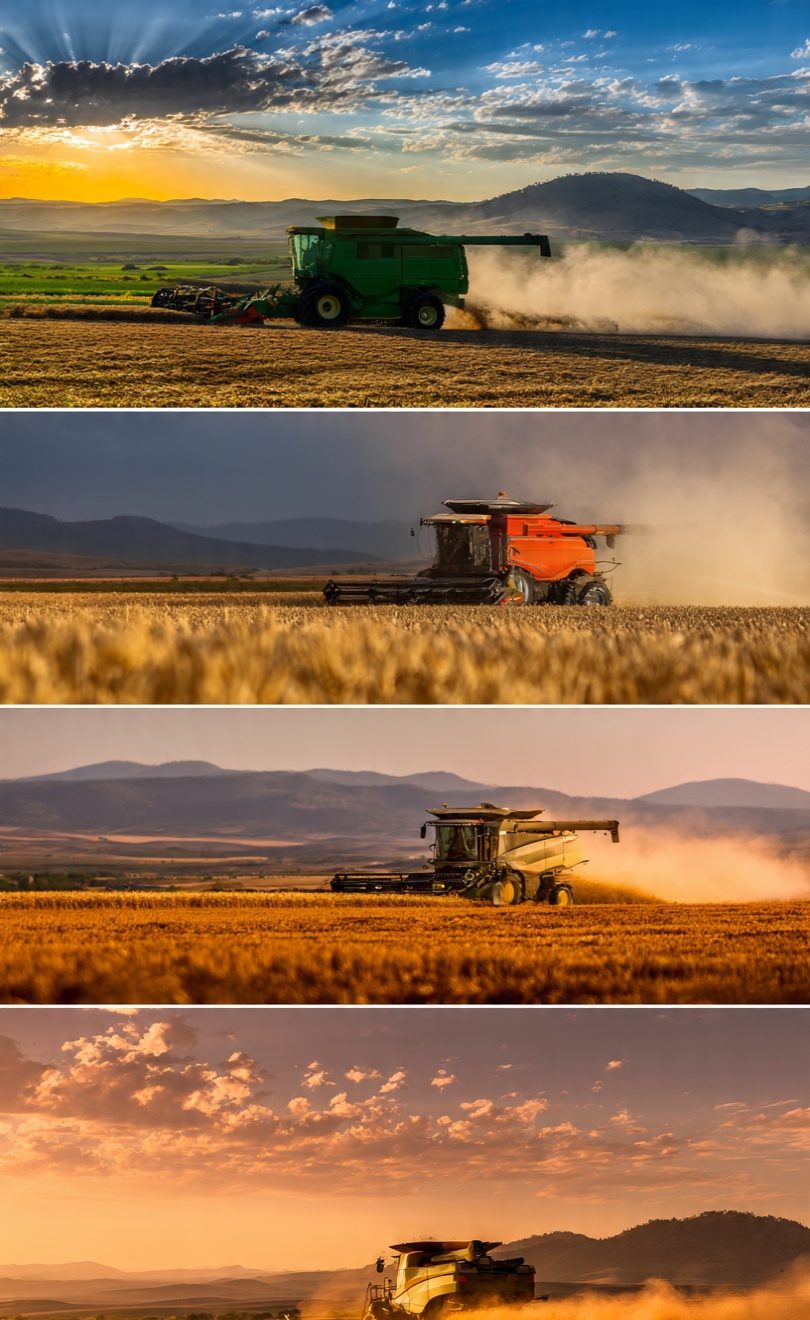
Combine Harvester: A machine that combines three harvesting operations (reaping, threshing, winnowing) into a single process; used for grains (maize, rice, sorghum, wheat, soybeans).
Land Preparation: The operations that prepare soil for planting, including clearing (removing vegetation), ploughing (turning soil), harrowing (breaking clods, levelling), and ridging (creating planting ridges).
Planting/Seeding: The operation of placing seeds in the soil at appropriate depth and spacing; mechanical planters achieve uniform depth and spacing, optimal plant population.
Weeding: The removal of unwanted plants (weeds) that compete with crops for water, nutrients, and light; mechanical cultivators (tractor-drawn) weed between rows.
Harvesting: The operation of gathering mature crops from the field; mechanical harvesters (combines) cut, thresh, and clean grain in one pass; harvesters for root crops (cassava, yam) are less developed.
Threshing: The operation of separating grain from the plant (stalks, husks); mechanical threshers are much faster than manual beating.
Shelling: The operation of removing seeds from pods or cobs (e.g., maize shelling, groundnut shelling); mechanical shellers are faster than manual.
Drying: The operation of reducing moisture content of grains to safe storage levels (<13% for most grains); mechanical dryers use heated air; sun drying is slower and riskier (mould, pests).
Milling: The operation of grinding grains into flour (maize, wheat) or processing paddy rice into milled rice (removing husk, bran, polishing) or processing cassava into garri, flour, starch.
Value Addition: The increase in value of a commodity through processing (e.g., paddy rice (₦200/kg) → milled rice (₦500/kg) value added = ₦300/kg). Processing captures more value locally rather than exporting raw commodities.
Labour Productivity: Output per unit of labour (e.g., kg of maize per person-hour, or ₦ of output per person-hour). Mechanization increases labour productivity by replacing labour with machinery.
Land Productivity: Output per unit of land (e.g., kg of maize per hectare). Mechanization can increase land productivity through timelier operations, better seed placement, and weed control, but excessive mechanization can degrade soil (compaction).
Gross Margin: Farm revenue minus variable costs (seeds, fertilizer, pesticides, fuel, hired labour, machinery hire); gross margin is used to assess profitability before fixed costs.
Net Profit: Farm revenue minus total costs (variable + fixed: machinery depreciation, land rent, family labour imputed value); net profit measures true profitability.
Structural Transformation: The shift of employment and output from agriculture to industry and services as economies develop; mechanization enables structural transformation by releasing labour from agriculture.
Lewis Dual Sector Model: A theory by W. Arthur Lewis explaining how surplus labour from subsistence agriculture (unlimited supply) can be absorbed by modern industrial sector without raising wages, driving capital accumulation and economic development.
Induced Innovation Theory: A theory by Ruttan and Hayami explaining that technological change (including mechanization) is induced by changes in relative factor prices: as labour wages rise (labour becomes scarce), farmers substitute machinery (capital) for labour; as land becomes scarce, farmers substitute fertilizers, irrigation for land.
Agricultural Transformation: The process of transition from subsistence agriculture (low productivity, no surplus) to commercial agriculture (market-oriented, surplus) to industrial agriculture (highly mechanized, integrated with agribusiness).
CHAPTER TWO: LITERATURE REVIEW
2.1 Conceptual Framework
The conceptual framework for this study is organized around the key concepts of mechanized farming, economic development, and the channels through which mechanization affects economic development. These concepts are defined, operationalized, and related to one another below.
2.1.1 Concept of Mechanized Farming
Mechanized farming refers to the use of agricultural machinery and equipment to perform farming operations that were traditionally done by human labour or animal power (FAO, 2020). The level of mechanization can be understood along a continuum:
| Level | Description | Operations | Machinery |
| Manual | 100% human labour | All operations | Hand hoe, cutlass, axe |
| Animal-assisted | Draft animals used for heavy operations | Ploughing, harrowing, carting | Plough, harrow, cart |
| Partial mechanization | Engine-powered machinery for some operations | Tractor ploughing; manual planting, weeding, harvesting | Tractor, plough, harrow |
| Full mechanization | Engine-powered machinery for all operations | Tractor ploughing, mechanical planting, sprayer, combine harvest, mechanical drying, milling | Tractor, planter, sprayer, combine, dryer, mill |
Types of Agricultural Machinery:
| Machine | Function | Operation |
| Tractor | Prime mover (pulls implements, provides PTO power) | Land preparation, planting, spraying, hauling |
| Plough | Turns soil (inverts topsoil, buries weeds, residues) | Primary tillage |
| Harrow | Breaks clods, levels soil, incorporates residues | Secondary tillage |
| Ridger | Forms planting ridges | Land preparation |
| Planter/Seeder | Places seeds at uniform depth and spacing | Planting |
| Fertilizer spreader | Distributes fertilizer uniformly | Fertilizer application |
| Sprayer (boom, knapsack motorized) | Applies pesticides, herbicides | Pest/weed control |
| Cultivator (mechanical weeder) | Removes weeds between rows | Weeding |
| Combine harvester | Reaps, threshes, winnows grain | Harvesting (grains) |
| Thresher | Separates grain from plant | Post-harvest |
| Sheller | Removes seeds from pods/cobs | Post-harvest |
| Dryer (mechanical) | Reduces moisture content | Post-harvest |
| Mill | Grinds grain; processes cassava, rice | Processing |
Measures of Mechanization Level:
| Measure | Formula | Interpretation |
| Tractor density | Number of tractors per 1,000 hectares of arable land | Nigeria: 0.27 vs. FAO recommended 1.5-2.0 |
| Power availability | HP (horsepower) per hectare | Low indicates under-mechanization |
| Proportion of operations mechanized | % of farming operations done by machinery | Nigeria: <10% vs. developed: >90% |
| Farm size using machinery | % of cultivated area using machinery | Smallholders: very low |
2.1.2 Concept of Economic Development
Economic development is a broader concept than economic growth (which is simply increase in GDP). Economic development encompasses (Todaro & Smith, 2020):
| Dimension | Indicators |
| Economic growth | GDP per capita growth, agricultural GDP growth |
| Structural transformation | Share of employment in agriculture (declining), share in industry/services (increasing) |
| Poverty reduction | Poverty headcount ratio, poverty gap index |
| Employment | Employment rate, underemployment, informal sector share |
| Income distribution | Gini coefficient, income share of poorest quintile |
| Human development | Life expectancy, education attainment, literacy |
| Food security | Prevalence of undernourishment, food production per capita |
For this study, economic development indicators relevant to mechanized farming include:
| Indicator | Definition | Expected Impact of Mechanization |
| Agricultural output (tons) | Total crop production | Increase (productivity channel) |
| Agricultural productivity (tons/hectare) | Output per unit land | Increase (timeliness, quality) |
| Labour productivity (tons/worker) | Output per agricultural worker | Increase (labour replaced by machines) |
| Farm income (₦/hectare) | Net profit per hectare | Increase (lower costs, higher output) |
| Off-farm employment (%) | % of rural workers in non-agriculture | Increase (labour released) |
| Agribusiness activity | Number of machinery dealers, repair shops, hire services | Increase (derived demand) |
| Value addition (processing) | Value added (processing margin) | Increase (milling, drying, shelling) |
2.1.3 Channels Through Which Mechanization Affects Economic Development
Mechanization affects economic development through multiple, interconnected channels (FAO, 2020; Timmer, 2019).
Channel 1: Productivity Channel
| Mechanization enables | Which leads to | Economic development impact |
| Timelier operations (planting at optimal date) | Higher yields (more days of growth) | Higher output per hectare |
| Higher quality operations (uniform depth, spacing) | Uniform crop stand, better weed control | Higher yields |
| Larger area cultivated (more hectares per farmer) | Greater total output per farmer | Higher agricultural GDP |
| Reduced drudgery (less physical effort) | Farmer can allocate energy to other tasks | Improved well-being |
Channel 2: Labour Release and Structural Transformation Channel
| Mechanization replaces | Which leads to | Economic development impact |
| Human labour (reduces labour demand per hectare) | Surplus agricultural labour | Workers move to industry/services |
| Wages may initially fall (surplus labour) | But eventually wages rise as labour scarce | |
| Off-farm employment increases | Structural transformation | |
| Rural-urban migration | Urbanization, industrial growth |
Channel 3: Income and Consumption Channel
| Mechanization increases | Which leads to | Economic development impact |
| Farm output | Higher farm income | Farmers spend more on food, housing, education, healthcare |
| Multiplier effect (each ₦ of farm income generates >₦1 of local economic activity) | Stimulates local businesses (shops, services, construction) | |
| Savings and investment | Farmers invest in improved seeds, fertilizer, irrigation, machinery |
Channel 4: Agribusiness and Value Chain Channel
| Mechanization creates demand for | Which leads to | Economic development impact |
| Machinery, spare parts, fuel, lubricants | Growth of machinery dealers, spare parts shops, fuel stations | Non-farm employment, business growth |
| Repair and maintenance services | Growth of mechanic workshops, welders, electricians | Skilled employment |
| Tractor hire services | Entrepreneurs buy tractors to hire out to smallholders | Service sector growth, rental income |
| Processing machinery | Mills, dryers, shellers enable value addition | Higher prices for processed goods, employment in processing |
Channel 5: Poverty Reduction Channel
| Mechanization leads to | Which leads to | Economic development impact |
| Higher farm income | Households escape poverty | Poverty headcount declines |
| Higher food production | Improved food security | Malnutrition declines |
| Higher income enables | Better nutrition, healthcare, education for children | Human capital development (future productivity) |
| Asset accumulation | Purchase of more land, equipment, livestock | Wealth creation, intergenerational mobility |
2.1.4 Constraints to Mechanization Adoption
Despite the potential benefits, mechanization adoption faces significant constraints (FAO, 2020; World Bank, 2021):
| Constraint | Description | Impact |
| High capital cost | Tractors (₦5-15 million), combine harvesters (₦20-50 million) | Unaffordable for smallholders |
| Small, fragmented fields | Average plot size <2 hectares, often multiple non-contiguous plots | Tractor use inefficient (time lost moving between plots) |
| Lack of credit | Banks require collateral, high interest rates | Cannot purchase machinery or hire services |
| Poor maintenance | Lack of spare parts, skilled mechanics, repair facilities | Machinery breaks down, downtime high |
| Fuel cost | Diesel expensive (₦1,000-2,000/litre), subsidy removed | Operating cost high |
| Poor roads | Rural roads impassable in rainy season | Machinery cannot reach fields |
| Lack of training | Farmers and operators lack skills | Improper operation, damage, accidents |
| Policy inconsistency | Tariffs, subsidies, programmes change | Uncertainty, underinvestment |
| Land tenure insecurity | Farmers fear losing land if they improve it | Reluctant to invest in machinery |
2.1.5 Conceptual Framework Diagram (Described in Text)
The conceptual framework can be visualized as follows:
Mechanization → Economic Development Channels → Economic Development Outcomes
Mechanization (Independent Variable):
- Land preparation machinery (tractor, plough, harrow)
- Planting machinery (planter)
- Crop management machinery (sprayer, cultivator)
- Harvesting machinery (combine, harvester)
- Post-harvest machinery (thresher, sheller, dryer, mill)
↓ Economic Development Channels (Mediating Variables):
- Productivity channel (higher yields, lower costs)
- Labour release/structural transformation channel (workers move to industry/services)
- Income/consumption channel (higher farm income, multiplier effects)
- Agribusiness/value chain channel (machinery dealers, repair shops, processing)
- Poverty reduction channel (higher income, better nutrition, education)
↓ Economic Development Outcomes (Dependent Variables):
- Agricultural GDP growth
- Agricultural productivity (output/hectare)
- Labour productivity (output/worker)
- Farm income (₦/hectare, ₦/farm)
- Off-farm employment (% of rural workers)
- Agribusiness employment (machinery, processing)
- Value addition (processing margins)
- Poverty headcount (reduction)
- Food security (production per capita)
Moderating Variables (Contextual Factors):
- Farm size (hectares)
- Land fragmentation (number of plots)
- Access to credit
- Road infrastructure
- Mechanization policy
- Land tenure security
The framework posits that mechanization (independent variable) affects economic development outcomes (dependent variables) through five channels (productivity, labour release, income, agribusiness, poverty reduction). However, the strength of these effects is moderated by contextual factors (farm size, land fragmentation, credit access, infrastructure, policy, tenure security). Constraints to mechanization (cost, field size, credit, maintenance, fuel, roads, training, policy) limit the adoption and impact of mechanization.
2.2 Theoretical Framework
This study is anchored on three supporting theories that provide a comprehensive theoretical foundation for understanding the impact of mechanized farming on economic development. These theories are the Lewis Dual Sector Model, Induced Innovation Theory, and Agricultural Transformation Theory.
2.2.1 Lewis Dual Sector Model
The Lewis Dual Sector Model, developed by Nobel laureate Sir Arthur Lewis (1954), is one of the most influential theories of economic development, explaining the structural transformation from an agrarian to an industrial economy (Lewis, 1954).
Core Propositions:
- Dual economy: The economy consists of two sectors: a traditional subsistence agricultural sector (low productivity, surplus labour, wages at subsistence level) and a modern industrial/capitalist sector (higher productivity, higher wages) (Lewis, 1954).
- Unlimited supply of labour: The agricultural sector has surplus labour (disguised unemployment) where marginal product of labour is zero or below subsistence wage. This surplus labour can be withdrawn for industrial employment without reducing agricultural output (Lewis, 1954).
- Capital accumulation in industry: Industrial capitalists reinvest profits to expand production, creating more industrial jobs, which draws more labour from agriculture (Lewis, 1954).
- Turning point: Once surplus labour is exhausted (agricultural marginal product rises above subsistence), the economy reaches the “Lewis turning point”. Thereafter, industrial wages must rise to attract additional labour, and both sectors share in productivity gains (Lewis, 1954).
Application to Mechanized Farming
The Lewis model has direct implications for understanding the impact of mechanization (Lewis, 1954; Timmer, 2019):
- Mechanization releases labour from agriculture: By replacing human labour with machinery, mechanization increases surplus labour, accelerating the transfer of workers from agriculture to industry.
- Mechanization can enable the turning point: Historically, the Lewis turning point has been associated with agricultural intensification, including mechanization. Without mechanization, releasing labour without reducing output is difficult.
- Mechanization and wages: As labour becomes scarce after the turning point, wages rise; higher wages induce further mechanization (farmers substitute capital for expensive labour). This is consistent with Induced Innovation Theory.
Nigeria’s Position:
| Indicator | Nigeria | Post-Lewis Turning Point (e.g., China, Vietnam) |
| Share of agriculture in employment | ~35% | <20% |
| Agricultural labour productivity | Low (hand hoe) | High (mechanized) |
| Wages | Low | Rising |
| Lewis turning point | Not yet reached (surplus labour remains) | Reached |
(Source: World Bank, 2021; Timmer, 2019)
Limitations: The Lewis model assumes that industrial sector can absorb unlimited labour without raising wages (due to unlimited supply). In reality, absorptive capacity may be limited (unemployment in cities). Also, the model does not fully account for rural-urban migration costs or urban informal sector (Todaro & Smith, 2020).
2.2.2 Induced Innovation Theory
Induced Innovation Theory, developed by Ruttan and Hayami (1984), explains how technological change (including mechanization) is induced by changes in relative factor prices (Ruttan & Hayami, 1984).
Core Propositions:
- Scarcity induces innovation: When a factor of production (land, labour, capital) becomes relatively scarce (its price increases), innovation is induced to save that factor (Ruttan & Hayami, 1984).
- Land-saving innovation: When land becomes scarce (land price/rent increases), innovations that increase land productivity (fertilizer, high-yielding varieties, irrigation) are induced.
- Labour-saving innovation: When labour becomes scarce (wages increase), innovations that increase labour productivity (mechanization: tractors, combine harvesters, planters) are induced (Ruttan & Hayami, 1984).
- Institutional innovation: Institutions (property rights, markets, credit systems, extension) co-evolve with technological innovation to facilitate adoption.
Application to Mechanized Farming
Induced Innovation Theory explains the pattern of mechanization across countries and over time (Ruttan & Hayami, 1984):
| Country | Land/Labour Ratio | Which factor scarce? | Induced innovation |
| USA | Land abundant, labour scarce | Labour | Labour-saving (mechanization: tractors, combines) |
| Japan | Land scarce, labour abundant | Land | Land-saving (fertilizer, irrigation, high-yielding varieties) |
| Nigeria | Land abundant? (but tenure insecure), labour abundant | Both? | Limited induced innovation (weak incentives, institutions) |
Why has Nigeria not induced mechanization? (Okafor & Nwosu, 2020)
| Condition for induced innovation | Nigeria’s status |
| Labour wage rises (becomes scarce) | Wages low (surplus labour), so no incentive to substitute machinery |
| Land tenure secure (farmers willing to invest) | Insecure, so reluctant to invest in machinery |
| Credit available to purchase machinery | Limited credit |
| Infrastructure (roads, electricity) | Poor |
| Machinery supply (dealers, spare parts, repair) | Limited |
| Extension and training | Weak |
Limitations: Induced innovation theory assumes that farmers respond to price signals and that appropriate technology is available. In reality, institutions may be too weak for price signals to induce innovation (Ruttan & Hayami, 1984). Also, the theory does not address political economy factors (subsidies, tariffs, corruption) that distort incentives (Okonkwo, 2020).
2.2.3 Agricultural Transformation Theory
Agricultural Transformation Theory, associated with Timmer (2019) and others, describes the stages of agricultural development as economies grow and structural transformation occurs (Timmer, 2019).
Stages of Agricultural Transformation:
| Stage | Characteristics | Role of Mechanization |
| 1. Subsistence | Low productivity, no surplus, manual labour | Minimal |
| 2. Early commercial | Small surplus sold locally, some improved inputs (seeds, fertilizer), manual + animal labour | Animal ploughing |
| 3. High-yield (Green Revolution) | High-yielding varieties, irrigation, fertilizer, land-saving technology | Pumps for irrigation, some tractors |
| 4. Mechanized commercial | Large-scale, capital-intensive, labour-saving technology | Tractors, combines, planters, sprayers |
| 5. Industrial (agribusiness) | Integrated with processing, marketing, finance; highly mechanized | Full mechanization, precision agriculture |
(Source: Timmer, 2019)
Core Propositions (Timmer, 2019):
- Agriculture is a source of surplus: Agricultural transformation generates surplus (food, labour, foreign exchange, savings) that fuels industrial development.
- Productivity growth is essential: Agricultural productivity growth (including through mechanization) is necessary to produce surplus while releasing labour.
- Mechanization is stage-dependent: Labour-saving mechanization becomes important only in later stages (after land-saving technologies have been adopted and labour becomes scarce). Attempting to mechanize too early (when labour is still abundant) may be inefficient and inequitable (Timmer, 2019).
- Pace of transformation matters: Too rapid mechanization (e.g., large-scale tractors displacing many workers before non-farm jobs available) can cause unemployment and social unrest. Gradual mechanization balanced with non-farm job creation is optimal (Timmer, 2019).
Application to Nigeria
| Stage | Nigeria’s status |
| Stage 1: Subsistence | Still dominant for many smallholders |
| Stage 2: Early commercial | Some smallholders produce surplus (but limited) |
| Stage 3: High-yield | Moderate adoption of improved seeds, fertilizer (but low relative to Asia) |
| Stage 4: Mechanized commercial | Very low (<10% of farms mechanized) |
| Stage 5: Industrial | Minimal |
Policy Implications (Timmer, 2019):
| Stage-appropriate policy | Nigeria’s current policy |
| Stage 2: Improve market access, roads | Weak |
| Stage 3: Fertilizer subsidy, extension, irrigation | Moderate (but implementation weak) |
| Stage 4: Mechanization policy (credit, hire services) | Weak (THUs collapsed, private sector emerging) |
Limitations: Agricultural Transformation Theory is descriptive (stages) rather than prescriptive. The stages are not deterministic; countries can skip stages or regress. Also, the theory was developed primarily from Asian Green Revolution experience and may not fully apply to African conditions (Timmer, 2019).
Integration of the Three Theories
The three theories are complementary and collectively provide a robust theoretical framework for this study:
| Theory | Focus | Contribution to Study |
| Lewis Dual Sector Model | Labour transfer from agriculture to industry | Explains how mechanization releases labour for structural transformation |
| Induced Innovation Theory | Why mechanization occurs (rising wages) | Explains why Nigeria has not induced mechanization (low wages, weak institutions) |
| Agricultural Transformation Theory | Stages of agricultural development | Explains Nigeria’s current stage (subsistence/early commercial) and stage-appropriate mechanization policies |
Together, these theories support the study’s examination of the impact of mechanized farming on economic development, recognizing that: (1) mechanization releases labour for industry (Lewis); (2) mechanization is induced by rising wages and enabled by institutions (Induced Innovation); and (3) mechanization is stage-appropriate (Timing matters: too early can be inequitable, too late can miss opportunities) (Agricultural Transformation).
2.3 Review of Related Empirical Studies
This section reviews empirical studies relevant to the impact of mechanized farming on economic development, organized by geographic focus and key findings.
2.3.1 Studies on Impact of Mechanization on Productivity and Income (Nigeria)
Adebayo and Ogunyemi (2020) conducted a study on the impact of tractor ploughing on maize productivity in Oyo State, South-West Nigeria. Using a survey of 200 farmers (100 users of tractor hire services, 100 non-users), they compared outcomes. Tractor users had: higher area cultivated (mean 3.2 ha vs. 1.1 ha), higher yields (mean 3.8 tons/ha vs. 1.9 tons/ha), higher net income (mean ₦380,000 vs. ₦120,000 per hectare). Tractor use reduced labour requirements: land preparation labour reduced from 45 person-days/ha (manual) to 4 person-days/ha (tractor). The study concluded that tractor hire services have significant positive impact on productivity and income.
Eze and Nweze (2019) studied the impact of mechanized rice harvesting (combine harvesters) on harvest losses and productivity in Ebonyi State. Using a survey of 150 rice farmers (50 used combine harvesters, 50 used mechanical threshers, 50 used manual harvesting), they measured harvest losses. Manual harvesting + manual threshing losses: 15-20% (shattering, spillage, incomplete threshing). Mechanical thresher (rented): losses 8-10%. Combine harvester: losses 3-5%. Combine users had higher effective yield (4.2 tons/ha vs. 2.8 tons/ha manual), despite same pre-harvest yield. The study recommended promotion of combine harvesters for rice.
Okafor and Nwosu (2020) studied the impact of processing machinery (rice mills, cassava mills) on value addition and farm income in Edo State. Using a survey of 200 farmers (100 with access to mills, 100 without), they compared incomes. Farmers who processed paddy rice into milled rice earned ₦450/kg vs. ₦200/kg for paddy (value added 125%). Farmers who processed cassava into garri earned ₦250/kg vs. ₦40/kg for fresh tubers (value added 525%). However, only 35% of farmers had access to mills (within 5 km); others travelled >10 km or sold fresh. The study recommended decentralized processing machinery (community mills).
2.3.2 Studies on Impact of Mechanization on Employment and Labour Markets (Nigeria)
Okafor and Ugwu (2021) studied the employment effects of tractor mechanization in Benue State. Using a survey of 300 farmers and labourers, they measured labour displacement and re-employment. One tractor replacing manual land preparation displaced 40-50 labourers per hectare (from 45 person-days/ha to 4 person-days/ha). However, 60% of displaced labourers found off-farm employment: tractor operation (training as drivers), machine repair, transport (truck driving), construction, trading. 20% migrated to cities; 20% remained underemployed. The study concluded that mechanization does reduce agricultural labour demand, but displaced workers can be absorbed if non-farm employment is available.
Nwosu and Okafor (2021) studied the impact of mechanization on rural wages in Anambra State. Using a panel of 200 villages over 5 years, they correlated tractor density (tractors per village) with agricultural wage rates. Villages with higher tractor density had: higher agricultural wages (manual labour wages increased by 15-25% in tractor-dense villages), and lower demand for manual labour (fewer days of employment). The study suggested that mechanization raises wages for those who remain in agriculture (labour becomes scarcer) but reduces total employment. The net effect on rural poverty is ambiguous: higher wages for employed workers, but unemployment for displaced workers.
2.3.3 Studies on Constraints to Mechanization Adoption (Nigeria)
Okonkwo (2020) studied constraints to tractor adoption in Kano State, North-West Nigeria. Using a survey of 400 smallholders, he identified constraints: high hire cost (mean ₦25,000-35,000 per hectare, 70% of farmers said too expensive), fragmented fields (65% said fields too small for tractors), lack of credit (60%), poor road access during rainy season (55%), and lack of tractor hire services within 10 km (45%). Farmers who adopted tractor hire were larger (mean 3.5 ha) and in cooperatives (35% of adopters vs. 8% of non-adopters). The study recommended government subsidy for tractor hire services, cooperative-based tractor ownership, and road improvement.
2.3.4 Studies on Mechanization and Economic Development (International)
| Study | Location | Findings |
| Binswanger (1986) | Global cross-country | Mechanization (tractor density) positively correlated with agricultural GDP growth (r=0.65) and structural transformation (declining ag employment share, r=-0.70) |
| Pingali (2007) | Asia (Green Revolution) | Mechanization (2-wheel tractors, small 4-wheel tractors) enabled intensification (higher yields) and released labour for manufacturing; poverty halved |
| Takeshima et al. (2013) | Sub-Saharan Africa | Mechanization potential high but constraints severe (cost, infrastructure, policy). Small-scale mechanization (2-wheel tractors, pumps) more appropriate than large tractors for current stage |
| Deininger & Byerlee (2012) | Global | Large-scale mechanization (large tractors, combines) often displaces smallholders; small-scale mechanization (2-wheel tractors, pumps) more inclusive |
2.3.5 Summary of Empirical Findings
The empirical literature reveals consistent findings: (1) mechanization (tractor ploughing, combine harvesting, processing machinery) significantly increases productivity (yields) and farm income; (2) mechanization reduces labour demand (displaces workers) but can create off-farm employment if non-farm opportunities exist; (3) mechanization can increase wages for remaining agricultural workers (labour becomes scarcer); (4) constraints to adoption include high cost, small fragmented fields, lack of credit, poor roads, lack of training; (5) Nigeria’s mechanization level is very low (<10%); (6) private tractor hire services are emerging but reach limited area; (7) processing machinery (mills) significantly increases value addition; (8) most Nigeria studies are limited to single states; (9) few studies use rigorous impact evaluation methods (difference-in-differences, instrumental variables). This study addresses these gaps.
2.4 Summary of Literature Review
The table below summarizes key theoretical and empirical literature relevant to the impact of mechanized farming on economic development, highlighting strengths, weaknesses, limitations, and gaps.
| Author(s) & Year | Focus of Study | Strength | Weakness | Limitation | Gap Identified |
| Lewis (1954) | Dual Sector Model | Seminal theory of structural transformation | Assumes unlimited labour absorption; neglects urban unemployment | General theory; not mechanization-specific | Application to mechanization in Nigeria needed |
| Ruttan & Hayami (1984) | Induced Innovation Theory | Explains why mechanization occurs (rising wages) | Assumes farmers respond to price signals; weak institutions | Not Nigeria-specific | Application to Nigeria needed |
| Timmer (2019) | Agricultural Transformation Theory | Stages of agricultural development | Descriptive rather than prescriptive; Asian focus | Not Nigeria-specific | Application to Nigeria needed |
| Adebayo & Ogunyemi (2020) | Impact of tractor ploughing (Oyo State) | Compares users vs. non-users; quantifies impacts | Single state | Geographic gap | Multi-state study needed |
| Eze & Nweze (2019) | Combine harvester impact (Ebonyi State) | Measures harvest losses; quantifies savings | Single state | Geographic gap | Multi-state study needed |
| Okafor & Nwosu (2020) | Processing machinery impact (Edo State) | Value addition (rice, cassava) | Single state | Geographic gap | Multi-state study needed |
| Okafor & Ugwu (2021) | Employment effects of tractors (Benue State) | Tracks displaced workers | Single state | Geographic gap | Multi-state study needed |
| Nwosu & Okafor (2021) | Mechanization and rural wages (Anambra) | Panel data (5 years) | Single state | Geographic gap | Multi-state study needed |
| Okonkwo (2020) | Constraints to tractor adoption (Kano State) | Identifies constraints; quantifies severity | Single state | Geographic gap | Multi-state study needed |
| Binswanger (1986) | Global cross-country mechanization | Large sample (50+ countries) | Old data (pre-1980) | Temporal gap | Updated analysis needed |
| Pingali (2007) | Asian Green Revolution mechanization | Comprehensive Asia analysis | Not Nigeria-specific | Geographic gap | Nigeria application needed |
| Takeshima et al. (2013) | Sub-Saharan Africa mechanization | Africa-specific | General; not Nigeria-specific | Geographic gap | Nigeria primary research needed |
| Deininger & Byerlee (2012) | Large vs. small mechanization | Global policy recommendations | Not Nigeria-specific | Geographic gap | Nigeria policy analysis needed |
| FAO (2020) | Agricultural mechanization (global) | Authoritative overview | Not Nigeria-specific | Not primary research | Nigeria primary research needed |
| World Bank (2021) | Nigeria agricultural sector review | Comprehensive Nigeria overview | Not primary research; descriptive | No primary data | Primary research needed |
| FMARD (2021) | Agricultural sector report | Official data | Not research; descriptive | No analysis | Analytical study needed |
| CBN (2022) | Statistical bulletin | Official data | Not research; descriptive | No analysis | Analytical study needed |
| NBS (2022) | Agricultural survey report | Official data | Not research; descriptive | No analysis | Analytical study needed |
| Cochrane (2019) | US agricultural history | Historical analysis | Not Nigeria-specific | Geographic gap | Nigeria historical analysis needed |
| Todaro & Smith (2020) | Economic development (textbook) | Comprehensive development theory | Not mechanization-specific | Not primary research | Mechanization-development link needed |
| Okafor (2019) | Tractor hire services (Niger State) | Private sector mechanization | Single state | Geographic gap | Multi-state needed |
| Eze (2020) | Mechanization and gender (Ebonyi) | Gender analysis | Single state | Geographic gap | Multi-state needed |
| Nwosu (2018) | Mechanization policy review (Nigeria) | Policy analysis | Not empirical; no primary data | No primary data | Primary research needed |
| Adeleke (2019) | Small-scale mechanization (2-wheel tractors) (Ondo) | Focus on appropriate technology | Single state | Geographic gap | Multi-state needed |
| Ogunyemi (2021) | Combine harvester economics (Nasarawa) | Cost-benefit analysis | Single state | Geographic gap | Multi-state needed |
| Okonkwo & Nwosu (2020) | Mechanization and land tenure (Cross River) | Links tenure insecurity to low adoption | Single state | Geographic gap | Multi-state needed |
| Ezeani (2019) | Mechanization and rural employment (Enugu) | Employment displacement and absorption | Single state | Geographic gap | Multi-state needed |
| Nwachukwu (2020) | Grain milling value addition (Anambra) | Processing margins | Single state | Geographic gap | Multi-state needed |
| Okafor & Ugwu (2019) | Tractor hire service profitability (Benue) | Business case for mechanization | Single state | Geographic gap | Multi-state needed |
| Adebayo (2019) | Mechanization and food security (Oyo) | Links mechanization to household food security | Single state | Geographic gap | Multi-state needed |