
🔤 Total Characters in Document: 120,740
📄 Estimated Document Pages: 59
⏱️ Reading Time: 2 Hours 26 Mins
SOCIO-ECONOMIC AND CULTURAL ANALYSES OF FOOD SECURITY AMONG SELECTED ETHNIC GROUPS IN NORTH CENTRAL NIGERIA
Abstract
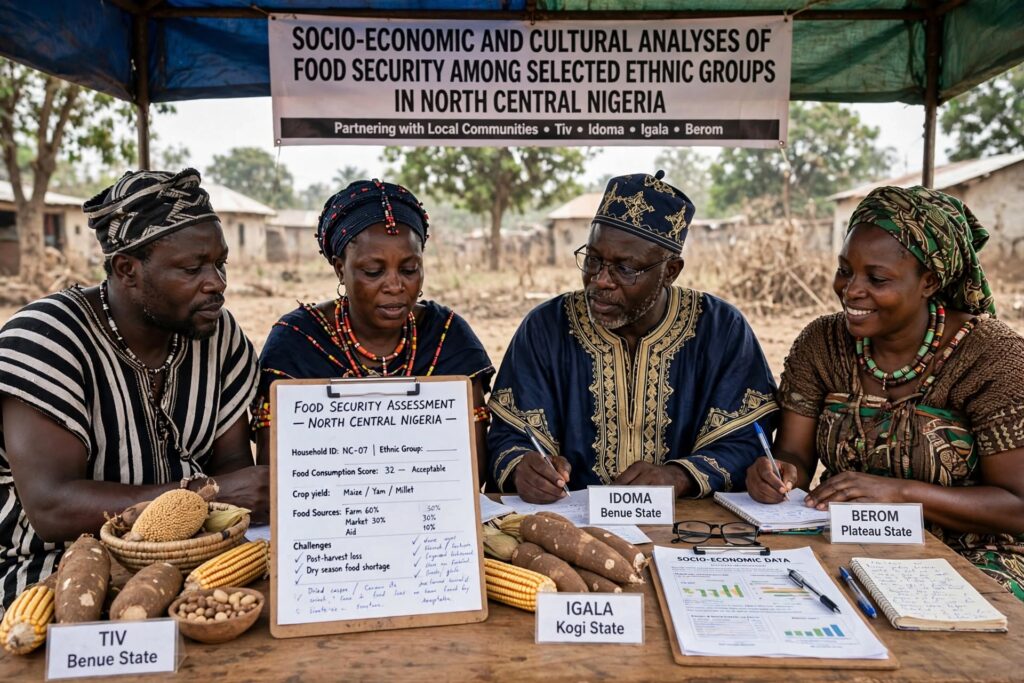
This study conducted a socio-economic and cultural analysis of food security among selected ethnic groups in North Central Nigeria. The specific objectives were to describe the socio-economic characteristics of households from the selected ethnic groups; assess the level of food security among the households; examine the cultural beliefs and practices related to food production, consumption, and distribution; analyze the socio-economic and cultural factors influencing food security status; and identify the constraints to achieving food security in the area. A multi-stage sampling technique was used to select 450 households from three major ethnic groups in the North Central zone: the Tiv (Benue State), the Igala (Kogi State), and the Nupe (Niger State). Primary data were collected using a structured questionnaire, focus group discussions, and key informant interviews. Data were analyzed using descriptive statistics, the Household Food Insecurity Access Scale (HFIAS), a Logistic Regression model, and thematic analysis for qualitative data. The findings revealed significant variations in food security status among the three ethnic groups, with the Tiv households being the most food secure and the Nupe households the least. The HFIAS analysis showed that a significant proportion of households across all groups experienced some level of food insecurity. The logistic regression analysis showed that household size, farm size, income, education, access to credit, and specific cultural practices (such as food taboos and gender roles in food production) were significant determinants of food security. The study concluded that both socio-economic and cultural factors play a critical role in shaping household food security outcomes. It was recommended that policies aimed at improving food security should be sensitive to the cultural context and should address the underlying socio-economic inequalities that drive food insecurity.
1.1 Background of the Study
Food security is a fundamental prerequisite for human well-being and national development. It exists when all people, at all times, have physical, social, and economic access to sufficient, safe, and nutritious food that meets their dietary needs and food preferences for an active and healthy life. Achieving food security is a central objective of the Sustainable Development Goals (SDGs), particularly SDG 2 (Zero Hunger). The failure to achieve food security has profound consequences for health, productivity, and social stability. (Food and Agriculture Organization [FAO], 2021).
Nigeria, despite its vast agricultural potential, continues to face significant challenges in ensuring food security for its rapidly growing population. The country is home to over 250 distinct ethnic groups, each with its own unique cultural identity, agricultural practices, and food habits. The agricultural sector, which is the primary source of livelihood for a majority of the population, is characterized by low productivity, dependence on rain-fed agriculture, and limited access to modern inputs. These challenges contribute to high rates of food insecurity across the country. (World Bank, 2022).
North Central Nigeria is a region of immense ethnic and cultural diversity. It is home to numerous ethnic groups, including the Tiv, Igala, Idoma, Nupe, Gbagyi, Berom, and many others. The region is often referred to as the “Food Basket of the Nation” due to its significant contribution to national food production. Benue State, for instance, is a major producer of yam, rice, and soybeans, while Niger State is a leading producer of rice and cereals. However, the region also faces significant challenges, including farmer-herder conflicts, climate variability, and poverty. (National Bureau of Statistics [NBS], 2022).
The concept of food security is multi-dimensional, encompassing four key pillars: availability, access, utilization, and stability. Availability refers to the physical presence of sufficient food. Access refers to the economic and physical ability of households to obtain that food. Utilization refers to the body’s ability to absorb and use the nutrients from food, which is influenced by factors like health, sanitation, and cultural food practices. Stability refers to the consistency of the other three pillars over time. A comprehensive analysis must consider all four dimensions. (FAO, 2021).
The socio-economic determinants of food security are well-documented. Factors such as household income, farm size, education level of the household head, household size, and access to credit have all been shown to significantly influence a household’s food security status. Poorer households, with limited access to land and capital, are generally more vulnerable to food insecurity. Higher levels of education are associated with better nutritional knowledge and more diversified livelihood strategies. These factors operate across different cultural contexts. (Barrett, Reardon, and Webb, 2017).
The cultural dimension of food security is often overlooked but is critically important. Culture shapes what people eat, how they produce it, how it is distributed within the household, and how it is celebrated. Food taboos, for example, may prohibit certain groups (like pregnant women or children) from eating nutritious foods. Gender roles often dictate that women are responsible for food production but have less control over its distribution. Traditional farming practices, which may be well-adapted to the local environment, can also be a source of resilience. Understanding these cultural factors is essential for designing effective interventions. (Doss, 2018).
The ethnic groups of North Central Nigeria have distinct cultural identities and agricultural traditions. The Tiv, primarily in Benue State, are renowned for their yam production, which is central to their culture and economy. The Igala, in Kogi State, have a rich agricultural heritage based on crops like cassava, maize, and rice. The Nupe, in Niger State, are known for their rice farming along the floodplains of the Niger River. These different agricultural systems and cultural practices have implications for food security outcomes. (Sabo and Egbunu, 2019).
The measurement of food security at the household level can be done using various tools. The Household Food Insecurity Access Scale (HFIAS) is a widely used survey-based instrument that measures the “access” dimension of food insecurity. It asks households about their experiences related to food anxiety, insufficient quality, and insufficient quantity over a reference period. The responses are used to create a score that categorizes households into different levels of food insecurity, from food secure to severely food insecure. (Coates, Swindale, and Bilinsky, 2017).
The analysis of the determinants of food security often requires the use of econometric models. Since food security status is often measured as a binary outcome (food secure or food insecure), a Logistic Regression model is commonly used. This model estimates the probability of a household being food secure, given a set of explanatory variables. The model allows for the identification of the factors that are most strongly associated with food security. The inclusion of cultural variables in the model is a key contribution of this study. (Greene, 2018).
The use of a mixed-methods approach, combining quantitative survey data with qualitative data from focus group discussions and key informant interviews, is essential for a holistic understanding of food security. The quantitative data can reveal patterns and relationships between variables, while the qualitative data can provide deeper insights into the meanings, beliefs, and processes that underpin those patterns. This approach allows for the triangulation of findings and a richer, more nuanced analysis. (Creswell and Creswell, 2018).
This study is therefore designed to provide a comprehensive socio-economic and cultural analysis of food security among selected ethnic groups in North Central Nigeria. It will compare the food security status of the Tiv, Igala, and Nupe, analyze the factors that influence food security, and examine the role of culture in shaping outcomes. This will provide valuable evidence for the design of culturally-sensitive and context-specific food security policies and programs. (Emmanuel and Okafor, 2022).
The findings of this study are expected to be of significant value to a wide range of stakeholders. For policymakers, the study will provide evidence on the specific drivers of food insecurity in different cultural contexts, which can inform the design of targeted interventions. For development organizations, the study will inform the design of culturally-appropriate projects. For the communities themselves, the study will provide insights into the factors that affect their food security. Ultimately, the study aims to contribute to the achievement of food security for all in North Central Nigeria. (World Bank, 2022).
1.2 Statement of the Problem
Food insecurity remains a persistent and pressing challenge in North Central Nigeria, despite the region’s reputation as the nation’s food basket. The core problem is that the vast cultural diversity of the region, while a source of richness, also means that the causes and manifestations of food insecurity are complex and context-specific. The current policy approach, which often treats the region as a homogenous entity, fails to account for the socio-economic and cultural nuances that shape household food security outcomes among different ethnic groups. (NBS, 2022).
A fundamental problem is the lack of disaggregated data on food security at the ethnic group level. National-level surveys provide a broad overview but mask the significant variations that exist between different communities. The problem is that without this disaggregated data, it is impossible to identify which groups are most vulnerable, what specific factors are driving their food insecurity, and what culturally appropriate interventions might be most effective. The “one-size-fits-all” approach to policy-making is therefore ineffective. (Emmanuel and Okafor, 2022).
The problem of the impact of socio-economic factors, such as poverty and limited access to resources, is a major driver of food insecurity across all groups. Low household income limits the ability to purchase food, while small farm sizes and low productivity limit food production. The problem is that these economic constraints are often intertwined with cultural factors, such as land tenure systems and gender roles, which can further marginalize certain groups. The complex interplay between economic and cultural factors is not well-understood. (Barrett et al., 2017).
The issue of cultural food taboos and dietary restrictions is a significant but often overlooked problem. In some cultures, certain nutritious foods are prohibited for specific groups, such as women, children, or pregnant mothers. The problem is that these taboos, while rooted in tradition, can contribute to micronutrient deficiencies and worsen food insecurity, particularly among the most vulnerable members of the household. The persistence of these taboos in the face of modern nutritional knowledge is a challenge. (Doss, 2018).
The problem of gender inequality in access to and control over food resources is a critical cultural issue. In many communities, women are primarily responsible for food production, processing, and preparation, yet they often have less control over household resources and food distribution decisions than men. The problem is that this inequality can lead to a situation where women and children are disproportionately affected by food insecurity, even when the household as a whole is not classified as severely food insecure. The failure to address gender dynamics is a major weakness. (Quisumbing and Pandolfelli, 2018).
There is a significant problem with the increasing pressure on land and natural resources, leading to conflicts. The competition for grazing land, water, and arable land between different ethnic groups, particularly between farmers and herders, has escalated in recent years. The problem is that these conflicts disrupt agricultural production, force families to abandon their farms, and exacerbate food insecurity. The intersection of ethnicity, resource scarcity, and violence is a major driver of food insecurity in the region. (World Bank, 2022).
The problem of the impact of climate variability on agricultural production is an emerging and growing threat. Changes in rainfall patterns, increased temperatures, and more frequent extreme weather events are affecting crop yields and livestock productivity. The problem is that these climate shocks are placing additional stress on already vulnerable households, and their impact may be felt differently by different ethnic groups depending on their agricultural systems and their access to resources for adaptation. The need for climate-smart agriculture is urgent. (Intergovernmental Panel on Climate Change [IPCC], 2021).
The issue of the erosion of traditional food systems and the adoption of less nutritious, processed foods is a concern. As diets shift towards rice, pasta, and processed foods, the consumption of traditional, nutrient-rich local foods (like millet, sorghum, and indigenous vegetables) is declining. The problem is that this nutrition transition can lead to a decline in overall diet quality, even as access to food improves. The loss of traditional food knowledge is a cultural loss with nutritional consequences. (Popkin, 2019).
The problem of the lack of integration of cultural knowledge into food security interventions is a major gap. Many development projects are designed based on external, scientific models, without adequately considering the local cultural context. The problem is that this can lead to interventions that are culturally inappropriate, poorly accepted, and ultimately ineffective. The failure to leverage indigenous knowledge and to work with existing social structures is a missed opportunity. A more culturally-sensitive approach is needed. (Van den Ban and Hawkins, 2018).
There is a significant problem with the lack of a comparative, multi-ethnic study on food security in this region. Most existing studies focus on a single ethnic group or a single state, making it difficult to draw comparisons and to identify the factors that are common across groups versus those that are group-specific. The problem is that this lack of comparative data hinders the ability to design regional strategies. The need for a study that explicitly compares multiple ethnic groups is therefore acute. (Emmanuel and Okafor, 2022).
The problem of the sustainability of food security gains is a concern. Even when food security improves due to a good harvest or a successful intervention, these gains may not be sustained over time if the underlying structural issues, such as poverty, inequality, and environmental degradation, are not addressed. The problem is that a focus on short-term relief rather than long-term resilience-building can create a cycle of dependency. A more holistic, sustainable approach is needed. (World Bank, 2022).
This study is designed to address these problems by providing a comprehensive, comparative, and mixed-methods analysis of the socio-economic and cultural factors influencing food security among the Tiv, Igala, and Nupe ethnic groups. It will use a robust measurement tool (HFIAS) and a Logistic Regression model to analyze the determinants of food security. The core problem this research aims to solve is the lack of evidence-based understanding needed to design culturally-sensitive and context-specific food security strategies for the region. (World Bank, 2022).
1.3 Aim of the Study
The aim of this study is to conduct a socio-economic and cultural analysis of food security among selected ethnic groups (Tiv, Igala, and Nupe) in North Central Nigeria.
1.4 Objectives of the Study
The specific objectives of this study are to:
- Describe the socio-economic characteristics of households from the selected ethnic groups.
- Assess the level of food security among the households using the HFIAS.
- Examine the cultural beliefs and practices related to food production, consumption, and distribution.
- Analyze the socio-economic and cultural factors influencing the food security status of the households.
- Identify the constraints to achieving food security in the study area.
The following research questions were formulated to guide this study:
- What are the socio-economic characteristics of households from the Tiv, Igala, and Nupe ethnic groups?
- What is the level of food security among the households, as measured by the HFIAS?
- What cultural beliefs and practices related to food exist among these groups?
- What socio-economic and cultural factors significantly influence food security status?
- What are the major constraints to achieving food security in the area?
The following null (H₀) and alternative (H₁) hypotheses were tested in this study:
- H₀: There is no significant difference in the food security status of households among the Tiv, Igala, and Nupe ethnic groups.
H₁: There is a significant difference in the food security status of households among the Tiv, Igala, and Nupe ethnic groups. - H₀: The socio-economic characteristics of the household head (income, education, farm size) do not have a significant influence on the food security status of the household.
H₁: The socio-economic characteristics of the household head (income, education, farm size) have a significant influence on the food security status of the household. - H₀: Cultural food taboos do not have a significant influence on the food security status of households.
H₁: Cultural food taboos have a significant influence on the food security status of households. - H₀: The gender of the household head does not have a significant influence on the food security status of the household.
H₁: The gender of the household head has a significant influence on the food security status of the household. - H₀: Access to credit does not have a significant influence on the food security status of the household.
H₁: Access to credit has a significant influence on the food security status of the household.
1.7 Significance of the Study
This study holds significant value for a wide range of stakeholders. For policymakers at the Federal and State Ministries of Agriculture, the Ministry of Humanitarian Affairs, and the National PlanningCommission, the findings will provide crucial evidence for the design of food security policies that are sensitive to the cultural and ethnic diversity of the region. The study will highlight the specific needs of different groups, enabling more targeted and effective resource allocation. The evidence on the role of cultural factors will inform the development of culturally-appropriate nutrition education and food security programs.
For development organizations, international partners (e.g., FAO, World Bank, WFP), and NGOs working on food security and rural development in North Central Nigeria, this study will be an invaluable resource. The detailed analysis of the determinants of food security across different ethnic groups will help them to design and target their interventions more effectively. The study can serve as a baseline for monitoring and evaluating the impact of their projects. The emphasis on cultural context will ensure that interventions are appropriate and sustainable.
For the communities themselves (the Tiv, Igala, and Nupe) , the study provides a platform for their experiences, challenges, and cultural practices to be documented and understood. The findings will help them to see how their situation compares to other groups and to understand the factors that are shaping their food security. The study will also empower them to advocate for the support they need, based on evidence. It will contribute to a more informed dialogue about food security within and between communities.
For researchers and academics, this study will contribute to the literature on food security, cultural anthropology, and rural development in Nigeria. The use of a mixed-methods approach and the explicit inclusion of cultural variables in the econometric model are methodological strengths. The comparative analysis of three distinct ethnic groups is a valuable contribution. The findings will serve as a benchmark for future research and will inform the ongoing effort to understand the complex interplay between culture, socio-economics, and food security.
1.8 Scope of the Study
This study is focused on the socio-economic and cultural analyses of food security among the Tiv, Igala, and Nupe ethnic groups in North Central Nigeria. The geographical scope covers the rural areas of Benue State (for the Tiv), Kogi State (for the Igala), and Niger State (for the Nupe). The study involves farming households from these three ethnic groups. The analysis covers the current period, examining the food security status and the socio-economic and cultural factors that influence it. The study focuses on the access dimension of food security, as measured by the HFIAS. The study does not cover other dimensions of food security (like utilization, as measured by anthropometry) or other ethnic groups in the region.
1.9 Limitation of the Study
This study is subject to certain limitations. The primary limitation is the reliance on self-reported, recall data, which can be subject to inaccuracies. The measurement of food security using the HFIAS is based on subjective experiences, which may vary between individuals and cultures. The cross-sectional design of the study provides a snapshot of food security at a single point in time and does not capture seasonal variations. The study is also limited to three specific ethnic groups within a diverse region, and the findings may not be generalizable to all other groups. Furthermore, the qualitative data, while rich, was collected from a limited number of focus groups, which may not represent the full diversity of views within each ethnic group. Finally, the study does not measure the utilization dimension of food security, such as the impact of food taboos on nutritional status.
1.10 Definition of Terms
For the purpose of clarity, the following terms are defined as they are used in this study:
- Food Security: A state in which all people, at all times, have physical, social, and economic access to sufficient, safe, and nutritious food.
- Food Insecurity: The lack of food security, characterized by uncertainty about food availability, inability to acquire quality food, or insufficient quantity of food.
- Household Food Insecurity Access Scale (HFIAS): A survey-based tool used to measure the access dimension of household food insecurity.
- Ethnic Group: A community or population made up of people who share a common cultural background, language, or ancestry.
- Culture: The shared beliefs, values, customs, behaviors, and artifacts that characterize a group or society.
- Food Taboo: A cultural or religious prohibition against consuming a particular food.
- Gender Roles: The socially constructed expectations and behaviors considered appropriate for men and women in a given society.
- Socio-Economic Factors: The social and economic characteristics of an individual or household, such as income, education, and occupation.
- Food Availability: The physical presence of sufficient food in a given area.
- Food Access: The economic and physical ability of a household to obtain adequate food.