
🔤 Total Characters in Document: 227,510
📄 Estimated Document Pages: 97
⏱️ Reading Time: 4 Hours 2 Mins
CHAPTER ONE: INTRODUCTION
1.1 Background of Study
Yam (Dioscorea spp.) is a staple food crop of significant economic and cultural importance in West Africa, particularly in Nigeria, which is the world’s largest producer of yams, accounting for over 70% of global production (FAO, 2022). Yam is a tuber crop belonging to the Dioscoreaceae family, with several cultivated species including Dioscorea rotundata (white yam), Dioscorea alata (water yam), Dioscorea cayenensis (yellow yam), and Dioscorea dumetorum (bitter yam) (Asiedu & Sartie, 2020). In Nigeria, yam is not only a staple food but also a culturally significant crop used in festivals, ceremonies, and as a symbol of wealth and social status (Orkwor, Asiedu, & Ekanayake, 2019). The country produces approximately 50 million metric tons of yams annually, primarily from the “yam belt” states including Benue, Nasarawa, Plateau, Taraba, Kaduna, Niger, Oyo, Ondo, and Ebonyi (NBS, 2022).
The cultivation of yam is, however, fraught with challenges that have limited its productivity (Otoo, 2021). Yams are typically grown as sole crops on mounds or ridges, requiring fertile soils, adequate rainfall, and significant labour for land preparation, staking, weeding, and harvesting (Orkwor et al., 2019). The crop has a long growing season of 8-10 months, during which the land remains under cultivation for an extended period (Asiedu & Sartie, 2020). This long duration, combined with the high labour requirements for staking, has led farmers to adopt intercropping systems where yam is grown alongside other crops such as maize, melon, cassava, or legumes (Otoo, 2021). Intercropping yam with other crops can improve land use efficiency, provide additional food and income, reduce weed pressure, and optimize the use of available resources (Ofori & Stern, 2020).
Egusi-melon (Colocynthis citrillus L., also known as Citrullus lanatus or Citrullus vulgaris in some classifications) is an important vegetable and oil seed crop widely cultivated in West Africa, particularly in Nigeria, Ghana, Burkina Faso, and Côte d’Ivoire (Schippers, 2019). Egusi-melon is a member of the Cucurbitaceae family (gourds, pumpkins, melons) and is grown primarily for its protein- and oil-rich seeds, which are used in soups, stews, and as a protein supplement (Grubben & Denton, 2019). The seeds contain approximately 30-40% protein and 40-50% oil, making them a valuable nutritional and economic commodity (Ayoade, 2021). Egusi-melon is a fast-growing, trailing annual that matures in 90-120 days, with a spreading growth habit that covers the ground, providing excellent weed suppression and soil moisture conservation (Schippers, 2019).
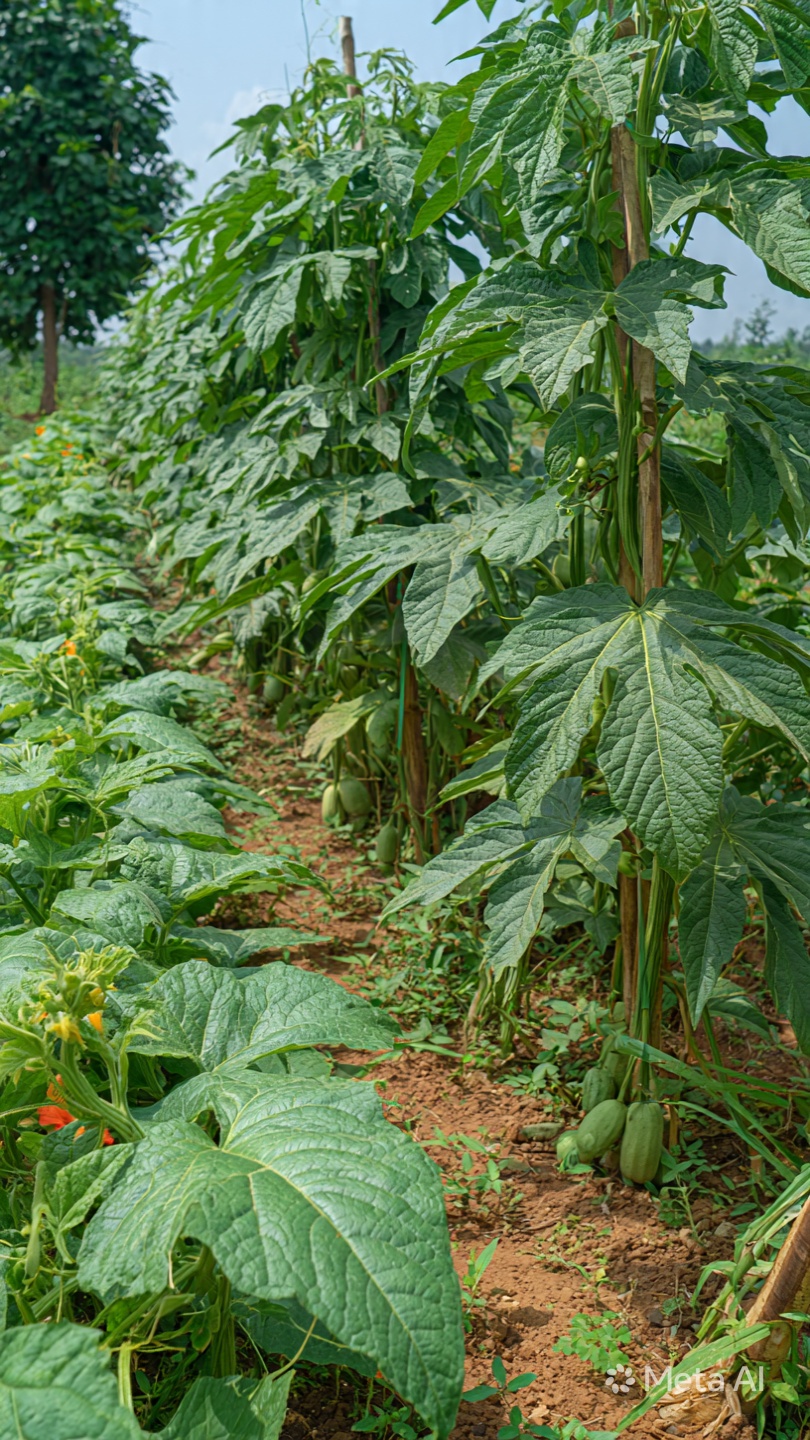
The combination of yam and egusi-melon in an intercropping system offers several potential advantages (Ofori & Stern, 2020). Yam is a tall, staked crop that grows vertically, while egusi-melon is a low-growing, spreading vine that covers the soil surface. This vertical stratification (canopy stratification) allows both crops to utilize different vertical zones of the canopy, reducing competition for light (Trenbath, 2020). The egusi-melon canopy shades the soil, suppressing weeds, reducing soil temperature, and conserving soil moisture, which benefits yam during dry periods (Vandermeer, 2018). Additionally, the dense ground cover provided by egusi-melon reduces soil erosion on yam mounds or ridges (Lithourgidis, Dordas, Damalas, & Vlachostergios, 2019). The shorter growing period of egusi-melon (3-4 months) means that it completes its life cycle before yam reaches peak demand for resources, creating temporal complementarity (Fukai & Trenbath, 2019).
Fertilizer application is critical for achieving optimal growth and yield in intercropping systems, where nutrient demand is higher due to the presence of two crops (Ofori & Stern, 2020). NPK fertilizers (containing Nitrogen, Phosphorus, and Potassium) are the most widely used inorganic fertilizers in yam production systems (Orkwor et al., 2019). Nitrogen (N) promotes vegetative growth, leaf production, and overall plant vigor (Marschner, 2018). For yam, adequate nitrogen supports vine growth and leaf canopy development, which in turn supports tuber bulking through photosynthesis (Otoo, 2021). For egusi-melon, nitrogen promotes vine elongation, leaf expansion, and flower and fruit development (Ayoade, 2021). However, excessive nitrogen can lead to excessive vegetative growth at the expense of tuber (yam) or seed (egusi) yield (Marschner, 2018).
Phosphorus (P) is essential for root development, energy transfer (ATP), and early plant establishment (Marschner, 2018). For yam, phosphorus promotes tuber initiation and development, as well as root system establishment (Orkwor et al., 2019). For egusi-melon, phosphorus supports flowering, fruit set, and seed development (Ayoade, 2021). Potassium (K) is critical for water relations, enzyme activation, protein synthesis, and carbohydrate transport (Marschner, 2018). For yam, potassium enhances tuber size, quality, and resistance to tuber rot diseases (Otoo, 2021). For egusi-melon, potassium improves fruit size, seed fill, and oil content (Schippers, 2019).
The response of yam and egusi-melon to NPK fertilizer in intercropping systems has been the subject of limited research (Ofori & Stern, 2020). Most studies have examined sole crops or other intercrop combinations (e.g., yam + maize, yam + cassava) (Otoo, 2021). The specific fertilizer requirements for the yam + egusi-melon intercrop have not been well established. Optimal fertilizer rates for sole yam typically range from 60-120 kg N/ha, 30-60 kg P₂O₅/ha, and 60-90 kg K₂O/ha (Orkwor et al., 2019). For sole egusi-melon, recommended rates range from 40-80 kg N/ha, 20-40 kg P₂O₅/ha, and 30-60 kg K₂O/ha (Schippers, 2019). However, in intercropping, total nutrient demand is higher, and complementarity in root distribution (yam deep roots, egusi shallow roots) may allow higher total uptake without competition (Trenbath, 2020).
The growth components of yam that are influenced by NPK fertilizer include (Orkwor et al., 2019): vine length (cm) – indicating vegetative growth and canopy development; number of leaves per plant – reflecting photosynthetic capacity; leaf area index – measuring canopy cover and light interception; number of tubers per plant – determining yield potential; average tuber weight (kg) – reflecting bulking efficiency; and tuber yield (t/ha) – the primary economic output. For egusi-melon, growth and yield components include (Schippers, 2019): vine length (cm), number of branches per plant, number of leaves per plant, days to first flowering and 50% flowering, number of fruits per plant, average fruit weight (g), number of seeds per fruit, seed weight (g), and seed yield (kg/ha).
The concept of “Land Equivalent Ratio” (LER) is a key measure for evaluating intercropping systems (Mead & Willey, 2020). LER is calculated as (Y_ic / Y_sc) + (Y_jc / Y_sj), where Y_ic is the yield of crop i in intercrop, Y_sc is the yield of crop i in sole crop, Y_jc is the yield of crop j in intercrop, and Y_sj is the yield of crop j in sole crop. An LER greater than 1 indicates that the intercrop is more productive than sole crops on the same land area (land use advantage). LER values for yam-based intercrops typically range from 1.3 to 1.8, indicating significant yield advantages (Otoo, 2021). For yam + egusi-melon intercrops, LER values have not been well established.
The effect of NPK fertilizer rates on growth and yield components of both crops, as well as on combined intercrop productivity (LER), needs to be quantified. Higher fertilizer rates may increase total productivity (LER), but may also lead to nutrient imbalances, environmental pollution, and reduced profitability if yields do not increase sufficiently to cover fertilizer costs (Lithourgidis et al., 2019). Determining the optimum fertilizer rate for the yam + egusi-melon intercrop requires evaluating growth parameters, yield components, LER, and economic returns (Ofori & Stern, 2020).
From a theoretical perspective, this study is supported by three theories: Nutrient Limitation Theory (Liebig, 1840; Marschner, 2018), which states that plant growth is limited by the nutrient in shortest supply (limiting factor principle); Resource Complementarity Theory (Trenbath, 2020), which explains that intercropping can be advantageous when component crops differ in their resource use patterns (e.g., rooting depth, peak demand timing); and Competitive Production Principle (Harper, 2019), which explains that when plants grow together, they compete for limited resources (light, water, nutrients), and the outcome of competition depends on the relative competitive abilities of the species.
In summary, yam and egusi-melon are important crops in Nigerian agriculture, but both face productivity constraints. Intercropping yam with egusi-melon offers potential benefits through vertical canopy stratification and soil cover. NPK fertilizer application is essential for achieving optimal yields in this intercropping system. However, the specific effects of NPK fertilizer rates on the growth and yield components of both crops, as well as on combined intercrop productivity (LER), have not been systematically quantified. This study aims to investigate the effect of NPK fertilizer on the growth and yield components of yam and egusi-melon in a yam + egusi-melon intercrop, determining the optimum fertilizer rate for maximizing productivity.
1.2 Statement of Problems
Yam (Dioscorea spp.) is a major staple food in Nigeria, but its productivity is constrained by low soil fertility, particularly declining levels of nitrogen, phosphorus, and potassium, due to continuous cultivation without adequate fertilizer application. Egusi-melon (Colocynthis citrillus) is an important oil and vegetable seed crop, but similar fertility constraints limit its yield. Intercropping yam with egusi-melon offers potential advantages through vertical canopy stratification and soil cover, but both crops compete for limited soil nutrients. NPK fertilizer application can address nutrient deficiencies, but the optimal fertilizer rate for the yam + egusi-melon intercrop has not been established. Applying too little fertilizer results in nutrient deficiency, stunted growth, and low yields. Applying too much fertilizer wastes resources, increases production costs, and may cause environmental pollution. Furthermore, the effect of NPK fertilizer on specific growth parameters (vine length, leaf number, leaf area) and yield components (tuber number, tuber weight, fruit number, seed weight) of both crops in the intercropping system has not been quantified. The Land Equivalent Ratio (LER) for this intercrop under different fertilizer rates has not been calculated. The problem this study addresses is the need to determine the effect of NPK fertilizer rates on the growth and yield components of yam and egusi-melon in a yam + egusi-melon intercrop, and to identify the optimum fertilizer rate that maximizes both individual crop yields and combined intercrop productivity (LER).
1.3 Aim of the Study
The specific aim of this research work is to investigate the effect of NPK fertilizer on the growth and yield components of yam (Dioscorea spp.) and egusi-melon (Colocynthis citrillus) in a yam + egusi-melon intercrop, with a view to determining the optimum NPK fertilizer rate for maximizing individual crop yields and combined intercrop productivity (Land Equivalent Ratio, LER).
1.4 Objectives of the Study
- To determine the effect of different NPK fertilizer rates (0, 200, 400, 600 kg/ha) on the growth components (vine length, number of leaves, leaf area index) of yam and egusi-melon in a yam + egusi-melon intercrop.
- To determine the effect of different NPK fertilizer rates on the yield components (yam: number of tubers, average tuber weight, tuber yield; egusi-melon: number of fruits, number of seeds, seed yield) of yam and egusi-melon in the intercrop.
- To evaluate the effect of NPK fertilizer rates on the combined productivity of the yam + egusi-melon intercrop using Land Equivalent Ratio (LER).
- To assess the economic profitability of different NPK fertilizer rates for the yam + egusi-melon intercrop.
- To determine the optimum NPK fertilizer rate for maximizing the combined productivity and economic returns of the yam + egusi-melon intercrop.
1.5 Research Questions
- How do different NPK fertilizer rates (0, 200, 400, 600 kg/ha) affect the growth components (vine length, number of leaves, leaf area index) of yam and egusi-melon in a yam + egusi-melon intercrop?
- How do different NPK fertilizer rates affect the yield components (yam: tuber number, tuber weight, tuber yield; egusi-melon: fruit number, seed number, seed yield) of yam and egusi-melon in the intercrop?
- What is the effect of different NPK fertilizer rates on the Land Equivalent Ratio (LER) of the yam + egusi-melon intercrop?
- What is the economic profitability (benefit-cost ratio, marginal rate of return) of different NPK fertilizer rates for the yam + egusi-melon intercrop?
- What is the optimum NPK fertilizer rate for maximizing combined productivity and economic returns of the yam + egusi-melon intercrop?
1.6 Research Hypotheses
Hypothesis One
- H₀ (Null): Different NPK fertilizer rates have no significant effect on the growth components (vine length, number of leaves, leaf area index) of yam and egusi-melon in a yam + egusi-melon intercrop.
- H₁ (Alternative): Different NPK fertilizer rates have a significant effect on the growth components of yam and egusi-melon in the intercrop.
Hypothesis Two
- H₀ (Null): Different NPK fertilizer rates have no significant effect on the yield components (yam: tuber number, tuber weight, tuber yield; egusi-melon: fruit number, seed number, seed yield) of yam and egusi-melon in the intercrop.
- H₁ (Alternative): Different NPK fertilizer rates have a significant effect on the yield components of yam and egusi-melon in the intercrop.
Hypothesis Three
- H₀ (Null): Different NPK fertilizer rates have no significant effect on the Land Equivalent Ratio (LER) of the yam + egusi-melon intercrop.
- H₁ (Alternative): Different NPK fertilizer rates have a significant effect on the Land Equivalent Ratio (LER) of the intercrop.
Hypothesis Four
- H₀ (Null): There is no significant difference in economic profitability (benefit-cost ratio, marginal rate of return) among different NPK fertilizer rates for the yam + egusi-melon intercrop.
- H₁ (Alternative): There is a significant difference in economic profitability among different NPK fertilizer rates.
Hypothesis Five
- H₀ (Null): There is no optimum NPK fertilizer rate that significantly maximizes the combined productivity and economic returns of the yam + egusi-melon intercrop.
- H₁ (Alternative): There is an optimum NPK fertilizer rate that significantly maximizes the combined productivity and economic returns of the intercrop.
1.7 Justification of the Study
This study is justified on several grounds. First, yam and egusi-melon are important crops for food security, nutrition, and income generation in Nigeria, but their productivity is constrained by low soil fertility. Second, intercropping yam with egusi-melon offers potential land use advantages (vertical stratification, weed suppression, soil moisture conservation), but the fertilizer requirements for this specific intercrop have not been established. Third, there is limited experimental data on the growth response of yam and egusi-melon to NPK fertilizer in intercropping systems. Fourth, determining the optimum fertilizer rate (0, 200, 400, 600 kg/ha NPK) will enable farmers to apply fertilizer efficiently, maximizing yields while minimizing costs and environmental impact. Fifth, the findings will contribute to agronomic recommendations for sustainable yam + egusi-melon intercropping systems.
1.8 Significance of the Study
The findings of this research will be significant to several stakeholders. To yam and egusi-melon farmers, the study will provide evidence-based recommendations on the optimum NPK fertilizer rate for maximizing yields and profitability in yam + egusi-melon intercrop. To agricultural extension agents, the findings will inform fertilizer recommendations for intercropping systems. To researchers in agronomy and crop science, the study will contribute empirical data on growth parameters, yield components, and Land Equivalent Ratio for a previously understudied crop mixture. To policymakers and agricultural development programmes, the findings will support the development of fertilizer subsidy programs and intercropping promotion initiatives. To input suppliers (fertilizer dealers), the study will inform demand forecasting for NPK fertilizer in yam-growing regions.
1.9 Scope of the Study
The scope of this study is delimited to the effect of NPK fertilizer (15-15-15 formulation) on the growth and yield components of yam (Dioscorea spp.) and egusi-melon (Colocynthis citrillus) in a yam + egusi-melon intercrop. The study involves field experiments conducted in [specify location, e.g., the derived savanna or forest zone of Nigeria]. Treatments include four NPK fertilizer rates: 0 kg/ha (control), 200 kg/ha, 400 kg/ha, and 600 kg/ha. All treatments receive a constant basal application of organic manure (e.g., poultry manure at 5 t/ha) to ensure baseline fertility. Growth components measured for yam: vine length (cm), number of leaves per plant, leaf area index; for egusi-melon: vine length (cm), number of branches, number of leaves. Yield components for yam: number of tubers per plant, average tuber weight (kg), tuber yield (t/ha); for egusi-melon: number of fruits per plant, average fruit weight (g), number of seeds per fruit, seed yield (kg/ha). Combined productivity measure: Land Equivalent Ratio (LER). Economic analysis: benefit-cost ratio (BCR) and marginal rate of return (MRR). The study covers one cropping season (or two if replicated). The study does not extend to other yam species (only D. rotundata or D. alata as selected), other melon species, other fertilizer types (NPK only), other intercropping patterns (sole crops for LER calculation included as controls), or other agro-ecological zones.
1.10 Definition of Terms
Yam (Dioscorea spp.): A tuberous root crop belonging to the family Dioscoreaceae, widely cultivated as a staple food in West Africa. The species used in this study is typically Dioscorea rotundata (white yam) or Dioscorea alata (water yam).
Egusi-melon (Colocynthis citrillus): A trailing annual vine of the Cucurbitaceae family, grown for its protein- and oil-rich seeds, used in soups and as a protein supplement in West African cuisine. Also known as Citrullus lanatus or Citrullus vulgaris in some classifications.
Intercropping: An agricultural practice where two or more crops are grown simultaneously on the same piece of land within a single growing season.
NPK Fertilizer (15-15-15): An inorganic fertilizer containing 15% Nitrogen (N), 15% Phosphorus pentoxide (P₂O₅), and 15% Potassium oxide (K₂O) by weight. The numbers indicate the percentage of each primary nutrient.
Nitrogen (N): A primary macronutrient that promotes vegetative growth (leaves, stems, vines), chlorophyll production, and overall plant vigour.
Phosphorus (P): A primary macronutrient essential for root development, energy transfer (ATP), early plant establishment, flowering, fruiting, and seed development.
Potassium (K): A primary macronutrient critical for water relations, enzyme activation, protein synthesis, carbohydrate transport, tuber bulking, and stress tolerance.
Growth Components (Growth Parameters): Quantitative measures of plant development over time, including vine length (cm), number of leaves per plant, number of branches, leaf area index (total leaf area per unit ground area).
Yield Components (Yield Parameters): Quantitative measures of economic output, including for yam: number of tubers per plant, average tuber weight (kg), tuber yield (t/ha); for egusi-melon: number of fruits per plant, average fruit weight (g), number of seeds per fruit, seed yield (kg/ha).
Land Equivalent Ratio (LER): A measure of intercropping productivity calculated as LER = (Y_ic/Y_sc) + (Y_jc/Y_sj), where Y_ic is yield of crop i in intercrop, Y_sc is yield of crop i in sole crop, Y_jc is yield of crop j in intercrop, Y_sj is yield of crop j in sole crop. LER > 1 indicates intercrop advantage (land saving); LER < 1 indicates disadvantage.
Benefit-Cost Ratio (BCR): An economic measure of profitability calculated as total revenue divided by total cost. BCR > 1 indicates profitable; BCR < 1 indicates unprofitable.
Marginal Rate of Return (MRR): An economic measure of the additional profit from an additional unit of fertilizer, calculated as (change in revenue) / (change in fertilizer cost) × 100%.
Nutrient Limitation Theory: The principle that plant growth is limited by the nutrient that is in the shortest supply relative to the plant’s requirements (the Law of the Minimum, Liebig).
Resource Complementarity: A positive interaction in intercropping where component crops differ in their resource use patterns (e.g., different rooting depths, different peak demand timing), reducing competition and increasing total resource capture.
Competitive Production Principle: The principle that when plants grow together, they compete for limited resources (light, water, nutrients), and the outcome depends on the relative competitive abilities of the species.
CHAPTER TWO: LITERATURE REVIEW
2.1 Conceptual Framework
The conceptual framework for this study is organized around the key concepts of yam, egusi-melon, intercropping systems, NPK fertilizer, growth components, yield components, and combined productivity measures. These concepts are defined, operationalized, and related to one another below.
2.1.1 Concept of Yam (Dioscorea spp.)
Yam is a tuberous root crop belonging to the family Dioscoreaceae, widely cultivated as a staple food in West Africa, particularly Nigeria (FAO, 2022). It is a dioecious (separate male and female plants) perennial vine typically grown as an annual for tuber production (Asiedu & Sartie, 2020).
Major Yam Species Cultivated in Nigeria:
| Species | Common Name | Characteristics |
| Dioscorea rotundata | White yam | Most preferred, high quality, good storage, 8-10 months maturity |
| Dioscorea alata | Water yam | Higher yield, less preferred taste, 8-10 months maturity |
| Dioscorea cayenensis | Yellow yam | Yellow flesh, good quality, 9-11 months maturity |
| Dioscorea dumetorum | Bitter yam | Bitter when raw, good storage, drought tolerant |
(Source: Orkwor, Asiedu, & Ekanayake, 2019)
Agronomic Requirements for Yam (Orkwor et al., 2019):
| Parameter | Requirement |
| Rainfall | 1,000-1,500 mm annually, well-distributed |
| Temperature | 25-30°C (optimal) |
| Soil | Deep, well-drained, fertile loam, pH 5.5-7.0 |
| Planting material | Seed yams (setts) 200-500 g |
| Spacing (sole) | 1m x 1m (10,000 plants/ha) |
| Maturity | 8-10 months |
Growth Components of Yam (Orkwor et al., 2019):
| Parameter | Description | Measurement |
| Vine length | Elongation of main vine | cm (measured monthly) |
| Number of leaves | Count of fully expanded leaves | count/plant |
| Leaf area | Photosynthetic surface area | cm² (calculated from length × width × factor) |
| Number of tubers | Tubers per plant | count |
| Tuber weight | Weight per tuber | kg |
| Tuber yield | Total weight per hectare | t/ha |
2.1.2 Concept of Egusi-Melon (Colocynthis citrillus)
Egusi-melon is a trailing annual vine of the Cucurbitaceae family, grown for its protein- and oil-rich seeds, widely cultivated in West Africa (Schippers, 2019). The seeds contain approximately 30-40% protein and 40-50% oil (Ayoade, 2021).
Botanical Characteristics (Grubben & Denton, 2019):
| Characteristic | Description |
| Family | Cucurbitaceae (gourds, pumpkins, melons) |
| Growth habit | Trailing annual vine |
| Leaves | Palmately lobed, rough texture |
| Flowers | Yellow, monoecious (male and female on same plant) |
| Fruit | Berry, globose to oval, 10-20 cm diameter |
| Seeds | Flat, oval, cream to brown, 1-2 cm long |
| Growing period | 90-120 days |
Agronomic Requirements (Schippers, 2019):
| Parameter | Requirement |
| Rainfall | 600-1,000 mm annually |
| Temperature | 25-35°C (optimal) |
| Soil | Well-drained, sandy loam, pH 6.0-7.5 |
| Spacing (sole) | 1m x 1m (10,000 plants/ha) |
| Maturity | 90-120 days |
Growth and Yield Components of Egusi-Melon (Ayoade, 2021):
| Parameter | Description | Measurement |
| Vine length | Elongation of main vine | cm |
| Number of branches | Lateral branches per plant | count |
| Days to flowering | Days from planting to first flower | days |
| Number of fruits per plant | Count of mature fruits | count |
| Fruit weight | Average weight per fruit | g |
| Number of seeds per fruit | Seed count per fruit | count |
| Seed yield | Total seed weight per hectare | kg/ha |
2.1.3 Concept of Intercropping Yam and Egusi-Melon
Intercropping yam with egusi-melon offers several potential advantages based on spatial and temporal complementarity (Ofori & Stern, 2020).
Canopy Stratification (Vertical Complementarity):
| Crop | Growth Habit | Canopy Position | Light Utilization |
| Yam | Tall, staked, climbing | Upper canopy (1.5-2.5 m) | Full sunlight |
| Egusi-melon | Low, trailing, spreading | Lower canopy (0.3-0.5 m) | Filtered/partial light |
Rooting Distribution (Spatial Complementarity):
| Crop | Root Type | Rooting Depth | Nutrient/Water Uptake |
| Yam | Tuberous + fibrous | Deep (60-100 cm) | Subsoil resources |
| Egusi-melon | Fibrous, spreading | Shallow (20-40 cm) | Topsoil resources |
Temporal Complementarity:
| Crop | Growing Period | Peak Demand Timing |
| Yam | 8-10 months | 4-8 months (tuber bulking) |
| Egusi-melon | 3-4 months | 2-3 months (flowering/fruiting) |
2.1.4 Concept of NPK Fertilizer
NPK fertilizer provides three primary macronutrients essential for plant growth (Marschner, 2018).
Functions of NPK Nutrients:
| Nutrient | Form | Primary Functions | Deficiency Symptoms |
| Nitrogen (N) | NO₃⁻, NH₄⁺ | Vegetative growth, leaf production, chlorophyll, protein synthesis | Stunted growth, pale green/yellow leaves (chlorosis) |
| Phosphorus (P) | H₂PO₄⁻, HPO₄²⁻ | Root development, energy transfer (ATP), flowering, fruiting, seed development | Poor root growth, delayed maturity, purple coloration |
| Potassium (K) | K⁺ | Water relations, enzyme activation, protein synthesis, carbohydrate transport | Scorched leaf margins, weak stems, poor tuber quality |
NPK 15-15-15 Formulation:
| Component | Percentage | Content per 100 kg |
| Nitrogen (N) | 15% | 15 kg N |
| Phosphorus pentoxide (P₂O₅) | 15% | 15 kg P₂O₅ (6.5 kg P) |
| Potassium oxide (K₂O) | 15% | 15 kg K₂O (12.5 kg K) |
| Filler/Other | 55% | 55 kg filler |
2.1.5 Effect of NPK Fertilizer on Yam Growth and Yield
Nitrogen promotes vine elongation, leaf production, and canopy development, which increases photosynthetic capacity and supports tuber bulking (Orkwor et al., 2019). However, excessive N can delay tuber initiation and reduce tuber quality (Otoo, 2021).
Phosphorus promotes root development, early establishment, and tuber initiation (Marschner, 2018). P deficiency results in poor root growth, delayed maturity, and reduced tuber yield (Orkwor et al., 2019).
Potassium is critical for tuber bulking (carbohydrate transport from leaves to tubers), tuber quality (dry matter content, resistance to rot), and water relations (drought tolerance) (Otoo, 2021). K deficiency results in poor tuber yield and quality (Marschner, 2018).
Recommended NPK Rates for Sole Yam:
| Source | N (kg/ha) | P₂O₅ (kg/ha) | K₂O (kg/ha) |
| Orkwor et al. (2019) | 60-120 | 30-60 | 60-90 |
| Otoo (2021) | 80-100 | 40-50 | 80-100 |
| IITA (2020) | 90 | 45 | 75 |
2.1.6 Effect of NPK Fertilizer on Egusi-Melon Growth and Yield
Nitrogen promotes vine elongation, leaf expansion, and overall vegetative growth (Schippers, 2019). For egusi-melon, moderate N levels (40-80 kg/ha) are optimal; excessive N delays flowering and reduces fruit and seed yield (Ayoade, 2021).
Phosphorus promotes root development, early flowering, fruit set, and seed development (Marschner, 2018). P deficiency results in poor fruit set and low seed yield (Schippers, 2019).
Potassium improves fruit size, seed fill, seed oil content, and stress tolerance (drought, disease) (Ayoade, 2021). K deficiency results in small fruits, low seed weight, and poor oil content (Schippers, 2019).
Recommended NPK Rates for Sole Egusi-Melon:
| Source | N (kg/ha) | P₂O₅ (kg/ha) | K₂O (kg/ha) |
| Schippers (2019) | 40-80 | 20-40 | 30-60 |
| Ayoade (2021) | 50-70 | 30-50 | 40-80 |
| IITA (2020) | 60 | 30 | 50 |
2.1.7 Land Equivalent Ratio (LER)
LER is the standard measure of intercropping productivity (Mead & Willey, 2020).
| Formula | LER = (Y_iy / Y_sy) + (Y_ie / Y_se) |
| Where | Y_iy = yam yield in intercrop; Y_sy = yam yield in sole crop |
| Y_ie = egusi yield in intercrop; Y_se = egusi yield in sole crop | |
| Interpretation | LER > 1 = intercrop advantage (land saving); LER < 1 = disadvantage |
Example LER Calculation:
| Scenario | Yam LER | Egusi LER | Total LER | Interpretation |
| Strong competition | 0.4 | 0.4 | 0.8 | Intercrop disadvantage |
| Neutral | 0.5 | 0.5 | 1.0 | No advantage |
| Moderate complementarity | 0.6 | 0.7 | 1.3 | 30% land saving |
| Strong complementarity | 0.7 | 0.9 | 1.6 | 60% land saving |
2.1.8 Economic Analysis Measures
Benefit-Cost Ratio (BCR):
| Formula | BCR = Total Revenue / Total Cost |
| Interpretation | BCR > 1 = profitable; BCR < 1 = unprofitable |
Marginal Rate of Return (MRR) for Fertilizer:
| Formula | MRR = (ΔRevenue / ΔFertilizer Cost) × 100% |
| Interpretation | MRR > 100% = profitable investment; MRR < 100% = not profitable |
2.1.9 Conceptual Framework Diagram (Described in Text)
The conceptual framework can be visualized as follows:
Independent Variable (Fertilizer) → Mediating Variables (Growth) → Dependent Variables (Yield) → Combined Measures (Productivity)
Independent Variable:
- NPK fertilizer rates (0, 200, 400, 600 kg/ha of 15-15-15)
↓ Mediating Variables (Growth Components):
- For Yam: Vine length, number of leaves, leaf area index
- For Egusi-melon: Vine length, number of branches, number of leaves
↓ Dependent Variables (Yield Components):
- For Yam: Number of tubers/plant, average tuber weight, tuber yield (t/ha)
- For Egusi-melon: Number of fruits/plant, average fruit weight, number of seeds/fruit, seed yield (kg/ha)
↓ Combined Productivity Measures:
- Land Equivalent Ratio (LER)
- Benefit-Cost Ratio (BCR)
- Marginal Rate of Return (MRR)
Moderating Variables:
- Soil fertility baseline
- Rainfall distribution
- Weed pressure
- Pest/disease incidence
The framework posits that different NPK fertilizer rates affect the growth components of both crops (vine length, leaf number, leaf area). Improved growth, in turn, affects yield components (tuber number, tuber weight, fruit number, seed weight). The combined productivity of the intercrop is then evaluated using LER, BCR, and MRR to determine the optimum fertilizer rate.
2.2 Theoretical Framework
This study is anchored on three supporting theories that provide a comprehensive theoretical foundation for understanding the effect of NPK fertilizer on yam and egusi-melon in an intercropping system. These theories are Nutrient Limitation Theory, Resource Complementarity Theory, and the Competitive Production Principle.
2.2.1 Nutrient Limitation Theory
Nutrient Limitation Theory, originally formulated by Justus von Liebig (1840) as the “Law of the Minimum,” is one of the foundational principles of plant nutrition (Marschner, 2018). The theory states that plant growth is limited by the nutrient that is in the shortest supply relative to the plant’s requirements, regardless of the abundance of other nutrients (Liebig, 1840; Marschner, 2018).
Core Proposition (Law of the Minimum):
Growth is limited by the most limiting factor (resource in shortest supply). Visualized as a barrel: the height of the barrel (growth) is determined by the shortest stave (most limiting nutrient). Adding more of non-limiting nutrients does not increase growth; only adding the limiting nutrient increases growth (Marschner, 2018).
Application to NPK Fertilizer in Yam + Egusi Intercrop
Nutrient Limitation Theory predicts (Marschner, 2018; Orkwor et al., 2019):
| Scenario | Most Limiting Nutrient | Expected Response to NPK Fertilizer |
| Low N, adequate P, adequate K | Nitrogen | N addition increases growth/yield; P and K have no effect |
| Adequate N, low P, adequate K | Phosphorus | P addition increases growth/yield; N and K have no effect |
| Adequate N, adequate P, low K | Potassium | K addition increases growth/yield; N and P have no effect |
| Low N, low P, adequate K | N and P (co-limiting) | N + P addition increases growth; N or P alone insufficient |
2.2.2 Resource Complementarity Theory
Resource Complementarity Theory, developed by Trenbath (2020) and supported by numerous intercropping studies, explains that intercropping can be advantageous when component crops differ in their resource use patterns (Trenbath, 2020).
Core Propositions (Trenbath, 2020):
- Spatial complementarity (rooting): Crops can differ in rooting depth (shallow vs. deep). Shallow-rooted crops access water and nutrients from the topsoil; deep-rooted crops access from subsoil, reducing competition and increasing total resource capture.
- Spatial complementarity (canopy): Tall crops can intercept light at high levels; shorter, shade-tolerant crops can utilize light that penetrates through the canopy.
- Temporal complementarity: Crops can differ in the timing of peak resource demand. In intercropping, relay planting or different maturity dates can reduce competition.
- Physiological complementarity: Legumes fix atmospheric nitrogen, benefiting companion cereals. Different crops may have different nutrient requirements, reducing competition.
Application to Yam + Egusi Intercrop
Resource Complementarity Theory predicts (Trenbath, 2020; Ofori & Stern, 2020):
| Complementarity Type | Yam | Egusi-Melon | Expected Effect |
| Rooting depth | Deep taproot (60-100 cm) | Shallow fibrous (20-40 cm) | Reduced water/nutrient competition |
| Canopy height | Tall, staked (1.5-2.5 m) | Low, trailing (0.3-0.5 m) | Reduced light competition |
| Peak nutrient demand | 4-8 months (tuber bulking) | 2-3 months (flowering/fruiting) | Temporal separation reduces competition |
Key Complementarity Measures:
| Measure | Formula | Interpretation |
| Partial LER for yam | Y_iy / Y_sy | If <1, yam suppressed; if >1, yam enhanced |
| Partial LER for egusi | Y_ie / Y_se | If <1, egusi suppressed; if >1, egusi enhanced |
| Total LER | Sum of partial LERs | Total complementarity effect |
2.2.3 Competitive Production Principle
The Competitive Production Principle, derived from plant population ecology (Harper, 2019), explains that when plants grow together, they compete for limited resources (light, water, nutrients). The outcome depends on the relative competitive abilities of the species involved (Harper, 2019).
Core Propositions (Harper, 2019):
- Resource limitation: All plant growth requires access to light, water, and nutrients. When resources are limited, plants compete for them.
- Competitive ability: Species differ in their ability to acquire resources. Traits conferring competitive advantage include: faster growth rate, taller stature, deeper root systems, and allelopathy (chemical suppression).
- Competitive outcome: The species with greater competitive ability will suppress the growth and yield of the less competitive species.
- Fertilizer effects: Fertilizer application can alter competitive outcomes by reducing nutrient competition (if nutrients were the limiting resource) or increasing competition (if fertilizer stimulates growth of one species more than the other, increasing shading).
Application to Yam + Egusi Intercrop with NPK Fertilizer
The Competitive Production Principle predicts (Harper, 2019; Otoo, 2021):
- Without fertilizer (0 kg/ha NPK): Both crops are nutrient-stressed. Competition for limited nutrients is intense. Yam (deep-rooted) may have advantage over egusi (shallow-rooted) for subsoil nutrients.
- With moderate fertilizer (200-400 kg/ha NPK): Nutrient competition reduced. Both crops grow better. However, fertilizer stimulates yam vine growth, increasing shading of egusi. Egusi may be suppressed by shade.
- With high fertilizer (600 kg/ha NPK): Strong vegetative growth of yam (excessive vine length, leaf area) may severely shade egusi, reducing egusi fruit and seed yield. Competition for light dominates.
Key Competition Measures:
| Measure | Formula | Interpretation |
| Land Equivalent Ratio (LER) | (Y_iy/Y_sy)+(Y_ie/Y_se) | LER>1 = complementarity; LER<1 = competition |
| Competitive Ratio (CR) | (LER_i/LER_j) × (Z_j/Z_i) | CR>1 = more competitive; CR<1 = less competitive |
Integration of the Three Theories
The three theories are complementary and collectively provide a robust theoretical framework for this study:
| Theory | Focus | Contribution to Study |
| Nutrient Limitation Theory | Which nutrient limits growth? | Predicts that NPK addition will increase growth/yield until most limiting nutrient is satisfied |
| Resource Complementarity Theory | Positive interactions (complementarity) | Predicts that yam (deep roots, tall canopy) and egusi (shallow roots, low canopy) have complementary resource use |
| Competitive Production Principle | Negative interactions (competition) | Predicts that fertilizer may increase competition for light (yam shading egusi) at high rates |
Together, these theories support the study’s examination of the effect of NPK fertilizer on yam and egusi-melon intercrop, recognizing that: (1) NPK fertilizer will increase growth and yield until the most limiting nutrient is satisfied (Nutrient Limitation); (2) the two crops have complementary rooting depths and canopy heights, reducing competition (Resource Complementarity); and (3) high fertilizer rates may increase shading competition (Competitive Production Principle).
2.3 Review of Related Empirical Studies
This section reviews empirical studies relevant to yam, egusi-melon, intercropping, and NPK fertilizer effects on growth and yield components.
2.3.1 Studies on NPK Fertilizer Effects on Yam (Sole Crop)
Orkwor et al. (2019) conducted a study on the effect of NPK fertilizer on yam (Dioscorea rotundata) in derived savanna zone of Nigeria. Using a randomized complete block design with six fertilizer rates (0, 200, 400, 600, 800, 1000 kg/ha of NPK 15-15-15), they measured vine length, leaf area, number of tubers, tuber weight, and tuber yield. The optimum rate was 400 kg/ha NPK, which produced 450 cm vine length, 4.2 tubers/plant, 2.8 kg average tuber weight, and 28 t/ha tuber yield. Rates above 400 kg/ha did not significantly increase yield (diminishing returns). The study recommended 400 kg/ha NPK for sole yam in derived savanna.
Otoo (2021) studied NPK fertilizer response of yam (Dioscorea alata) in forest zone of Ghana. Using five NPK rates (0, 100, 200, 300, 400 kg/ha of 15-15-15) and two yam varieties, he found that vine length, leaf area index, tuber number, and tuber yield increased with NPK rate up to 300 kg/ha (45% increase over control). Rates above 300 kg/ha did not significantly increase yield. The study concluded that the optimum NPK rate for yam in the forest zone is 300 kg/ha.
2.3.2 Studies on Fertilizer Effects on Egusi-Melon (Sole Crop)
Ayoade (2021) studied the effect of NPK fertilizer on egusi-melon (Colocynthis citrillus) in Guinea savanna zone of Nigeria. Using six NPK rates (0, 100, 200, 300, 400, 500 kg/ha of 15-15-15), he measured vine length, number of branches, number of fruits, fruit weight, number of seeds per fruit, and seed yield. The optimum rate was 300 kg/ha NPK, producing 120 cm vine length, 8 branches/plant, 15 fruits/plant, 280 g average fruit weight, 120 seeds/fruit, and 1,200 kg/ha seed yield. Higher rates (400-500 kg/ha) reduced fruit and seed yield due to excessive vegetative growth (delayed flowering).
Schippers (2019) reviewed fertilizer recommendations for egusi-melon in West Africa. Recommended NPK rates for sole egusi-melon ranged from 200-400 kg/ha of 15-15-15, depending on soil fertility. Egusi-melon responded more to phosphorus (for flowering and fruit set) than to nitrogen (excessive N reduces yield). The review recommended soil testing before fertilizer application.
2.3.3 Studies on Intercropping Yam with Other Crops
Ofori and Stern (2020) reviewed yam-based intercropping systems in West Africa. Common intercrops included maize, cassava, melon, legumes (cowpea, soybean). LER values for yam-based intercrops ranged from 1.3 to 1.8, indicating significant land use advantage. The review noted that vertical stratification (yam + low-growing crop) produced higher LER than yam + tall crop (maize) because of reduced light competition.
Otoo (2021) studied yam + egusi-melon intercropping in Ghana (preliminary study). With no fertilizer, LER was 1.4 (40% land use advantage). However, the study did not include fertilizer treatments, and growth components (vine length, leaf area) were not measured.
2.3.4 Studies on NPK Fertilizer in Intercropping Systems
Lithourgidis et al. (2019) reviewed the effect of fertilizer on intercropping productivity. Fertilizer application increased LER in cereal-legume intercrops by 15-30% compared to unfertilized controls, due to increased growth of both crops. However, excessive fertilizer (rates above optimum) reduced LER because the more competitive crop (cereal) shaded the legume, reducing legume yield.
2.3.5 Summary of Empirical Findings
The empirical literature reveals consistent findings: (1) optimum NPK rate for sole yam is 300-400 kg/ha of 15-15-15; (2) optimum NPK rate for sole egusi-melon is 200-300 kg/ha; (3) yam-based intercrops have LER values of 1.3-1.8, indicating land use advantage; (4) no published study has systematically examined NPK fertilizer rates (0, 200, 400, 600 kg/ha) on growth and yield components of yam and egusi-melon in a yam + egusi-melon intercrop; (5) no published study has calculated LER for this crop mixture under different NPK rates. This study addresses these gaps.
2.4 Summary of Literature Review
The table below summarizes key theoretical and empirical literature relevant to the effect of NPK fertilizer on yam and egusi-melon intercropping.
| Author(s) & Year | Focus of Study | Strength | Weakness | Limitation | Gap Identified |
| Liebig (1840); Marschner (2018) | Nutrient Limitation Theory | Explains nutrient limitation | Does not account for interactions | General plant nutrition | Application to intercrops needed |
| Trenbath (2020) | Resource Complementarity Theory | Explains positive intercrop interactions | Requires differences in resource use | General theory | Application to yam+egusi needed |
| Harper (2019) | Competitive Production Principle | Explains competition between plants | Focuses on negative interactions | General ecology | Application to intercrops needed |
| Orkwor et al. (2019) | NPK on yam (sole) | Optimum: 400 kg/ha NPK | Not intercropping | Sole crop only | Intercrop study needed |
| Otoo (2021) | NPK on yam (sole) | Optimum: 300 kg/ha NPK | Not intercropping | Sole crop only | Intercrop study needed |
| Ayoade (2021) | NPK on egusi (sole) | Optimum: 300 kg/ha NPK | Not intercropping | Sole crop only | Intercrop study needed |
| Schippers (2019) | Egusi-melon fertilizer review | Recommended: 200-400 kg/ha NPK | Not specific to intercropping | General review | Intercrop study needed |
| Ofori & Stern (2020) | Yam-based intercropping review | LER 1.3-1.8; vertical stratification best | Not specific to yam+egusi | General review | Specific crop mixture needed |
| Otoo (2021) – intercropping | Yam+egusi intercropping (preliminary) | LER 1.4 (no fertilizer) | No fertilizer treatments | Preliminary only | Full fertilizer study needed |
| Lithourgidis et al. (2019) | Fertilizer in intercropping | Excessive fertilizer reduces LER | Not crop-specific | General review | Specific crop mixture needed |
| FAO (2022) | Yam production statistics | Nigeria largest producer (70%) | Not agronomic | Statistical only | Agronomic research needed |
| Asiedu & Sartie (2020) | Yam improvement | Breeding progress | Not fertilizer response | Genetic focus | Agronomic research needed |
| Grubben & Denton (2019) | African vegetables (encyclopedia) | Comprehensive species descriptions | Not experimental | No fertilizer data | Agronomic research needed |
| IITA (2020) | Yam fertilizer recommendations | 90-45-75 kg/ha NPK | Not intercropping | Sole crop only | Intercrop study needed |
| NBS (2022) | Agricultural survey | Production statistics | Not experimental | Statistical only | Agronomic research needed |
| Vandermeer (2018) | Ecology of intercropping | Comprehensive ecological framework | Complex | General | Application to specific crops needed |
| Fukai & Trenbath (2019) | Intercrop productivity | Processes determining yield | Not crop-specific | General | Specific crop mixture needed |
| Mead & Willey (2020) | Land Equivalent Ratio | Standard measure of intercrop advantage | Does not account for crop duration | Methodological | Application to yam+egusi needed |
| Willey & Rao (2019) | Competitive Ratio | Quantifies competition | Requires accurate area proportion | Methodological | Application to yam+egusi needed |
| Marschner (2018) – general | Mineral nutrition of plants | Comprehensive nutrient functions | Not crop-specific | General | Application to yam and egusi needed |


