
🔤 Total Characters in Document: 111,230
📄 Estimated Document Pages: 55
⏱️ Reading Time: 2 Hours 16 Mins
YIELD AND WATER USE RESPONSE OF WATERMELON UNDER DEFICIT IRRIGATION AND MULCH
Abstract
This study investigated the yield and water use response of watermelon (Citrullus lanatus) under different deficit irrigation regimes and mulch types. The specific objectives were to determine the effect of deficit irrigation on watermelon yield; assess the effect of mulching on yield; analyze the interaction effect of deficit irrigation and mulch on yield and water use efficiency; determine the water use efficiency (WUE) under different treatments; and evaluate the economicimplications of the different treatments. A field experiment was conducted using a split-plot design with three irrigation levels as main plots (100% ETc, 75% ETc, and 50% ETc) and three mulch types as sub-plots (no mulch, black plastic mulch, and straw mulch). Data were collected on plant growth, fruit yield, and water applied. The data were analyzed using Analysis of Variance (ANOVA) and economic analysis. The findings revealed that deficit irrigation significantly reduced watermelon yield. The highest yield was obtained under full irrigation (100% ETc), while the lowest was under the 50% ETc regime. However, mulching was found to mitigate some of the negative effects of water stress. Both black plastic and straw mulch resulted in significantly higher yields compared to the no-mulch control, particularly under the 75% ETc regime. Water use efficiency (WUE) was highest under the 75% ETc regime with black plastic mulch. The economic analysis showed that the combination of 75% ETc irrigation and black plastic mulch yielded the highest net return. The study concluded that while full irrigation maximizes yield, a 25% reduction in irrigation water (75% ETc) combined with black plastic mulching is a viable strategy for saving water while maintaining good yields and maximizing profitability. It was recommended that farmers in water-scarce areas adopt deficit irrigation combined with mulching to optimize water use and economic returns in watermelon production.
1.1 Background of the Study
Watermelon (Citrullus lanatus) is an important vegetable crop grown widely across the tropical and subtropical regions of the world. In Nigeria, it is a popular and economically significant fruit, providing a source of income for many smallholder farmers and contributing to dietary diversity. The demand for watermelon is high, particularly in urban centers, where it is sold fresh or used in juices and salads. The crop is valued for its sweet, fleshy fruit, which is rich in water, vitamins, and antioxidants. (Food and Agriculture Organization [FAO], 2021).
The cultivation of watermelon requires a significant amount of water. It is a crop that is highly sensitive to water stress, particularly during the flowering and fruit development stages. Water stress during these critical periods can lead to reduced fruit set, smaller fruit size, and lower yields. Therefore, ensuring an adequate and reliable supply of water is essential for successful watermelon production. In many areas, this necessitates the use of irrigation. (Erdem and Yuksel, 2019).
In Nigeria, the irrigation of crops like watermelon is becoming increasingly important, particularly in the dry season when rainfall is scarce. However, water is itself a scarce and increasingly contested resource. The impacts of climate change, including more frequent droughts and changes in rainfall patterns, are exacerbating water scarcity in many regions. This necessitates a shift towards more efficient water managementpractices in agriculture. The challenge is to produce more food with less water. (World Bank, 2022).
Deficit irrigation is a water-saving strategy that involves deliberately applying less water than the crop’s full evapotranspiration (ETc) requirement. The goal is not to maximize yield per unit of land, but to maximize yield per unit of water used, i.e., to improve water use efficiency. Deficit irrigation is based on the principle that many crops can tolerate some level of water stress, particularly during certain growth stages, without a significant loss in yield. The approach is widely used in arid and semi-arid regions. (Fereres and Soriano, 2017).
Mulching is another important agricultural practice with significant benefits for water conservation. Mulch is a layer of material applied to the surface of the soil. It can be organic (e.g., straw, grass clippings) or inorganic (e.g., black plastic). Mulching helps to reduce water loss from the soil by suppressing evaporation. It also helps to control weeds, which compete with the crop for water and nutrients. Furthermore, mulching can help to moderate soil temperature, creating a more favorable environment for root growth. The combined effects of mulching can lead to significant improvements in crop yield and water use efficiency. (Lamont, 2017).
The concept of water use efficiency (WUE) is central to the evaluation of irrigation and mulching practices. WUE is a measure of the amount of biomass or economic yield produced per unit of water consumed or applied. It is a key indicator of the sustainability of agricultural systems in water-scarce environments. Improving WUE is a primary goal of modern irrigation management. Different combinations of irrigation and mulching can have vastly different effects on WUE. (Fereres and Soriano, 2017).
The interaction between deficit irrigation and mulching is a critical area of research. While deficit irrigation saves water but may reduce yield, mulching helps to conserve soil moisture, which can partially offset the negative effects of water stress. The combination of the two practices may therefore be a powerful strategy for achieving both water savings and good yields. The specific effects of this interaction on watermelon, however, require empiricalinvestigation. The optimal combination of these practices is not well-documented for the Nigerian context. (Kirnak and Dogan, 2019).
Previous studies in other parts of the world have shown that both deficit irrigation and mulching can have significant positive impacts on watermelon production. Research has demonstrated that while full irrigation maximizes yield, a moderate level of deficit irrigation (e.g., 75% ETc) can significantly improve WUE with only a marginal reduction in yield. Similarly, studies have shown that mulching, particularly with black plastic, can significantly increase watermelon yield and WUE by conserving soil moisture and controlling weeds. The combined effect is often synergistic. (Erdem and Yuksel, 2019).
The economic analysis of different irrigation and mulching treatments is crucial for evaluating their practicality and attractiveness to farmers. While an agronomic analysis may show that a particular treatment maximizes yield, a farmer is interested in maximizing profit. The costs of irrigation (water, energy) and mulching (materials, labor) must be weighed against the value of the resulting yield. A treatment that saves water and increases yield but is very expensive to implement may not be economically viable. The net return is the key indicator for decision-making. (Heady and Dillon, 2018).
This study is therefore designed to provide a comprehensive analysis of the yield and water use response of watermelon under different deficit irrigation regimes and mulch types in a Nigerian context. It will determine the individual and combined effects of these practices on yield, WUE, and economic returns. This will provide valuable evidence for farmers, extension agents, and policymakers seeking to promote sustainable and profitable watermelon production in water-scarce environments. (Emmanuel and Okafor, 2022).
The findings of this study are expected to be of significant value to a wide range of stakeholders. For farmers, the study will provide practical guidance on how to optimize water use and maximize profit from watermelon production. For extension services, the study will provide evidence-based recommendations for water management. For researchers, the study will contribute to the academic literature on deficit irrigation and mulching. Ultimately, the study aims to contribute to the development of a more sustainable and resilient agricultural system in Nigeria. (World Bank, 2022).
1.2 Statement of the Problem
Water scarcity is a growing challenge for agricultural production in Nigeria, threatening the productivity and profitability of water-demanding crops like watermelon. The core problem is that the traditional approach of full irrigation, which aims to meet the crop’s entire water requirement, is increasingly unsustainable in the face of declining water availability. There is an urgent need for water-saving strategies, but the optimal combination of these strategies for a specific crop like watermelon in the Nigerian context is not well-understood. (World Bank, 2022).
A fundamental problem is the low water use efficiency (WUE) that characterizes many traditional irrigation practices. Farmers often apply more water than the crop actually needs, leading to significant losses through deep percolation and evaporation. The problem is that this wastage of a precious resource reduces the overall efficiency of the agricultural system. The challenge is to shift from a mindset of maximizing yield per unit of land to one that also considers yield per unit of water. (Fereres and Soriano, 2017).
The problem of the knowledge gap regarding deficit irrigation for watermelon in Nigeria is a significant constraint. While the principles of deficit irrigation are well-established, their specific application to a particular crop, in a particular soil and climate, requires local validation. The problem is that the optimal level of water stress that a watermelon crop can tolerate without a significant yield penalty is unknown for many Nigerian agro-ecologies. This lack of local data makes it risky for farmers to adopt the practice. (Erdem and Yuksel, 2019).
There is a significant problem with the under-utilization of mulching practices among Nigerian vegetable farmers. Despite the well-documented benefits of mulching for moisture conservation, weed control, and yield improvement, its adoption is still limited. The problem is that many farmers lack awareness of the benefits, lack access to suitable mulch materials, or perceive the labor involved in applying mulch as a barrier. The failure to adopt this simple, cost-effective practice represents a missed opportunity for improving water use efficiency. (Lamont, 2017).
The issue of the interaction effect between irrigation and mulching is a critical knowledge gap. Most studies tend to examine deficit irrigation and mulching in isolation, rather than in combination. The problem is that the combined effect of these two practices is not simply additive; they interact in complex ways. For example, a mulch layer may reduce evaporation, meaning that a crop under deficit irrigation may actually experience less water stress than a crop under the same irrigation regime but without mulch. Understanding this interaction is key to optimizing the system. (Kirnak and Dogan, 2019).
The problem of the economic viability of water-saving practices is a major concern for farmers. While a practice may be agronomically sound, it will not be adopted if it is not profitable. The problem is that the economic analysis of different irrigation and mulching combinations is often lacking in research studies. Farmers need to know not just the yield effect, but also the impact on their bottom line. The costs of installing and operating a drip irrigation system, or of purchasing and laying plastic mulch, must be weighed against the potential increase in revenue. (Heady and Dillon, 2018).
There is a significant problem with the lack of location-specific research on watermelon agronomy in Nigeria. Most of the existing recommendations for watermelon production are based on research conducted in other countries or in different agro-ecological zones. The problem is that these recommendations may not be directly applicable to the specific conditions of Nigeria, including its soils, climate, and water quality. The need for locally-generated data to support evidence-based recommendations is therefore critical. (Emmanuel and Okafor, 2022).
The problem of the potential for water quality issues to interact with irrigation management is an important consideration. In some areas, the water available for irrigation may be saline or contain high levels of other minerals. The problem is that deficit irrigation, which reduces the amount of water applied, can lead to an accumulation of salts in the root zone, which can be toxic to plants. The interaction between water quality and irrigation management is a complex issue that is often overlooked. (Hillel, 2019).
The issue of the environmentalsustainability of different irrigation practices is a growing concern. The over-extraction of groundwater for irrigation can lead to a depletion of aquifers and a decline in water tables. The problem is that this is not environmentally sustainable in the long term. Deficit irrigation, by reducing the amount of water withdrawn, can help to mitigate this problem. The promotion of water-saving practices is therefore not just an economic issue but also an environmental imperative. (World Bank, 2022).
The problem of the influence of soil type on the effectiveness of deficit irrigation and mulching is a key technical consideration. The water-holding capacity of the soil determines how much water is available to the plant between irrigation events. The problem is that a deficit irrigation regime that works well on a clay soil may not be appropriate for a sandy soil, which drains more quickly. Similarly, the effectiveness of different mulch types may vary depending on the soil. This heterogeneity needs to be considered when making recommendations. (Hillel, 2019).
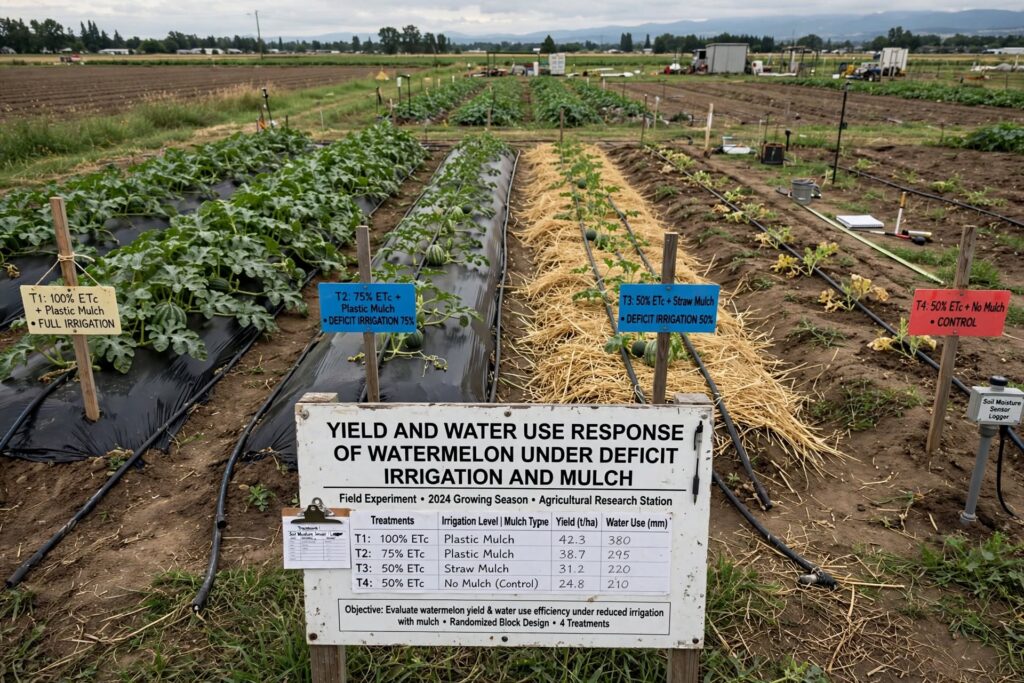
This study is designed to address these problems by providing a comprehensive, empirical analysis of the yield and water use response of watermelon under different deficit irrigation regimes and mulch types in a Nigerian context. It will quantify the individual and combined effects of these practices on yield, WUE, and economic returns. The core problem this research aims to solve is the lack of local, evidence-based information needed to guide farmers in adopting sustainable and profitable water management practices for watermelon production. (World Bank, 2022).
1.3 Aim of the Study
The aim of this study is to determine the yield and water use response of watermelon under different deficit irrigation regimes and mulch types.
1.4 Objectives of the Study
The specific objectives of this study are to:
- Determine the effect of different deficit irrigation levels (100% ETc, 75% ETc, 50% ETc) on the yield of watermelon.
- Assess the effect of different mulch types (no mulch, black plastic, straw) on the yield of watermelon.
- Analyze the interaction effect of deficit irrigation and mulch type on watermelon yield and water use efficiency.
- Determine the water use efficiency of watermelon under the different treatment combinations.
- Evaluate the economic implications (costs and returns) of the different treatments.
The following research questions were formulated to guide this study:
- What is the effect of different deficit irrigation levels on watermelon yield?
- What is the effect of different mulch types on watermelon yield?
- What is the interaction effect of deficit irrigation and mulch type on yield and water use efficiency?
- Which treatment combination achieves the highest water use efficiency?
- Which treatment combination is the most economically viable?
The following null (H₀) and alternative (H₁) hypotheses were tested in this study:
- H₀: Deficit irrigation levels do not have a significant effect on watermelon yield.
H₁: Deficit irrigation levels have a significant effect on watermelon yield. - H₀: Mulch types do not have a significant effect on watermelon yield.
H₁: Mulch types have a significant effect on watermelon yield. - H₀: The interaction between deficit irrigation and mulch type does not have a significant effect on watermelon yield.
H₁: The interaction between deficit irrigation and mulch type has a significant effect on watermelon yield. - H₀: There is no significant difference in water use efficiency among the different treatment combinations.
H₁: There is a significant difference in water use efficiency among the different treatment combinations. - H₀: The economic net return does not vary significantly among the different treatment combinations.
H₁: The economic net return varies significantly among the different treatment combinations.
1.7 Significance of the Study
This study holds significant value for a wide range of stakeholders. For watermelon farmers in Nigeria , the findings will provide practical, evidence-based guidance on how to manage water and improve profitability. The study will show which combination of irrigation and mulching is most efficient and profitable, enabling farmers to make informed decisions about resource allocation. The results can help them to reduce water costs, improve yields, and increase their net income, particularly in water-scarce environments.
For agricultural extension agents and agronomists , this study will provide valuable information for their advisory work. The findings will equip them with the knowledge to recommend specific water management practices to watermelon farmers, tailored to the local context. The study will help to bridge the gap between research and practice, translating scientific knowledge into actionable recommendations that can be adopted at the farm level.
For policymakers and development organizations concerned with water resource management and food security, this study will provide evidence to support the promotion of water-saving agricultural technologies. The findings on water use efficiency can inform the design of policies that incentivize the adoption of efficient irrigation and mulching practices. The study will contribute to the broader national goal of achieving sustainable agricultural production in the face of climate change and water scarcity.
For researchers and academics, this study will contribute to the scientific literature on deficit irrigation, mulching, and crop water productivity. The use of a controlled field experiment with a split-plot design provides a robust methodological framework. The study’s specific focus on watermelon in a Nigerian context fills a key knowledge gap. The findings will serve as a benchmark for future research and will inform the ongoing effort to develop sustainable intensification strategies for horticultural crops.
1.8 Scope of the Study
This study is focused on the yield and water use response of watermelon under different deficit irrigation regimes and mulch types. The geographical scope is a field experimental site within Nigeria (specific location to be defined by the researcher). The study involves the cultivation of a specific watermelon variety over a single growing season. The independent variables are irrigation level (100% ETc, 75% ETc, 50% ETc) and mulch type (no mulch, black plastic, straw). The dependent variables include plant growth parameters, fruit yield (total and marketable), water applied, water use efficiency, and economic returns. The study does not cover other crops, other types of irrigation (e.g., furrow, drip vs. sprinkler), or the post-harvest handling and marketing of the produce.
1.9 Limitation of the Study
This study is subject to certain limitations. The primary limitation is that it is a single-season, single-site field experiment. The results may be influenced by the specific weather conditions of that season and the particular soil type at the experimental site. The findings may therefore not be directly generalizable to other locations with different climatic and edaphic conditions. The study focuses on a specific watermelon variety, and the response of other varieties may be different. Furthermore, the economic analysis is based on a specific set of input and output prices, which can fluctuate. The long-term effects of deficit irrigation and mulching on soil health (e.g., salt accumulation) are not assessed in this short-term study. Finally, the study does not measure the physiological responses of the crop (e.g., leaf water potential) that could provide a deeper mechanistic understanding of the observed yield effects.
1.10 Definition of Terms
For the purpose of clarity, the following terms are defined as they are used in this study:
- Deficit Irrigation: An irrigation management strategy where water is applied below the full crop evapotranspiration (ETc) requirement, intentionally subjecting the crop to some level of water stress.
- Evapotranspiration (ETc): The combined process of water loss from the soil surface (evaporation) and from plant leaves (transpiration).
- Mulch: A layer of material (organic or inorganic) applied to the surface of the soil.
- Water Use Efficiency (WUE): The ratio of crop yield to the amount of water used or applied.
- Yield: The total quantity of marketable fruit produced per unit area (e.g., tonnes per hectare).
- Interaction Effect: The combined effect of two or more factors that is different from the sum of their individual effects.
- Split-Plot Design: A type of experimental design where one factor is assigned to main plots and another factor is assigned to sub-plots within the main plots.
- Black Plastic Mulch: An inorganic mulch made of thin black polyethylene film, used to suppress weeds and warm the soil.
- Straw Mulch: An organic mulch made from dried plant stalks (e.g., rice or wheat straw), used to conserve moisture and add organic matter to the soil.
- Net Return: The profit from an enterprise, calculated as the total revenue minus the total costs.