

🔤 Total Characters in Document: 141,680
📄 Estimated Document Pages: 67
⏱️ Reading Time: 2 Hours 47 Mins
PERFORMANCE OF FARMERS’ MULTIPURPOSE COOPERATIVE SOCIETIES IN ENUGU NORTH AGRICULTURAL ZONE OF ENUGU STATE, NIGERIA
Abstract
This study investigated the performance of Farmers’ Multipurpose Cooperative Societies (FMCS) in the Enugu North Agricultural Zone of Enugu State, Nigeria. The specific objectives were to describe the socio-economic characteristics of the members; examine the organizational structure and governance of the cooperatives; determine the services provided by the societies to their members; analyze the financial and operational performance of the cooperatives; identify the factors influencing the performance of the societies; and identify the constraints militating against their effectiveness. A multi-stage sampling technique was used to select 180 members from 30 registered FMCS across the zone. Primary data were collected using a structured questionnaire and an interview schedule, while secondary data were gathered from the cooperatives’ financial records. The data were analyzed using descriptive statistics, financial ratio analysis, a five-point Likert scale, and a multiple regression model. The findings revealed that the majority of the members were male, middle-aged, and literate. The primary services provided by the cooperatives included the supply of farm inputs (especially fertilizer), provision of credit, and marketing of members’ produce. The financial analysis showed that many of the societies were performing below par, with low liquidity ratios and a high dependence on external credit. The regression analysis revealed that the size of the cooperative, the educational level of the leadership, the level of member participation, and the quality of management were significant determinants of performance. The major constraints identified were inadequate capital, poor management, high rate of loan default, and government interference. The study concluded that while FMCS have great potential to contribute to agricultural development in Enugu North, their current performance is sub-optimal due to a combination of internal and external challenges. It was recommended that cooperatives should be empowered through capacity-building programs for their leaders, the promotion of internal capital mobilization, and the creation of an enabling environment that minimizes undue government interference.
Chapter One – Introduction
1.1 Background of the Study
Agriculture is the mainstay of the Nigerian economy and the primary source of livelihood for the majority of the rural population. The sector is fundamental to food security, employment generation, and the supply of raw materials to industries. However, agricultural productivity in Nigeria is constrained by several factors, including small farm sizes, low adoption of modern technology, poor access to credit, and inefficient marketing systems. Addressing these challenges requires a collaborative and organized approach from the farmers themselves. (Food and Agriculture Organization [FAO], 2021).
The cooperative movement has a long and rich history as a vehicle for social and economic development worldwide. A cooperative is an autonomous association of persons united voluntarily to meet their common economic, social, and cultural needs and aspirations through a jointly-owned and democratically-controlled enterprise. The fundamental principles of cooperatives include voluntary and open membership, democratic member control, member economic participation, autonomy and independence, education, training, and information, cooperation among cooperatives, and concern for the community. (International Cooperative Alliance [ICA], 2020).
In the Nigerian context, agricultural cooperatives have been promoted by successive governments as key institutions for rural development. They are seen as mechanisms for aggregating the fragmented production of smallholder farmers, thereby enabling them to achieve economies of scale in the purchase of inputs, the marketing of produce, and the processing of agricultural commodities. Cooperatives are also viewed as important channels for the delivery of government services, such as subsidized inputs and credit, to the farming population. (Federal Ministry of Agriculture and Rural Development [FMARD], 2021).
Farmers’ Multipurpose Cooperative Societies (FMCS) are a specific type of agricultural cooperative designed to serve a broad range of their members’ needs. Unlike single-purpose cooperatives that focus on a single activity, such as marketing a specific crop, FMCS engage in multiple functions. These typically include the procurement and distribution of farm inputs (fertilizer, seeds, agrochemicals), the provision of credit to members, the marketing of members’ produce, and sometimes processing and storage. The “multipurpose” nature of these societies is intended to make them a one-stop-shop for their members’ agricultural needs. (Oluwatayo, Sekumade, & Adesoji, 2019).
Enugu State, located in the South-East geopolitical zone of Nigeria, is an agrarian state where agriculture is the dominant occupation. The state is divided into three agricultural zones: Enugu North, Enugu East, and Enugu West. The Enugu North Agricultural Zone, which comprises local government areas such as Nsukka, Igbo-Etiti, Uzo-Uwani, Igbo-Eze North, Igbo-Eze South, and Udenu, is a major hub of agricultural activity, known for the production of crops like cassava, yam, rice, and various fruits and vegetables. Farmers in this zone have a long tradition of forming cooperative societies. (Enugu State Agricultural Development Programme [ESADEP], 2020).
The performance of an organization, in a general sense, refers to how well it is achieving its stated goals and objectives. For a cooperative society, performance is a multi-dimensional concept that can be assessed from various perspectives. From the financial perspective, performance is measured by indicators such as profitability, liquidity, solvency, and asset management efficiency. From the member perspective, performance is about the quality and value of the services provided, the level of member satisfaction, and the extent to which the cooperative has improved the members’ economic well-being. (Münkner, 2018).
Organizational performance is also reflected in the governance and management of the society. A well-performing cooperative is one that is governed democratically, with active member participation in decision-making, transparent and accountable leadership, and efficient day-to-day management. The organizational structure, the clarity of roles and responsibilities, and the effectiveness of internal controls are all critical determinants of a cooperative’s ability to achieve its objectives. Poor governance is a common reason for the failure of many cooperatives. (Birchall & Simmons, 2019).
The performance of FMCS in Nigeria has been a subject of considerable debate and research. While the theoretical benefits of cooperation are widely accepted, the practical performance of many cooperatives has been mixed. Some societies have thrived, providing valuable services to their members and contributing to agricultural development. However, many others have failed or are performing poorly, plagued by problems such as weak management, lack of capital, member apathy, and political interference. The gap between theory and practice is a major concern. (Adebayo, Oladele, & Sanusi, 2021).
Several factors can influence the performance of an FMCS. Internal factors include the quality of leadership and management, the level of member education and participation, the size of the membership, the adequacy of the capital base, and the effectiveness of internal governance structures. External factors include the policy environment, access to external finance, the state of the market, and the level of support from government agencies and development partners. Understanding the relative importance of these factors is crucial for designing interventions to improve performance. (Oluwatayo et al., 2019).
The provision of services is the core function of an FMCS, and the quality and relevance of these services are directly linked to its performance. A key service is the supply of farm inputs. By purchasing inputs like fertilizer and improved seeds in bulk, a cooperative can negotiate lower prices and pass these savings on to its members. This is particularly important in Nigeria, where smallholder farmers often struggle to access affordable inputs. The reliability and timeliness of input supply are critical indicators of a cooperative’s effectiveness. (FMARD, 2021).
Credit provision is another vital service. Access to credit is a major constraint for smallholder farmers, who are often excluded from formal financial institutions. Cooperatives can act as intermediaries, either by lending from their own internal savings or by on-lending funds obtained from external sources like Microfinance Banks or the Central Bank of Nigeria’s agricultural credit schemes. A cooperative’s ability to manage its loan portfolio effectively, ensuring high repayment rates, is a key determinant of its financial health and its ability to continue providing this essential service. (Armendáriz & Morduch, 2018).
Marketing services are often the most challenging for cooperatives to implement effectively. By pooling the produce of its members, a cooperative can achieve a stronger bargaining position in the market, potentially obtaining better prices than individual farmers could. However, successful marketing requires strong management skills, access to market information, and the ability to handle logistics like storage and transportation. The failure of many cooperatives in this area is often due to a combination of poor management and a lack of trust between the members and the leadership. (Adebayo et al., 2021).
The importance of member participation cannot be overstated. A cooperative is a member-owned and member-controlled enterprise, and its success depends on the active involvement of its members. Participation can take various forms, including attending general meetings, voting in elections, contributing to the capital, and utilizing the services of the society. High levels of member participation are often associated with greater transparency, better accountability, and a stronger sense of ownership, all of which contribute positively to performance. Conversely, member apathy is a major symptom of a struggling cooperative. (Birchall & Simmons, 2019).
The measurement of cooperative performance requires a combination of approaches. Financial ratio analysis, using data from the cooperative’s financial statements, provides an objective assessment of financial health. This involves calculating ratios like the current ratio (liquidity), the debt-to-equity ratio (solvency), and the return on assets (profitability). However, financial performance is not the only, or even the most important, measure of success for a cooperative. The social and member-oriented goals of a cooperative are equally important. Therefore, a comprehensive performance assessment should also include member perceptions and satisfaction. (Münkner, 2018).
This study is therefore designed to provide a comprehensive analysis of the performance of Farmers’ Multipurpose Cooperative Societies in the Enugu North Agricultural Zone of Enugu State. It will go beyond a simple description of the societies to analyze their financial health, the quality of their governance, and their effectiveness in delivering services to their members. By identifying the key determinants of performance and the major constraints, the study will provide an evidence base for improving the performance of these vital institutions. (ESADEP, 2020).
The findings of this study are expected to be of significant value to a wide range of stakeholders. For the cooperatives themselves and their members, the study will provide a mirror for self-assessment, highlighting areas of strength and weakness. For the government and its agencies, the study will provide evidence for the design of policies and programs to support the cooperative movement. For researchers and development practitioners, the study will contribute to the academic literature on cooperative performance in Nigeria. Ultimately, the study aims to contribute to the strengthening of the cooperative movement as a vehicle for agricultural and rural development. (World Bank, 2022).
1.2 Statement of the Problem
Farmers’ Multipurpose Cooperative Societies (FMCS) are widely promoted as a key institutional mechanism for transforming the Nigerian agricultural sector and improving the livelihoods of smallholder farmers. The core problem is that despite this promotion and the proliferation of cooperatives across the country, there is widespread evidence that the actual performance of many of these societies falls far short of their potential. Many are characterized by weak governance, poor financial management, and an inability to effectively deliver the services their members need. (Oluwatayo et al., 2019).
A fundamental problem is the weak capital base of many FMCS. The effectiveness of a cooperative is directly related to its financial capacity. The problem is that many societies in Enugu North are severely under-capitalized, relying on meager member contributions and struggling to access external credit. This lack of capital severely limits their ability to purchase inputs in bulk, provide meaningful loans to their members, or invest in necessary infrastructure like storage facilities. The result is a cooperative that exists in name but is unable to fulfill its core functions. (Adebayo et al., 2021).
The problem of poor management and leadership is endemic. The success of a cooperative hinges on the honesty, competence, and vision of its leaders. The problem is that many FMCS are plagued by leadership that lacks the necessary managerial and financial skills to run a business effectively. In some cases, the problem is even more severe, involving embezzlement of funds and a lack of accountability to the membership. This erodes trust, discourages member participation, and ultimately leads to the failure of the society. (Birchall & Simmons, 2019).
There is a significant problem with member apathy and low participation. A cooperative is only as strong as its members. The problem is that in many FMCS, the majority of members are passive, contributing their initial share capital but not actively participating in meetings, elections, or the business of the society. This apathy often stems from a lack of trust in the leadership or a feeling that their voice does not matter. The result is a vicious cycle where poor participation leads to poor governance, which further discourages participation. (Münkner, 2018).
The problem of high loan default rates is a critical challenge that undermines the financial viability of many cooperatives. When a cooperative provides credit to its members, the repayment of these loans is essential for its continued operation. The problem is that default rates are often high, due to a combination of factors including poor loan appraisal, inadequate monitoring, and a culture of viewing cooperative loans as “government money” that does not need to be repaid. This erodes the capital base of the society and prevents it from serving other members. (Armendáriz & Morduch, 2018).
The issue of political interference is a major structural problem. In Nigeria, cooperatives have historically been used by governments as tools for political patronage and mass mobilization. The problem is that this has often led to a situation where cooperative leaders are appointed based on political loyalty rather than merit, and the societies themselves are manipulated for political ends. This external interference undermines the autonomy and independence of the cooperatives, which are fundamental principles of the movement, and diverts them from their primary purpose of serving their members’ economic interests. (ICA, 2020).
There is a problem with the lack of effective regulation and supervision of cooperatives. The government department responsible for cooperative oversight is often understaffed and underfunded, making it unable to provide adequate guidance and supervision. The problem is that this regulatory vacuum allows mismanagement and corruption to go unchecked. Without proper external oversight, cooperatives are more likely to deviate from sound business practices and the principles of cooperation. The lack of reliable data on their performance is a symptom of this problem. (FMARD, 2021).
The problem of inadequate access to markets and market information is a major constraint on the performance of FMCS. Even if a cooperative successfully aggregates its members’ produce, it must be able to sell it profitably. The problem is that many cooperatives lack the resources and skills to conduct effective market research, negotiate with buyers, or transport goods to more lucrative markets. They are often forced to sell at the farm gate to middlemen at low prices, thereby failing to deliver the full benefit of collective marketing to their members. (Adebayo et al., 2021).
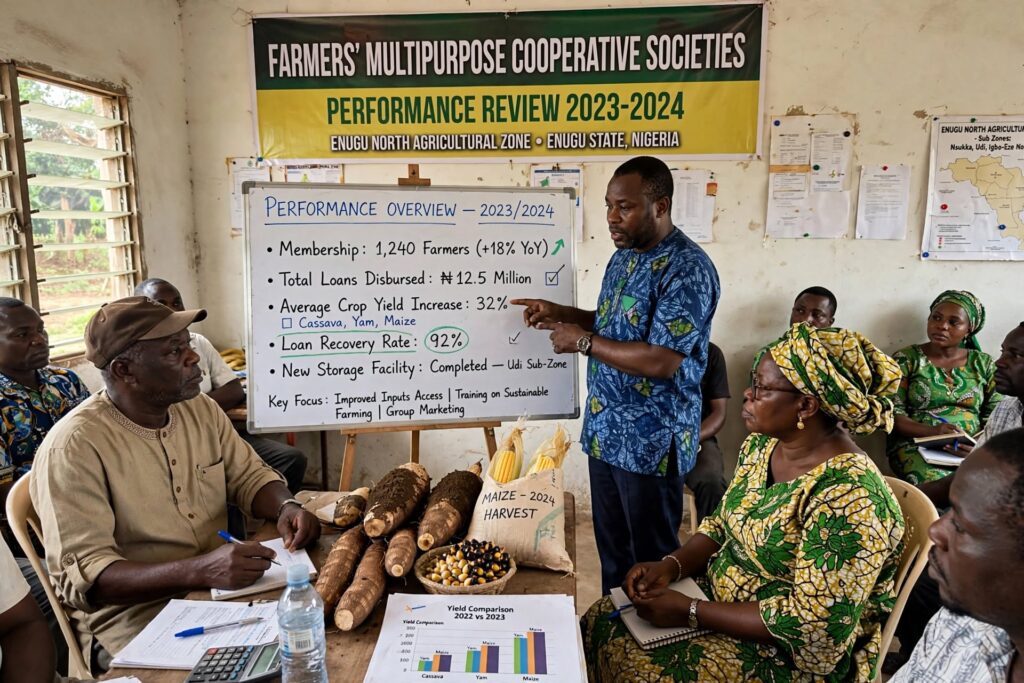
The issue of a lack of business skills among the leaders and members is a critical problem. Running a cooperative is like running a business, requiring skills in financial management, marketing, human resource management, and strategic planning. The problem is that many cooperative leaders are elected not because of their business acumen but because of their social standing or popularity. This skills gap means that the cooperative’s business is not managed professionally, leading to poor financial performance and an inability to compete in the marketplace. (Oluwatayo et al., 2019).
There is a significant problem with the lack of integration between cooperatives and the wider agricultural value chain. Most FMCS operate in isolation, focusing on a narrow set of activities and not linking up with processors, exporters, or large-scale buyers. The problem is that this lack of integration limits their potential for growth and profitability. By forming partnerships and alliances with other actors in the value chain, cooperatives could access new markets, adopt new technologies, and add more value to their members’ produce. (World Bank, 2022).
The problem of inadequate data and empirical research on the performance of FMCS in the specific context of Enugu North Agricultural Zone is a critical gap. Most existing studies are either too general, focusing on the national level, or they lack the rigorous financial and statistical analysis needed to provide a clear picture of what drives performance. The problem is that this lack of localized, evidence-based knowledge makes it difficult to design targeted interventions to support the cooperatives that need them most. (Emmanuel & Okafor, 2022).
This study is designed to address these problems by providing a comprehensive, empirical analysis of the performance of FMCS in the Enugu North Agricultural Zone. It will use a combination of financial ratio analysis and member perception surveys to provide a holistic view of performance. By identifying the key determinants of success and failure, the study will provide the evidence needed to inform policy, improve management practices, and strengthen the cooperative movement as a vital tool for agricultural development. (ESADEP, 2020).
1.3 Aim of the Study
The aim of this study is to analyze the performance of Farmers’ Multipurpose Cooperative Societies in the Enugu North Agricultural Zone of Enugu State, Nigeria.
1.4 Objectives of the Study
The specific objectives of this study are to:
- Describe the socio-economic characteristics of the members of Farmers’ Multipurpose Cooperative Societies in the study area.
- Examine the organizational structure and governance mechanisms of the cooperatives.
- Determine the services provided by the societies to their members.
- Analyze the financial and operational performance of the cooperatives using relevant performance indicators.
- Identify the factors influencing the performance of the Farmers’ Multipurpose Cooperative Societies.
The following research questions were formulated to guide this study:
- What are the socio-economic characteristics of the members of Farmers’ Multipurpose Cooperative Societies in Enugu North Agricultural Zone?
- What are the organizational structures and governance mechanisms of the cooperatives in the study area?
- What are the services provided by the societies to their members?
- What is the level of financial and operational performance of the cooperatives based on relevant indicators?
- What factors significantly influence the performance of the Farmers’ Multipurpose Cooperative Societies?
The following null (H₀) and alternative (H₁) hypotheses were tested in this study:
- H₀: The size of the cooperative (number of members) does not have a significant influence on its performance.
H₁: The size of the cooperative (number of members) has a significant influence on its performance. - H₀: The quality of leadership/management does not have a significant influence on the performance of the cooperative.
H₁: The quality of leadership/management has a significant influence on the performance of the cooperative. - H₀: The level of member participation does not have a significant influence on the performance of the cooperative.
H₁: The level of member participation has a significant influence on the performance of the cooperative. - H₀: The capital base of the cooperative does not have a significant influence on its performance.
H₁: The capital base of the cooperative has a significant influence on its performance. - H₀: Access to external credit does not have a significant influence on the performance of the cooperative.
H₁: Access to external credit has a significant influence on the performance of the cooperative.
1.7 Significance of the Study
This study holds significant value for a wide range of stakeholders. For the members and leaders of the Farmers’ Multipurpose Cooperative Societies , the study will provide a comprehensive assessment of their strengths and weaknesses. The findings will serve as a mirror for self-evaluation, highlighting areas of excellent performance as well as areas requiring improvement. The analysis of the determinants of performance will provide leaders with valuable insights into the specific factors they can influence to enhance their society’s success. This can empower them to make more informed decisions about management, governance, and service delivery.
For policymakers and government agencies (e.g., the Federal and State Ministries of Agriculture, the Department of Cooperatives), this study will provide crucial evidence for designing effective policies and programs to support the cooperative movement. The study will identify the specific constraints that are most binding, such as poor access to capital or weak management, enabling policymakers to target their interventions more effectively. The findings can also inform the design of regulatory frameworks that protect the autonomy of cooperatives while ensuring accountability and good governance.
For non-governmental organizations (NGOs) and development partners working on agricultural development and rural livelihoods, this study will provide an evidence base for designing and implementing their support programs. The findings can help them to identify the cooperatives that are most likely to benefit from their support and to tailor their interventions to address the specific challenges faced. The study can also serve as a baseline for monitoring and evaluating the impact of their support programs on cooperative performance.
For researchers and academics, this study will contribute to the growing body of literature on cooperative performance in sub-Saharan Africa. It will provide a valuable case study from the Nigerian context, using a combination of financial analysis and econometric modeling to provide a robust analysis. The study will also contribute to the methodological development of cooperative performance assessment, providing a template that can be adapted for use in other contexts. The findings will serve as a benchmark for future research and will contribute to the ongoing debate on the role of cooperatives in agricultural development.
1.8 Scope of the Study
This study is focused on the performance of Farmers’ Multipurpose Cooperative Societies in the Enugu North Agricultural Zone of Enugu State, Nigeria. The geographical scope covers the local government areas within this zone, including Nsukka, Igbo-Etiti, Uzo-Uwani, Igbo-Eze North, Igbo-Eze South, and Udenu. The study involves registered FMCS that are actively functioning. The analysis covers the 2021/2022 and 2022/2023 financial years. The study assesses performance from both a financial perspective (using financial ratio analysis) and a member perspective (using a satisfaction survey). The study does not cover other types of cooperatives, such as consumer or credit-only cooperatives.
1.9 Limitation of the Study
This study is subject to certain limitations. The primary limitation is the challenge of obtaining accurate and complete financial records from the cooperatives, as many lack a robust accounting system. This may introduce some measurement error in the financial performance analysis. The study is cross-sectional, providing a snapshot of performance at a single point in time, and may not capture the dynamic changes in performance over time. The use of member perceptions as a measure of performance is subjective and may be influenced by personal biases. Furthermore, the study’s focus on a specific agricultural zone means that the findings may not be generalizable to other zones or states with different socio-economic and cultural contexts.
1.10 Definition of Terms
For the purpose of clarity, the following terms are defined as they are used in this study:
- Cooperative Society: An autonomous association of persons united voluntarily to meet their common economic, social, and cultural needs through a jointly-owned and democratically-controlled enterprise.
- Multipurpose Cooperative Society: A cooperative that engages in multiple activities or provides a range of services to its members, such as the supply of inputs, provision of credit, and marketing of produce.
- Performance: The degree to which a cooperative is successfully achieving its stated objectives, which can be measured in financial terms, in terms of service delivery, and in terms of member satisfaction.
- Governance: The system of rules, practices, and processes by which a cooperative is directed and controlled. It involves balancing the interests of the members, the management, and other stakeholders.
- Member Participation: The active involvement of members in the affairs of the cooperative, including attending meetings, voting, contributing capital, and using services.
- Financial Ratio Analysis: A technique used to assess the financial performance of an organization by calculating and interpreting various ratios derived from its financial statements, such as liquidity, solvency, and profitability ratios.
- Liquidity: The ability of a cooperative to meet its short-term financial obligations as they fall due.
- Solvency: The ability of a cooperative to meet its long-term financial obligations, indicating its financial stability and long-term viability.
- Capital Base: The total amount of financial resources available to a cooperative, including member share capital, reserves, and retained earnings, used to fund its operations.
- Loan Default: The failure of a borrower (cooperative member) to repay a loan according to the agreed terms and conditions.