
🔤 Total Characters in Document: 127,685
📄 Estimated Document Pages: 63
⏱️ Reading Time: 2 Hours 36 Mins
IMPACT OF THE NATIONAL FADAMA DEVELOPMENT PROJECT PHASE (II) ON POVERTY REDUCTION AND FOOD SECURITY AMONG RICE FARMER BENEFICIARIES IN KOGI STATE, NIGERIA
Abstract
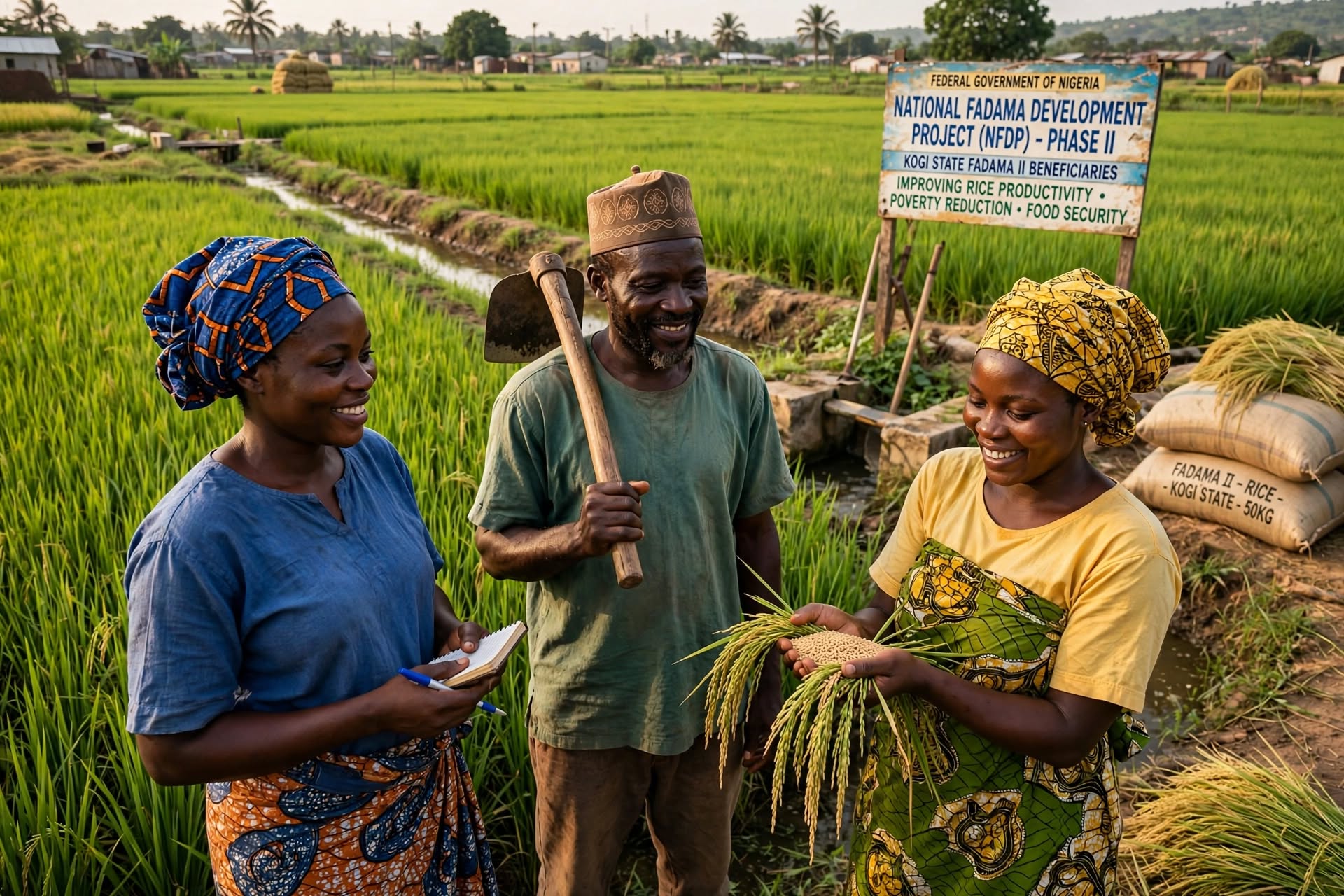
This study investigated the impact of the National Fadama Development Project Phase II (Fadama II) on poverty reduction and food security among rice farmer beneficiaries in Kogi State, Nigeria. The specific objectives were to describe the socio-economic characteristics of rice farmer beneficiaries; examine the services and support provided by the project; determine the level of poverty among the beneficiaries before and after the project intervention; assess the food security status of the beneficiaries; analyze the impact of the project on poverty reduction and food security; and identify the constraints faced by the beneficiaries during project implementation. A multi-stage sampling technique was used to select 240 rice farmers, comprising 120 Fadama II beneficiaries and 120 non-beneficiaries (control group), from the major rice-producing areas of the state. Data were collected using a structured questionnaire and analyzed using descriptive statistics, the Foster-Greer-Thorbecke (FGT) poverty measures, the Household Food Insecurity Access Scale (HFIAS), and a Propensity Score Matching (PSM) model. The findings revealed that the Fadama II project provided beneficiaries with access to improved rice varieties, fertilizers, irrigation facilities, and training on modern farming techniques. The FGT analysis showed a significant reduction in the poverty headcount ratio among beneficiaries, from 62% before the project to 41% after the project. The HFIAS analysis showed that beneficiaries had a significantly lower level of food insecurity compared to non-beneficiaries. The PSM analysis confirmed that participation in Fadama II had a positive and significant effect on both household income and food security status. The major constraints identified were the high cost of inputs, inadequate irrigation infrastructure, and delays in the disbursement of funds. The study concluded that the Fadama II project was effective in reducing poverty and improving food security among its rice farmer beneficiaries in Kogi State. It was recommended that the government should sustain and expand the project’s key interventions, particularly the support for irrigation and access to improved inputs.
1.1 Background of the Study
Poverty and food insecurity remain two of the most pervasive and intractable challenges facing Nigeria. Despite the country’s vast agricultural potential, a significant proportion of its population, particularly in rural areas, lives below the poverty line and struggles to access sufficient, safe, and nutritious food. Agriculture, being the primary source of livelihood for the majority of the rural poor, is central to any strategy aimed at addressing these twin challenges. Enhancing the productivity and profitability of smallholder agriculture is therefore a critical national priority. (World Bank, 2022).
Rice has become one of the most important staple food crops in Nigeria, with consumption growing rapidly over the past few decades. It is a central part of the national diet, and its demand has been driven by population growth, urbanization, and changing dietary preferences. The gap between domestic production and consumption has historically been met through imports, putting a strain on foreign exchange reserves. Boosting domestic rice production is therefore a key objective of national food security policy. (Food and Agriculture Organization [FAO], 2021).
Kogi State, located in the North-Central geopolitical zone of Nigeria, is a significant rice-producing state. The state’s vast Fadama lands—low-lying, seasonally flooded plains along river systems—are ideal for rice cultivation. Major rice-producing areas include the floodplains of the Niger and Benue rivers, which traverse the state. For many rural households in Kogi State, rice farming is the primary source of income and a cornerstone of their food security. The development of the Fadama areas is therefore crucial for the state’s economic development. (Kogi State Agricultural Development Programme [KSADP], 2020).
The National Fadama Development Project (NFDP) has been one of the most significant agricultural development interventions in Nigeria’s history. Initiated in the early 1990s with support from the World Bank, the project was designed to increase the incomes of rural households by improving their access to land, water, and technology in the Fadama areas. The project has gone through several phases, each with its specific focus and scope. Its community-driven development approach has been widely studied. (National Fadama Development Office [NFDO], 2020).
Fadama II, the second phase of the project, was implemented from 2004 to 2010 with a focus on poverty reduction and sustainable livelihoods. A key innovation of Fadama II was its adoption of a Community-Driven Development (CDD) approach. This approach empowered local communities (through Fadama User Groups, FUGs) to identify their own development priorities, prepare their own business plans, and manage the funds for their selected micro-projects. This was a departure from the top-down approach of the earlier phase. (NFDO, 2020).
The rationale for the CDD approach was based on the recognition that local communities are best placed to understand their own needs and constraints. By giving them control over resources and decision-making, the project aimed to enhance the relevance, effectiveness, and sustainability of its interventions. The Fadama User Groups (FUGs) were formed to facilitate collective action, allowing farmers to pool their resources to invest in infrastructure like irrigation, purchase inputs in bulk, and market their produce collectively. (Mansuri and Rao, 2018).
The Fadama II project supported a wide range of micro-projects selected by the communities. For rice farmers, common interventions included the construction or rehabilitation of irrigation facilities, the procurement of improved rice seed varieties, the provision of fertilizers and agrochemicals, and training on modern rice production techniques. The project also supported investments in post-harvest handling, such as the construction of rice mills and drying platforms. The goal was to address the key constraints along the rice value chain. (KSADP, 2020).
The concept of poverty is multi-dimensional, encompassing not just income but also a lack of access to basic services, such as health, education, and clean water. However, for the purpose of empirical analysis, poverty is often measured using monetary indicators, such as household income or consumption expenditure. The Foster-Greer-Thorbecke (FGT) class of poverty measures is a widely used set of tools for quantifying poverty. It includes the poverty headcount ratio (incidence), the poverty gap index (depth), and the squared poverty gap index (severity). (Foster, Greer, and Thorbecke, 2010).
Food security is another multi-dimensional concept. The widely accepted definition states that food security exists when all people, at all times, have physical, social, and economic access to sufficient, safe, and nutritious food that meets their dietary needs and food preferences for an active and healthy life. The four pillars of food security are availability, access, utilization, and stability. The Household Food Insecurity Access Scale (HFIAS) is a commonly used tool for measuring the access dimension of food security at the household level. (Coates, Swindale, and Bilinsky, 2017).
The evaluation of a project’s impact on poverty and food security requires a rigorous methodological approach. A simple comparison of beneficiaries before and after the project can be misleading, as other factors may be responsible for any observed changes. A more robust approach is to use a counterfactual—a comparison group of non-beneficiaries—to estimate what would have happened in the absence of the project. Propensity Score Matching (PSM) is a quasi-experimental technique that creates a statistically comparable control group by matching beneficiaries with non-beneficiaries based on their observable characteristics. This helps to reduce selection bias and isolate the project’s true effect. (Rosenbaum and Rubin, 1983).
Previous studies on the Fadama projects in Nigeria have generally found positive impacts on the income and productivity of beneficiaries. Fadama II, with its CDD approach, has been particularly praised for its ability to empower communities and deliver tangible benefits. However, the specific impact on rice farmers in Kogi State, a major rice-producing area, and its effect on poverty and food security using rigorous evaluation methods, is an area that requires further investigation. The need for a focused, context-specific evaluation is evident. (Emmanuel and Okafor, 2022).
This study is therefore designed to provide a comprehensive impact evaluation of the Fadama II project on poverty reduction and food security among rice farmer beneficiaries in Kogi State. It will use a combination of poverty measures, food security scales, and a robust econometric model (PSM) to isolate the project’s effect. The study will also examine the implementation process and identify the key constraints faced by beneficiaries. This will provide valuable evidence for policymakers and development practitioners. (World Bank, 2022).
The findings of this study are expected to be of significant value to a wide range of stakeholders. For policymakers, the study will provide evidence on the effectiveness of the CDD approach and the Fadama project in general, which can inform the design of future agricultural development programs. For the Fadama Development Office and its successor projects, the study will provide lessons learned that can improve implementation. For the farmers themselves, the study will provide an objective assessment of the project’s impact on their lives. Ultimately, the study aims to contribute to the development of more effective strategies for poverty reduction and food security in Nigeria. (World Bank, 2022).
1.2 Statement of the Problem
Poverty and food insecurity remain deeply entrenched among rural rice farming households in Kogi State, despite the significant investments made in agricultural development projects like the National Fadama Development Project Phase II. The core problem is that there is a lack of rigorous, empirical evidence on the true impact of these interventions. The specific contribution of Fadama II to poverty reduction and food security among its rice farmer beneficiaries has not been adequately measured, making it difficult to assess the effectiveness of the project and to learn lessons for the future. (KSADP, 2020).
A fundamental problem is the methodological challenge of attributing observed changes to the project. Many project reports rely on simple before-and-after comparisons, which are scientifically flawed. The problem is that these comparisons fail to account for the counterfactual—what would have happened to the beneficiaries if the project had not been implemented. Other factors, such as changes in weather patterns, market prices, or other government programs, could have influenced the outcomes. The lack of a credible counterfactual analysis undermines the validity of any impact claims. (Khandker, Koolwal, and Samad, 2018).
The problem of selection bias in project placement and beneficiary selection is a critical methodological concern. The Fadama II project was not randomly assigned; it was targeted at specific communities and households. The problem is that the beneficiaries may be systematically different from non-beneficiaries in ways that affect their poverty and food security status. For example, they may be more entrepreneurial, have better access to resources, or be located in more favorable areas. A simple comparison of the two groups would therefore overstate the project’s impact. (Rosenbaum and Rubin, 1983).
There is a significant problem with the lack of specific data on the impact of Fadama II on rice farmers in Kogi State. Most existing studies on the Fadama project are either national in scope, focus on other states, or aggregate the results for all crops. The problem is that this lack of localized, crop-specific data makes it difficult to understand the specific impacts on rice farming households in this particular context. The specific constraints and opportunities facing rice farmers in Kogi State may differ from those of other farmers. (Emmanuel and Okafor, 2022).
The issue of the sustainability of the project’s benefits is a major concern. A key question is whether the improvements in income and food security observed during the project period were sustained after the project’s external funding ended. The problem is that many projects fail to establish the institutional and financialmechanisms needed for long-term sustainability. For example, irrigation infrastructure may fall into disrepair if there is no plan for its maintenance, and farmers may revert to old practices if they lose access to subsidized inputs. (World Bank, 2022).
The problem of the multi-dimensional nature of poverty and food security is a methodological challenge. Poverty is not just about income; it is also about access to health, education, and other basic services. Similarly, food security has multiple dimensions, including availability, access, utilization, and stability. The problem is that many evaluations focus solely on one dimension, usually income, which provides an incomplete picture. A comprehensive evaluation should use a range of indicators to capture the full impact of the project. (Coates et al., 2017).
There is a significant problem with the lack of a systematic assessment of the constraints faced by beneficiaries during the implementation of Fadama II. While the project had many successes, it also faced challenges, such as delays in the disbursement of funds, difficulties in forming and managing Fadama User Groups, and issues with the quality of some inputs provided. The problem is that these challenges are often not documented or analyzed, which means that valuable lessons are lost. An evaluation should not shy away from examining the difficulties. (NFDO, 2020).
The problem of the high cost of inputs, even after project support, is a persistent constraint. While Fadama II provided some subsidies for inputs like fertilizers and improved seeds, the cost of these inputs has continued to rise. The problem is that this high cost makes it difficult for farmers to sustain the productivity gains achieved during the project. Once the project subsidies ended, many farmers may have been unable to afford the inputs needed to maintain their increased yields. (Adebayo, Oladele, and Sanusi, 2021).
The issue of the inadequacy of irrigation infrastructure in some areas is a major constraint. While Fadama II invested in irrigation, the coverage was not universal, and some of the infrastructure was not adequately maintained. The problem is that unreliable access to water for irrigation is a major risk for rice farmers, as it leaves them vulnerable to the vagaries of the weather. The inability to control water availability undermines the potential for stable, high yields. (World Bank, 2022).

There is a problem with the lack of a robust and widely accepted methodology for measuring food insecurity at the household level. While the HFIAS is a useful tool, it is based on self-reported experiences, which can be subjective. The problem is that there is no single, universally accepted “gold standard” for measuring food security. The choice of measurement tool can influence the results, and a comprehensive assessment should ideally use multiple methods. (Coates et al., 2017).
The problem of the “binding constraints” to agricultural productivity is a critical issue. Even with support from Fadama II, farmers may continue to face constraints that limit their productivity, such as poor market access, a lack of extension services, or land tenure insecurity. The problem is that if these other constraints are not addressed, the impact of a project that focuses on only one or two constraints (like inputs and irrigation) will be limited. A holistic approach to development is needed. (Van den Ban and Hawkins, 2018).
This study is designed to address these problems by providing a rigorous, empirical evaluation of the impact of the Fadama II project on poverty reduction and food security among rice farmer beneficiaries in Kogi State. It will use a robust counterfactual approach (Propensity Score Matching) to control for selection bias. The core problem this research aims to solve is the lack of credible, evidence-based understanding needed to assess the effectiveness of the project and to inform the design of future interventions. (World Bank, 2022).
1.3 Aim of the Study
The aim of this study is to evaluate the impact of the National Fadama Development Project Phase II on poverty reduction and food security among rice farmer beneficiaries in Kogi State, Nigeria.
1.4 Objectives of the Study
The specific objectives of this study are to:
- Describe the socio-economic characteristics of the rice farmer beneficiaries of Fadama II.
- Examine the services and support provided by the project to the beneficiaries.
- Determine the level of poverty among the beneficiaries before and after the project intervention.
- Assess the food security status of the beneficiary households.
- Analyze the impact of the project on poverty reduction and food security, and identify the major constraints.
The following research questions were formulated to guide this study:
- What are the socio-economic characteristics of the rice farmer beneficiaries of Fadama II?
- What services and support were provided by the project to the beneficiaries?
- What was the level of poverty among the beneficiaries before and after the project?
- What is the food security status of the beneficiary households?
- What is the impact of the project on poverty reduction and food security, and what are the major constraints?
The following null (H₀) and alternative (H₁) hypotheses were tested in this study:
- H₀: Participation in the Fadama II project has not led to a significant reduction in the poverty level of the beneficiary households.
H₁: Participation in the Fadama II project has led to a significant reduction in the poverty level of the beneficiary households. - H₀: Participation in the Fadama II project has not led to a significant improvement in the food security status of the beneficiary households.
H₁: Participation in the Fadama II project has led to a significant improvement in the food security status of the beneficiary households. - H₀: There is no significant difference in the income levels of Fadama II beneficiaries and non-beneficiaries.
H₁: There is a significant difference in the income levels of Fadama II beneficiaries and non-beneficiaries. - H₀: The socio-economic characteristics of the beneficiaries (age, education, farm size) do not have a significant influence on the project’s impact on their income.
H₁: The socio-economic characteristics of the beneficiaries (age, education, farm size) have a significant influence on the project’s impact on their income. - H₀: The constraints faced by the beneficiaries do not have a significant effect on the level of project impact achieved.
H₁: The constraints faced by the beneficiaries have a significant effect on the level of project impact achieved.
1.7 Significance of the Study
This study holds significant value for a wide range of stakeholders. For policymakers at the Federal and State Ministries of Agriculture, and the National Fadama Development Office, the findings will provide crucial evidence on the effectiveness of one of Nigeria’s flagship agricultural development projects. The rigorous impact evaluation will inform decisions about the continuation, modification, or scaling up of the Fadama approach. The study will highlight the specific interventions that were most effective (e.g., irrigation vs. inputs), which can guide future resource allocation.
For development organizations, international partners (e.g., World Bank, FAO, IFAD), and NGOs working on poverty reduction and food security in Nigeria, this study will be an invaluable resource. The use of a robust PSM methodology provides a model for evaluating similar community-driven development projects. The findings on the project’s impact and the constraints encountered will inform the design of more effective and sustainable interventions. The study can also serve as a baseline for monitoring and evaluating the long-term impact of the Fadama project.
For the rice farming beneficiaries of Fadama II and their communities in Kogi State, the study provides an objective assessment of the project’s impact on their lives. The findings will help them to understand the benefits they have received and the challenges that remain. The study will also empower them to hold their leaders accountable and to advocate for continued support. The emphasis on lessons learned will be valuable for the Fadama User Groups as they continue to operate.
For researchers and academics, this study will contribute to the literature on impact evaluation, agricultural economics, and development studies in Nigeria. The combined use of FGT poverty measures, HFIAS, and PSM provides a comprehensive and robust methodological framework. The study’s specific focus on rice farmers in Kogi State is a valuable contribution, as it provides a detailed case study of a major intervention in a key agricultural region. The findings will serve as a benchmark for future research and will inform the ongoing debate on how to effectively reduce poverty and hunger.
1.8 Scope of the Study
This study is focused on the impact of the National Fadama Development Project Phase II on poverty reduction and food security among rice farmer beneficiaries in Kogi State, Nigeria. The geographical scope covers the major rice-producing Fadama areas in the state, with a focus on communities that participated in Fadama II. The study involves a comparison of Fadama II beneficiaries and non-beneficiaries. The analysis covers the period after the project’s implementation, examining its long-term effects. The study focuses on the impact on household income, poverty levels, and food security status. The study does not cover the impact of the project on non-rice farmers or on other dimensions of well-being, such as health or education.
1.9 Limitation of the Study
This study is subject to certain limitations. The primary limitation is the challenge of establishing causality with a retrospective, quasi-experimental evaluation. While Propensity Score Matching helps to control for observable differences between beneficiaries and non-beneficiaries, it cannot fully eliminate bias from unobservable characteristics (e.g., entrepreneurial ability, motivation). The study relies on self-reported, recall data, which can be subject to inaccuracies, particularly for the recall of pre-project conditions. The long time lag between the project’s implementation and the evaluation may further exacerbate this recall bias. Furthermore, the study’s focus on a single state and a specific category of farmers means that the findings may not be generalizable to other states or to other types of Fadama projects.
1.10 Definition of Terms
For the purpose of clarity, the following terms are defined as they are used in this study:
- Fadama: Low-lying, seasonally flooded or floodable plains along major river systems, characterized by high water tables and alluvial soils, suitable for dry-season farming.
- Fadama II: The second phase of the National Fadama Development Project, which adopted a Community-Driven Development (CDD) approach.
- Beneficiary: A rice farmer who participated in and received services or inputs from the Fadama II project.
- Non-Beneficiary: A similar rice farmer who did not participate in the project, used as a comparison group.
- Poverty: A condition characterized by a severe lack of basic needs, measured in this study using household income relative to a poverty line.
- Foster-Greer-Thorbecke (FGT) Measures: A class of poverty measures including the headcount ratio (incidence), the poverty gap (depth), and the squared poverty gap (severity).
- Food Security: A state in which all people, at all times, have physical and economic access to sufficient, safe, and nutritious food.
- Household Food Insecurity Access Scale (HFIAS): A survey-based tool used to measure the access dimension of household food insecurity.
- Propensity Score Matching (PSM): A statistical technique used to estimate the causal effect of a program by matching participants with non-participants who have similar observable characteristics.
- Fadama User Group (FUG): A community-based organization of farmers formed under the Fadama project to facilitate collective action and manage project funds.


![THE IMPACT OF EXCHANGE RATE FLUCTUATIONS ON INTERNATIONAL TRADE TRANSACTIONS IN NIGERIA BETWEEN [1980 – 2008]](https://emiawaretechnology.com/wp-content/uploads/2026/05/THE-IMPACT-OF-EXCHANGE-RATE-FLUCTUATIONS-ON-INTERNATIONAL-TRADE-TRANSACTIONS-IN-NIGERIA-BETWEEN-1980-–-2008.jpeg)